
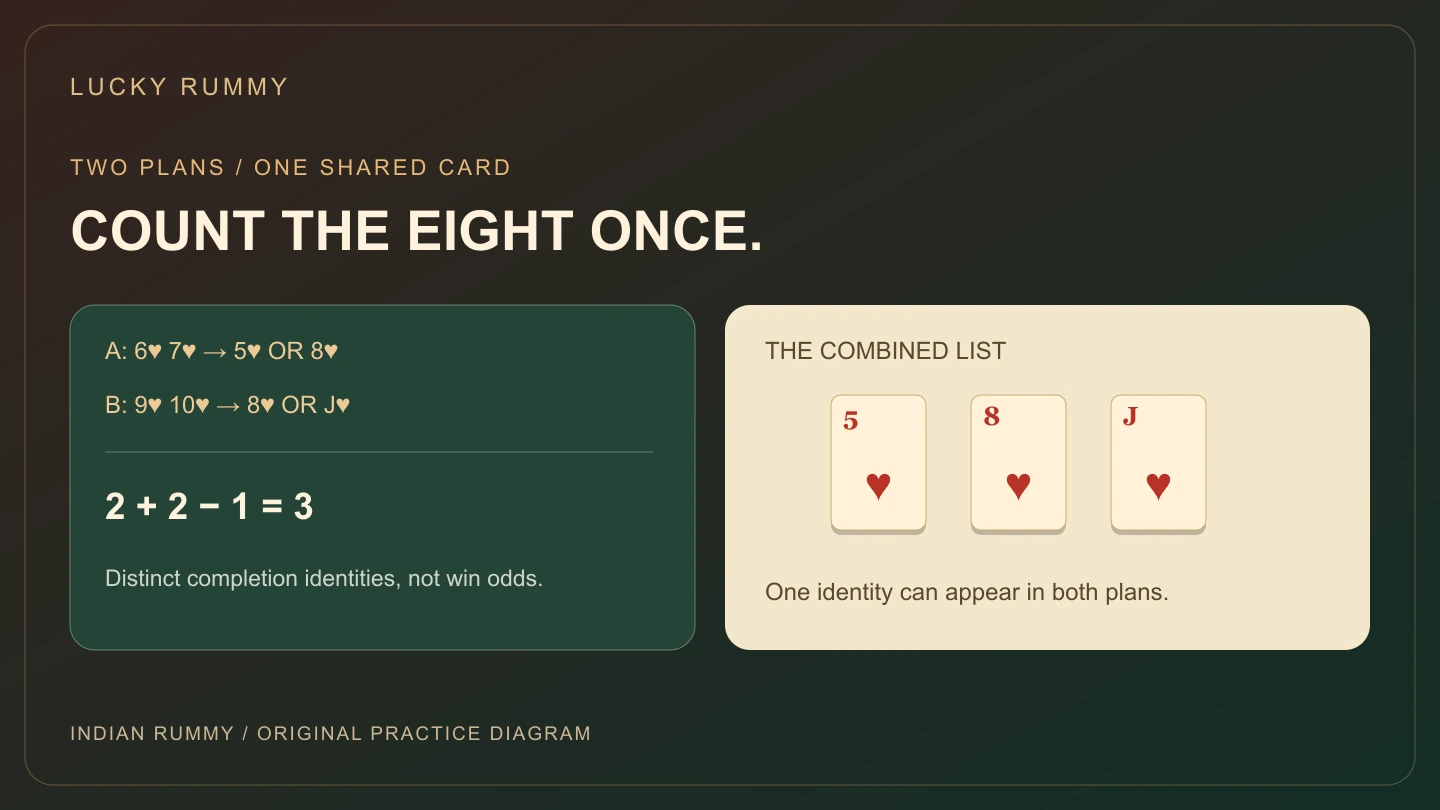
You have two promising pairs, and each appears to have two ways to improve. Does that give you four different useful draws? Not necessarily. A card can appear on both lists. Before counting possibilities, write the actual rank and suit beside each plan.
This is an offline, no-stakes exercise with natural cards and no wild rank. Its success condition is deliberately narrow: add one card to either named pair to make a three-card sequence. It does not measure a full hand’s chance of winning or reveal the contents of a live stock.
Make two lists before adding their lengths
Place 6♥ 7♥ in area A and 9♥ 10♥ in area B. For A, the natural completions are 5♥ and 8♥. For B, they are 8♥ and J♥. Read the suits as well as the ranks; an eight of clubs does not complete either heart pair in this exercise.
Write A = {5♥, 8♥} and B = {8♥, J♥}. Each list has two entries, but 8♥ occurs twice across the lists. The combined list of different card identities is {5♥, 8♥, J♥}: three, not four. Cross out the repeated name only in your combined list, not from either plan’s explanation.
Separate usefulness from physical allocation
Now add one real 8♥. It could join 6♥–7♥ or 9♥–10♥. It cannot occupy both separate three-card groups at once. Put it in A and point to the two cards left in B; then move it to B and identify the unfinished pair in A.
There is another arrangement worth noticing: 6♥ 7♥ 8♥ 9♥ 10♥ is one five-card natural sequence. The bridge card connects the whole row. That is different from claiming two non-overlapping three-card sequences from only five physical cards. For group lengths, use the long-sequence exercise.
Check the count with a controlled packet
Prepare exactly ten separate cards: 5♥, 8♥, J♥, 2♣, 3♦, 4♠, 6♣, 9♦, Q♠, K♣. None is wild. Shuffle them and assume each physical card is equally likely to be drawn next. For the success condition fixed above, three cards qualify, so the probability in this artificial packet is 3/10, or 30%.
Adding “two for A” and “two for B” would produce 40%, incorrectly counting the same physical eight twice. The error is in the favourable count, not in the number of cards in the packet. A card with two possible uses still occupies only one place among the ten possible draws.
For a separate test, replace K♣ with a second physical 8♥ from another deck. There are now four favourable physical cards among ten, giving 40%. The names of useful identities remain three. This time the count increased because the packet really gained another useful copy, not because you described the original copy twice.
Do not turn the packet into a live-game forecast
The packet was fully specified for teaching. In a game, unseen useful cards may be in other players’ hands, and public information may be incomplete. “Three useful identities” is not enough to compute the chance of your next stock draw. Consult the probability practice guide for denominators and replacement assumptions.
Also keep the target unchanged during a calculation. After you actually draw 8♥ and combine the five hearts, extending that new run is a different question. Start a new list rather than silently reusing the old success condition.
Try one final contrast
Return to the original pairs but change B to 9♣–10♣. Its completions become 8♣ and J♣. These no longer overlap A’s 5♥ and 8♥, so there are four distinct natural completion identities. Explain the difference without assigning a percentage to an unknown stock.
Write the pair, list its exact completions, merge the lists without repeated identities, then count actual copies only when they are known. Use the duplicate-card guide to keep copies distinct. This routine checks your reasoning; it promises no result.
Rule reference: Pagat: Indian Rummy, Runs and sets, for natural sequences and non-overlapping groups. The paired lists, packets and calculations are original exercises.