
“Two cards would help me” sounds like a probability, but it is only the start of a question. Does “two” mean two ranks, two rank-and-suit identities or two physical copies? How many cards can actually be drawn? Without those details, a percentage is guesswork.
This is a no-stakes probability lesson using a deliberately small, fully specified practice packet. It is not a way to inspect opponents’ cards or predict a live game. Do not carry its percentages into a real table with a different or unknown stock.
Define success narrowly
Place 6♥–7♥ on the table. In this drill, success means adding one natural card to make exactly a three-card heart sequence. There are no wild cards. A 5♥ or 8♥ succeeds; a 5♣ does not. Other cards might have value elsewhere in a full hand, but that is outside this question.
Write that definition before revealing any draw. Otherwise it is tempting to change “success” after seeing a card you like. The pure sequence guide explains why suit matters; here we are studying the count of possible draws.
Build a packet whose contents you really know
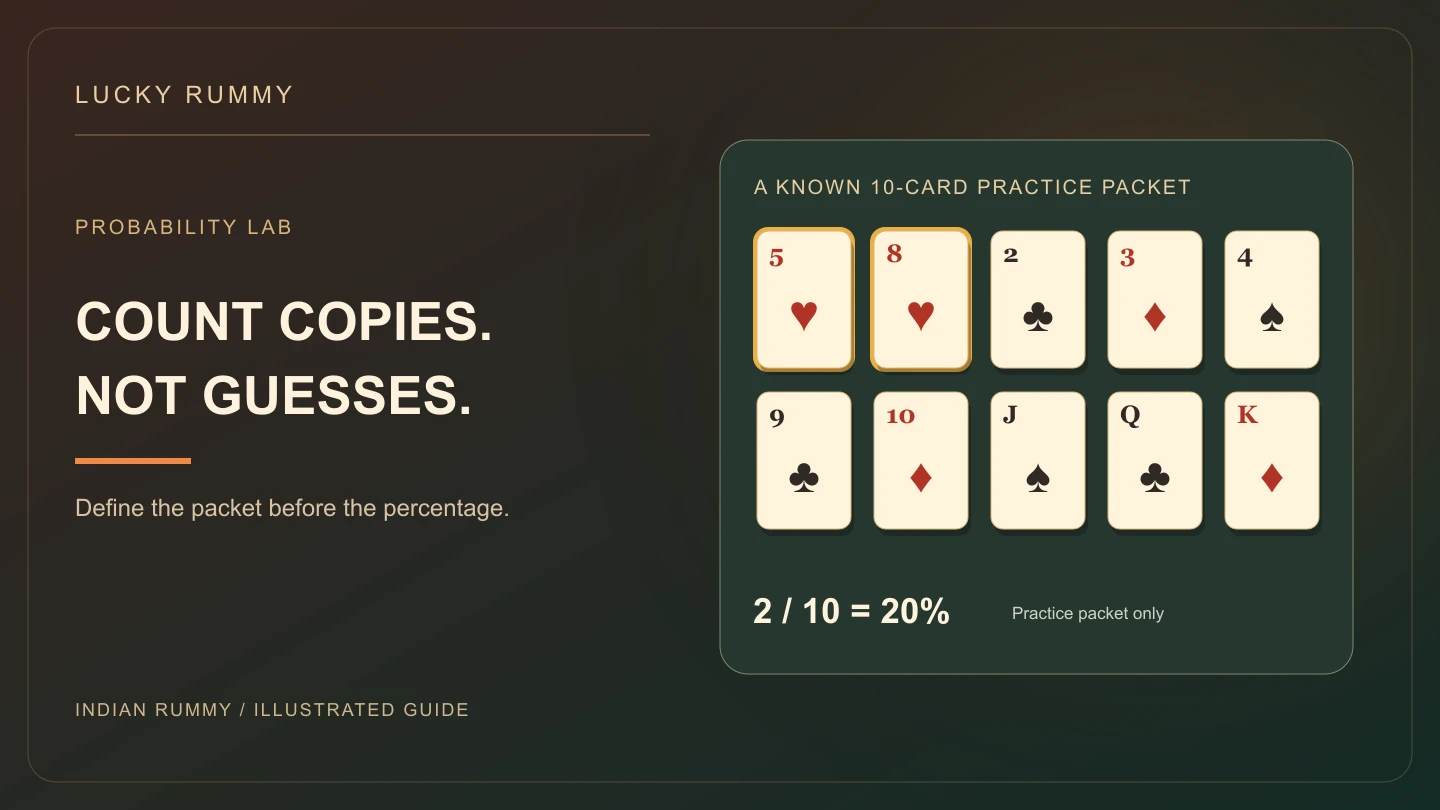
Use precisely these ten separate practice cards: 5♥, 8♥, 2♣, 3♦, 4♠, 9♣, 10♦, J♠, Q♣, K♦. None is already on the table in the heart pair. Shuffle the packet thoroughly and assume each physical card is equally likely to be its next card.
Two of the ten cards satisfy the definition. The one-draw probability is therefore 2 ÷ 10 = 20%. This is an exact calculation for this artificial packet, not an estimate for an Indian Rummy app. Its denominator is ten because ten cards are eligible to be drawn, not because ten cards happen to be visible in a picture.
Change a physical copy, not the success rule
Replace K♦ in the packet with a second physical copy of 8♥. There are still ten cards, but three now succeed: 5♥ and the two separate eights of hearts. The probability becomes 3 ÷ 10 = 30%. The useful rank-and-suit identities remain two; the number of favourable physical cards has risen to three.
This is the mistake behind counting only names such as “five or eight” in a multiple-deck exercise. Conversely, merely imagining another copy does not add it to the packet. For identifying copies in a hand, see the duplicate-card guide.
Check whether the draw is replaced
Return to the original ten-card packet with just one 5♥ and one 8♥. Reveal 2♣ and set it aside. If the next draw is uniformly random from the remaining nine cards, there are still two successes available. The next-draw chance is 2/9, about 22.2%. If you put 2♣ back and reshuffle instead, the chance is again 2/10.
Now reset to the original packet, reveal 5♥ and remove it. For the same fixed target test, only 8♥ remains favourable among nine cards, giving 1/9, about 11.1%. Do not change the target to extending a now-completed sequence: that would be a new question. These two removal tests show why the contents of the remaining packet matter.
Unseen cards are not automatically stock cards
During a real game, cards you cannot see may be in other players’ hands rather than the closed stock. A needed card that has not appeared publicly is not proven to be available on your next draw. A useful card in a discard pile is also governed by pickup rules, not by the probability of a random stock draw.
Without a justified model of the stock and the information available, report the limitation rather than manufacturing a precise chance. Counting useful identities can describe an incomplete group; it does not establish a win probability. Even completing the heart run would say nothing by itself about every other card in a full hand.
Try a short answer-before-drawing exercise
Using the original packet, add two harmless practice cards, 2♦ and 3♣. Before drawing, answer: how many cards are now eligible, and how many still meet the same target? The answer is 2/12, or about 16.7%. Then remove the added cards and explain why the answer returns to 20%. A few observed draws need not match either percentage exactly.
Keep the exercise offline and brief. For choosing between a known top discard and an unknown stock card, read the open and closed deck walkthrough. A correctly calculated practice probability promises neither a winning hand nor a financial return.
Rule reference: RummyCircle’s sequence definition. The finite packets, calculations and tests are original teaching examples. Cover: an editorial probability diagram, not a live-game forecast or screenshot.