
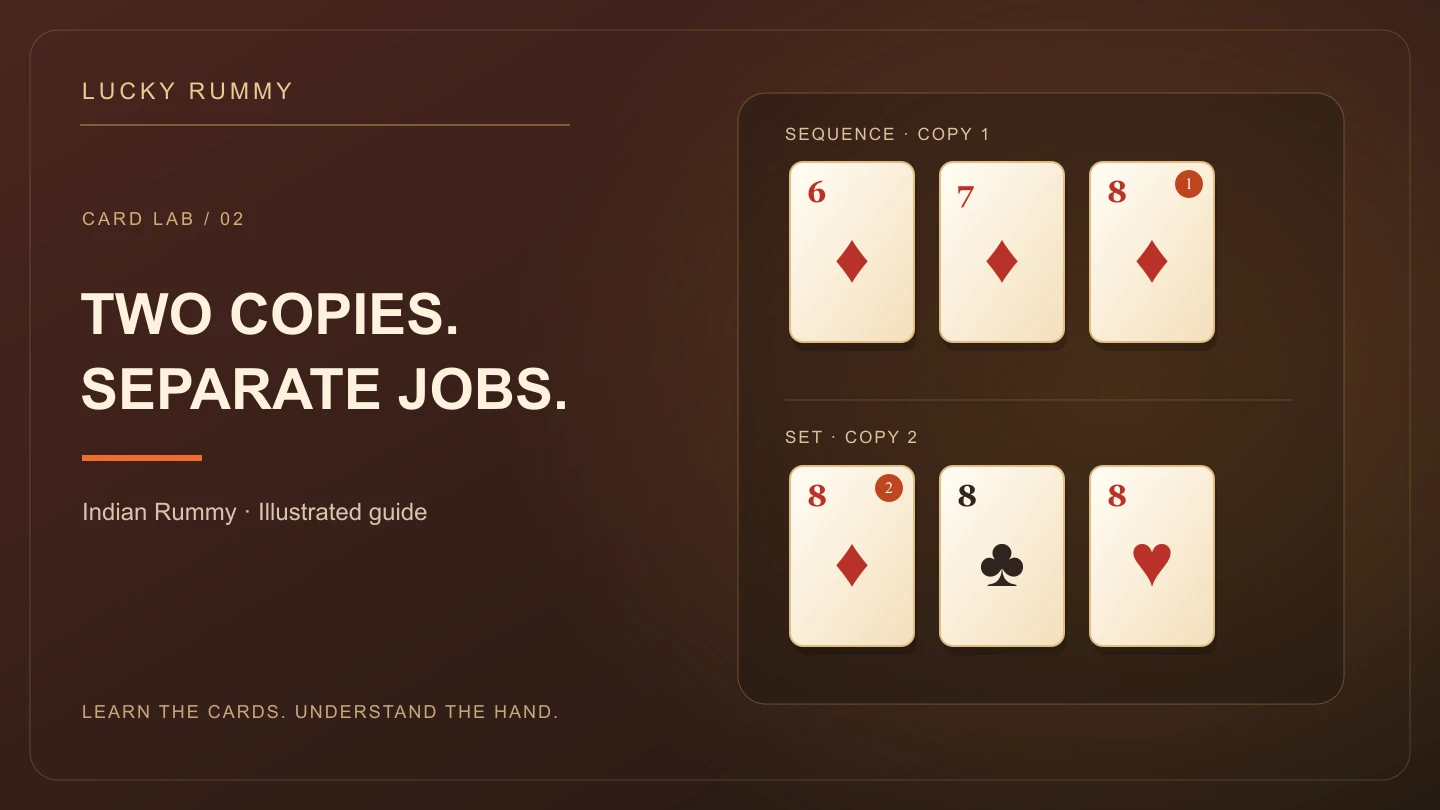
Drawing a second copy of a card can be confusing: the rank and suit match exactly, yet the two cards do not necessarily belong together. A good sorting method tracks physical copies as well as ranks. That makes it easier to see whether a duplicate is useful or merely looks useful.
This guide assumes a multiple-deck Indian Rummy format with ordinary different-suit sets. No card in the examples is a wild joker. Special combinations allowed in other variants are outside the exercise; read the actual table rules before transferring an arrangement to a game.
Same rank is only half the check
A natural set needs matching ranks and distinct suits under the convention used here. Two copies of 8♦ are two physical cards, but they are still the same suit. Placing 8♦ 8♦ 8♣ together does not produce the different-suit set that 8♦ 8♥ 8♣ would make. Check suit symbols individually, not just the repeated number.
Label identical copies during practice
Take 6♦ 7♦ 8♦ 8♦ 8♣ 8♥. In your notes, call the diamonds “8♦ copy 1” and “8♦ copy 2”. Use copy 1 with 6♦–7♦. Use copy 2 with 8♣–8♥. You now have two separate groups, each using three different physical cards.
The labels are only a learning aid; they do not change a card’s suit or rank. They help you distinguish this six-card arrangement from the five-card version with only one 8♦. Remove copy 2 and the diamond run can remain complete, but the other eights are only a pair. Imagining the missing copy does not complete it.
Inspect both jobs in a 13-card hand
Try 6♦ 7♦ 8♦ | 8♦ 8♣ 8♥ | 2♠ 3♠ 4♠ | J♣ Q♣ K♣ A♣. There are 13 cards, including two physical copies of 8♦. Under a format accepting the ace-high club run shown, each copy has a separate job and the arrangement is complete.
Now make a deliberate error: replace 8♥ with a third 8♦ on paper. The middle group has repeated diamonds and no longer works as the ordinary set used in this exercise. Do not “fix” the count by borrowing the same 8♦ from the first run. That move would leave another group unfinished.
A duplicate can support two sequences too
For a different six-card exercise, arrange 3♠ 4♠ 5♠ | 5♠ 6♠ 7♠. Each run contains one of the two physical fives. This is a useful way to study a duplicate whose neighbours are all in the same suit. Move both fives into one row and the duplicated rank makes the row misleading; a clear gap between the runs tells the story better.
Compare this with 3♠–4♠–5♠–6♠–7♠ plus a spare 5♠. The cards are the same, but the layout hides a possible second group. Before deciding that the duplicate has no job, try partitioning the row in a different place. This is a grouping exercise, not a prediction about which future card will arrive.
When the extra copy has no clear home
Suppose you hold 6♦–7♦–8♦ and another 8♦, but no other eights or nearby diamonds. Keep the completed run separate and list the spare copy on its own. Ask which actual cards could give it a distinct role. If your answer relies on several cards you do not hold, recognise that it is a new, unfinished plan.
Revisit the plan after a draw rather than protecting the extra copy just because it matches a completed group. For the later choice between loose cards, use our discard strategy guide. That decision needs the whole hand and visible information, not a blanket rule that all duplicates should be kept or discarded.
End the exercise with a copy audit
Cover your notes and rebuild the first six-card example. Point to each copy as you assign it. Remove one copy, explain which group becomes incomplete, then put it back. Finally check the 13-card version using the full-hand checklist. Every physical card should have exactly one place.
Practise without stakes and take breaks. Correct grouping prevents an avoidable mistake; it does not guarantee a win. Review the rules overview for the wider sequence and declaration requirements.
Rule reference: RummyCircle’s rules, sets and duplicate-card examples. The copy labels, hands and regrouping drills here are original teaching examples, not statements about Lucky Rummy’s unverified features. Cover: an original card diagram, not a game screenshot.