
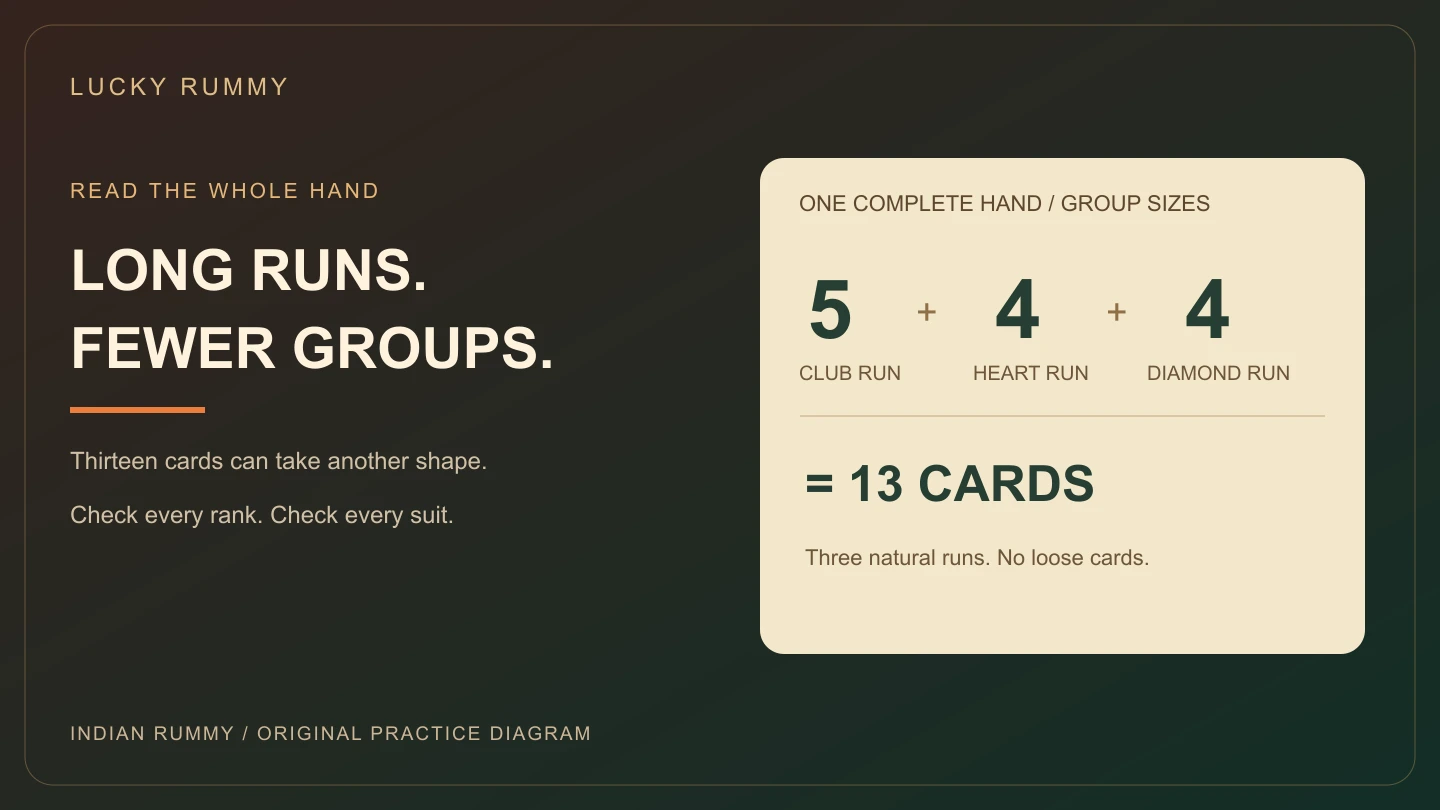
Many teaching diagrams divide thirteen cards into three groups of three and one of four. That layout is easy to read, but treating it as the only possible shape can make you dismantle a perfectly useful long sequence. Learn to count the groups you actually have before trying to match a familiar diagram.
This offline, no-stakes lesson uses the Indian Rummy grouping convention documented below: longer runs are permitted, and three-group hands can qualify when the sequence requirements are met. It does not confirm which arrangements a particular Lucky Rummy table or interface accepts. Read the instructions for your selected format first.
Separate the total from the group shape
Write 3+3+3+4, 5+4+4 and 5+5+3 on paper. Each totals thirteen. These sums describe sizes, not the legality of the cards inside them. A five-card row with a suit mismatch is not repaired by the fact that five fits an equation.
For this exercise, all cards are natural and none is designated wild. Keep each physical card in exactly one group. Use the pure sequence explanation if you need to check what makes a run natural.
Build a complete 5+4+4 example
Lay out 2♣ 3♣ 4♣ 5♣ 6♣ | 7♥ 8♥ 9♥ 10♥ | 9♦ 10♦ J♦ Q♦. Count five clubs, four hearts and four diamonds. Each group advances one rank at a time in one suit. There are thirteen distinct cards and three natural runs, so the arrangement satisfies the stated grouping convention without a fourth group.
Now try to turn the five clubs into two groups by placing a gap after 4♣. You get 2♣–3♣–4♣ and 5♣–6♣. The first is complete; the second is only a pair. No card was gained by moving the divider. Forcing an extra group has made the proposed layout incomplete.
Test a different three-group shape
Reset with 3♠ 4♠ 5♠ 6♠ 7♠ | 8♥ 9♥ 10♥ J♥ Q♥ | K♣ K♦ K♠. This is 5+5+3: two natural runs and a three-suit set. The kings are not a third sequence, but they do not need to be one in this example because the first two groups already meet the sequence requirement.
Change K♠ to Q♠ while leaving the rest untouched. The last group now mixes ranks. The sum remains thirteen, but the displayed arrangement fails. A correct total is an inventory check; it cannot certify a set. Restore K♠ before moving on.
When splitting really does work
Use a separate six-card fragment: 2♣ 3♣ 4♣ 5♣ 6♣ 7♣. It can remain a six-card natural run, or it can be displayed as 2♣–3♣–4♣ and 5♣–6♣–7♣. Both pieces have enough cards and remain consecutive. Unlike the five-card split, neither leaves a pair.
That does not mean splitting always improves a hand. This fragment contains only six cards; it proves nothing about the other seven. Compare the whole arrangement after a split, including the required sequences and any loose cards. Do not move a divider simply to increase the number of groups.
A repeatable practice check
Shuffle the first thirteen-card example face up and rebuild it without consulting the dividers. Record group sizes, then verify ranks and suits separately. Ask a practice partner to replace one card with a wrong suit. Identify the exact broken group instead of just saying the hand looks different.
Before declaring in any actual format, use the full-hand checklist. If rearrangement hides useful connections, try the two-pass sorting exercise. These lessons develop recognition; a neat grouping pattern does not predict the next draw or guarantee a result.
Rule reference: Pagat: Indian Rummy, Runs and sets, for long runs and alternative three-group hands. The card inventories, failed splits and practice routine above are original examples.