
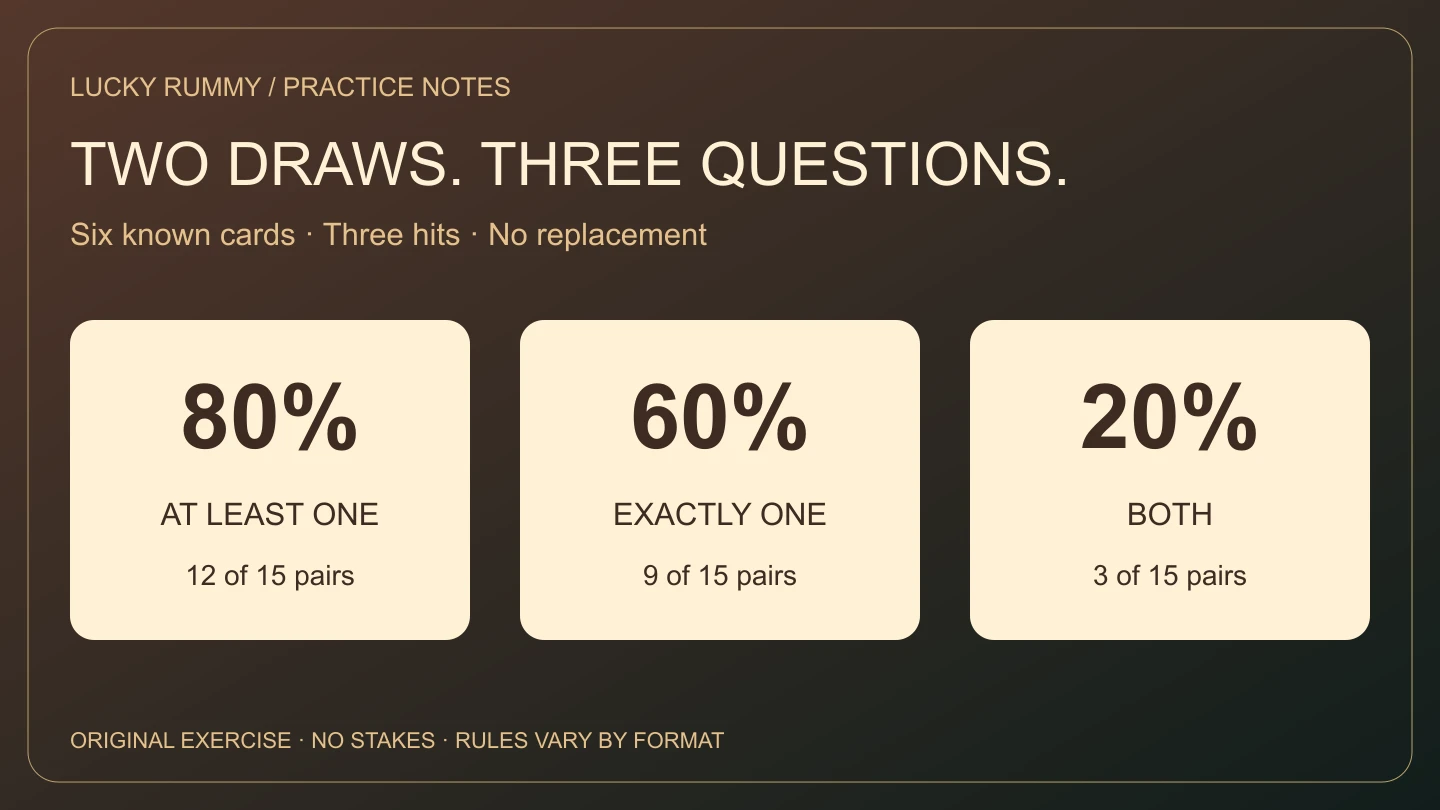
“What is the chance over two draws?” is incomplete until you define the event. Getting at least one useful card, getting exactly one, and getting two useful cards are different questions. A small practice packet lets you count every outcome and see the difference.
This is a no-stakes probability exercise, not a forecast for a live Rummy table. Place 6♥ and 7♥ outside the packet. A hit means drawing a natural 5♥ or 8♥ that could complete a three-card heart sequence with that pair. There are no wild cards, and the target stays fixed throughout.
Specify six physical cards and two draws
Prepare exactly 5♥, 8♥-A, 8♥-B, 2♣, Q♦, K♠. A and B identify two physical copies of 8♥ from different decks; they are not different suits or extra ranks. Three of the six cards are hits. The other three are misses for this narrowly defined target.
Shuffle fairly and draw two cards without replacement. Do not insert discards, opponents’ turns or a reshuffle between these two draws. Those conditions define a controlled packet experiment, not two consecutive turns in an actual game. For the single-draw starting point, see our probability practice guide.
Count unordered pairs instead of adding percentages
There are 6 × 5 = 30 ordered two-card outcomes. Each unordered pair appears in two orders, so there are 15 equally likely pairs. Label the hits H1, H2 and H3 and the misses M1, M2 and M3 to make the answer key easy to inspect.
The no-hit pairs are M1–M2, M1–M3 and M2–M3: three outcomes. The two-hit pairs are H1–H2, H1–H3 and H2–H3: another three. Exactly one hit pairs each of three H cards with each of three M cards, producing nine outcomes. The check is 3 + 3 + 9 = 15.
Therefore at least one hit = 12/15 = 80%, exactly one hit = 9/15 = 60%, and two hits = 3/15 = 20%. “At least one” includes the two-hit cases; “exactly one” excludes them. Keep the label beside every percentage.
Check the answer through the opposite event
The chance of missing first is 3/6. After a miss, two misses remain among five cards, so the chance of missing again is 2/5. Both misses therefore have probability (3/6) × (2/5) = 1/5. Subtracting from one gives 4/5, or 80%, for at least one hit.
Adding 50% for the first draw and 50% for the second gives 100%, but double-counts outcomes in which both draws hit. Treating the draws as independent and using 1 − (1/2)² gives 75%, which belongs to a replacement-and-reshuffle experiment instead. Our packet removes the first card.
A statistical hit is not a completed declaration
Drawing both copies of 8♥ counts as two hits under the fixed test, but 6♥ 7♥ 8♥-A 8♥-B is not one four-card sequence. Eight repeats. You can use one eight with the original pair; the other needs a separate role. Likewise, 5♥ and 8♥ together can extend the original pair into one four-card run, not two disjoint runs.
The event measures which cards were drawn, not whether every card in a thirteen-card hand is grouped. Read the duplicate-card guide before turning a favourable count into a grouping claim. In a real game the stock is not this known packet, and other players change what happens between your turns.
Practice check: list the fifteen pairs on paper and classify each once. The three category counts must sum to fifteen. A few random trials need not reproduce the exact percentages. Sequence definition reference: Pagat: Indian Rummy, Runs and sets. The packet, event comparison and calculations are original analysis.