
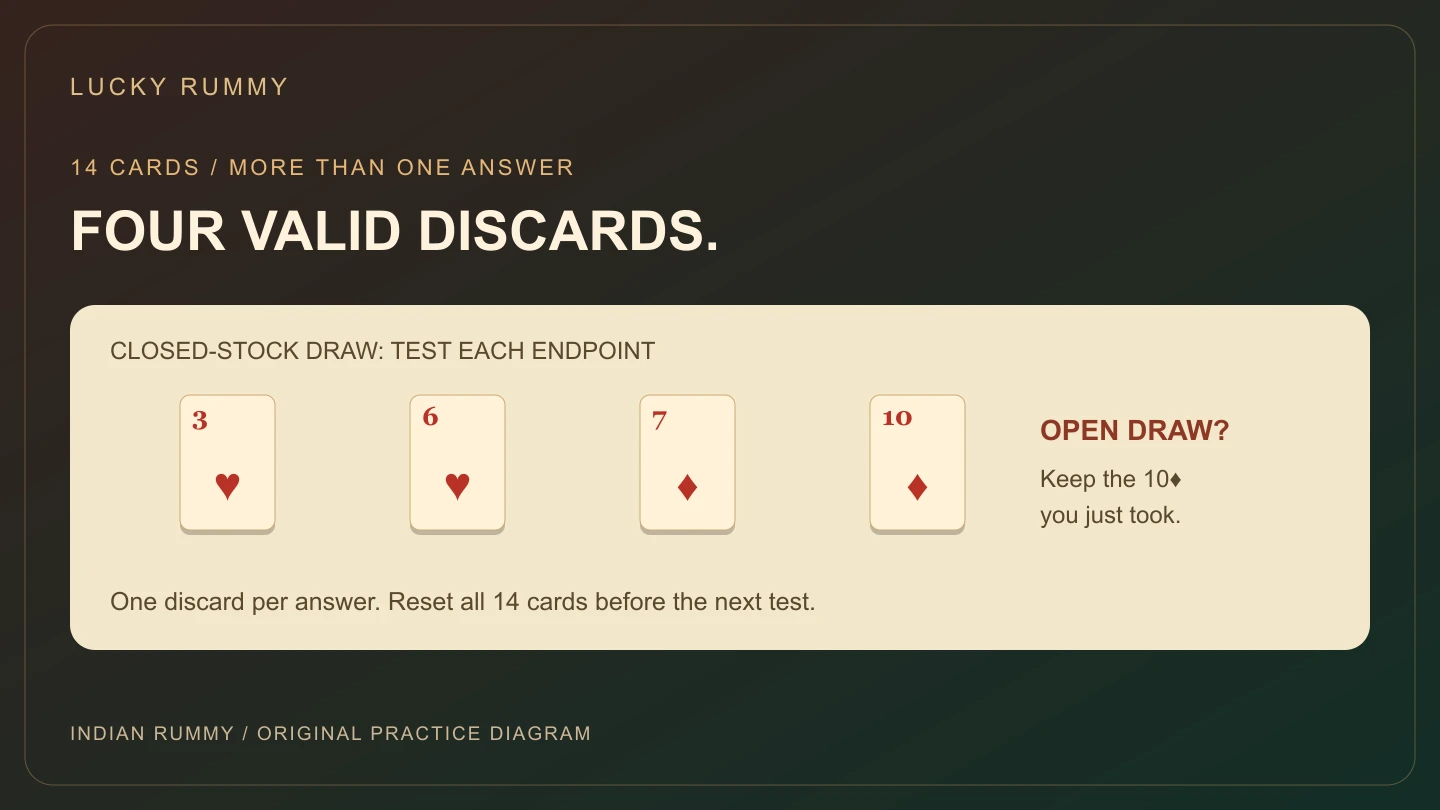
A practice answer key sometimes shows one discard even though more than one answer works. That can make a learner reject a sound arrangement. Instead of guessing which card the author intended, test whether each proposed discard leaves a complete thirteen-card hand.
This no-stakes puzzle uses natural cards only: no printed jokers and no designated wild rank. Use groups of at least three cards, two sequences including a pure one, and no card shared between groups. It is a teaching exercise, not a description of Lucky Rummy’s current game mode or declaration controls.
Lay out the fourteen cards
Arrange 3♥ 4♥ 5♥ 6♥ / 7♦ 8♦ 9♦ 10♦ / J♣ Q♣ K♣ / 2♣ 2♦ 2♠. The slash marks separate candidate groups. Count 4 + 4 + 3 + 3 = 14. Suppose the last card drawn was 10♦ from the closed stock. Before that draw, you held the other thirteen.
The question is deliberately precise: which single discards leave thirteen cards that can all be grouped correctly? We are not choosing a move against a particular opponent or comparing possible rewards. Cover the answers below and write one candidate at a time on paper.
Check the four endpoint answers
Discard 3♥: keep 4♥–5♥–6♥, the four diamonds, J♣–Q♣–K♣ and the three twos. The group lengths are 3 + 4 + 3 + 3 = 13. Discard 6♥: the heart sequence instead becomes 3♥–4♥–5♥; everything else stays intact.
Discard 7♦: keep the four hearts, 8♦–9♦–10♦, the club sequence and the twos. Discard 10♦: the diamond sequence becomes 7♦–8♦–9♦. These last two arrangements each contain 4 + 3 + 3 + 3 = 13 cards. Each answer has three natural sequences and one set.
That gives four distinct discard choices, not four extra cards to remove. Reset to the original fourteen before testing each answer. If you remove 3♥ and then remove 6♥ without resetting, you are solving a different, twelve-card problem.
Why the other ten choices fail here
Removing 4♥ or 5♥ leaves a gap in the heart group. Removing 8♦ or 9♦ does the same to the diamonds. Removing any club face card reduces its three-card run to two. Removing any two reduces the three-card set to two.
Could rearranging rescue those choices? In this particular list, no. The heart ranks occur nowhere else as same-rank partners, and the same is true of the diamonds and club face cards. The isolated twos have no matching-suit neighbours that form another run. There is no joker. Thus the broken fragments cannot be reassigned into a complete partition. This explanation matters more than saying “middle cards are always bad”: that slogan would be false for other hands.
Change the draw source, not the cards
Now suppose the same 10♦ came from the open discard pile. Under the rule used in this exercise, you cannot return the card picked from that pile during the same turn. The arrangement left by discarding 10♦ is still structurally complete, but that move is unavailable on this turn. The legal answers become 3♥, 6♥ and 7♦.
This separates two checks: the remaining cards must form a valid hand, and the action itself must be permitted. Read the open-versus-closed draw guide before applying a platform’s own rules. Do not infer a button sequence from this paper exercise.
Build an answer key that accepts every correct solution
For each candidate, write four short entries: discarded card, draw source, remaining groups and card total. Reject an answer only after naming its specific failure. A higher card value alone does not make a discard correct, and keeping a long run does not automatically invalidate a shorter run.
Use the group-length guide if the four-card sequences are unfamiliar, then finish with the declaration checklist. Success here means explaining all four stock-draw answers and all three open-draw answers. It is a reasoning check, not a prediction of a game result.
Rule reference: Pagat: Indian Rummy, Runs and sets; The play. The fourteen-card puzzle and its exhaustive answer key are original.