
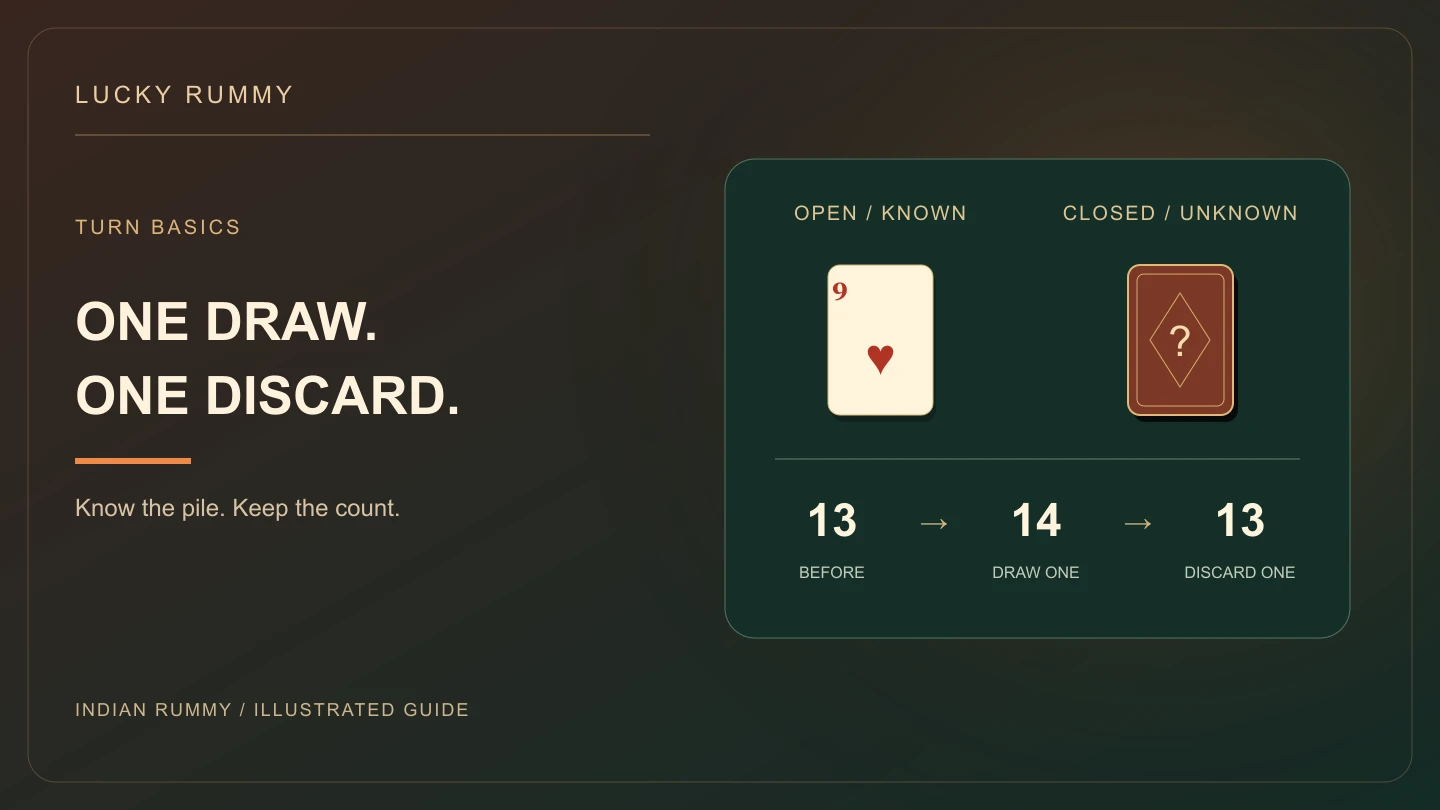
Two piles sit beside a rummy hand, but they offer different information. The top discard is visible; the next card in the closed stock is unknown. Before choosing a pile, identify what the visible card actually does for your hand. Then complete the turn in order instead of treating drawing and discarding as unrelated actions.
This guide uses the ordinary draw-and-discard procedure described in Pagat’s Indian Rummy rules. Individual tables can differ on joker pickups, the first turn and special declarations. Check those controls and exceptions in the game you are using. The exercise below is offline and has no stakes; it does not describe unverified Lucky Rummy interface features.
Identify the two piles before touching a card
The closed stock is the face-down pile from which the next card is drawn unseen. The open discard pile holds face-up discards. Under the procedure used here, only its top card is available, not any attractive card you remember seeing earlier. A useful card buried underneath is not a selectable option.
Do not confuse the separate card indicating the wild rank with either draw pile. Its job is to identify a rule for the hand. In physical practice, place a clearly labelled marker away from the piles so you do not accidentally draw it. If you are new to the terms, read the beginner guide first.
Work through one visible-card pickup
Start with these 13 cards: 2♣ 3♣ 4♣ | 7♥ 8♥ | 5♦ 5♠ 5♥ | J♣ Q♣ K♣ | 2♦ 9♠. No rank in the example is wild. The bars help you read the hand; they do not turn the heart pair or the last two cards into completed groups.
Suppose 9♥ is on top of the open pile. Before taking it, say its job aloud: it joins 7♥–8♥ to make a natural heart sequence. Pick it up and count again. You now hold 14 cards. Put the three hearts together; do not throw away another card while still mentally counting only the original 13.
For this procedure exercise, put 2♦ onto the discard pile. You return to 13 cards. The new arrangement has two three-card runs, a three-card set, a three-card club run and a loose 9♠. It is not ready to declare: 3 + 3 + 3 + 3 + 1 is a correct count but leaves one card ungrouped. The point of the exercise is turn order, not a claim that 2♦ is the best strategic discard.
A visible pickup is a commitment within that turn
In the referenced procedure, a card taken from the open pile cannot be discarded again on that same turn. You must discard a different card. Try a dry run with the pile labelled “9♥ taken”: if your intended next move is to put that very card straight back, stop and reconsider before making the pickup.
This restriction is one reason to name the card’s job in advance. It is not a reason to take every card that could eventually become useful. The whole hand still matters. For a separate comparison of discard candidates, use the discard strategy guide.
Reset before testing a closed-stock draw
Return to the original 13 cards rather than adding a second draw to the completed turn. Now imagine the open top card is 10♦. It does not immediately complete any shown group. In this alternative exercise, draw once from the closed stock and reveal 6♠. Count 14, evaluate the new hand, then discard one card and count 13.
Nothing in the first version predicts that 6♠ would appear. The closed draw trades knowledge of the visible card for an unknown result. It may help, or it may not. Do not peek at several stock cards and choose a favourite; that would be a different exercise and not the stated turn procedure.
Finish with a physical three-step check
Use three spaces on paper: “13 before”, “14 after drawing”, and “13 after discarding”. Move one counter through them as you rehearse. Check which pile supplied the card and which card became the new top discard. Once this feels clear, review the full-hand declaration checks. A clean turn and a complete hand are separate things.
Rule reference: Pagat, Indian Rummy: The play. The hands, counter exercise and explanation are original editorial examples. Cover: an illustrated practice table, not an app screenshot.