
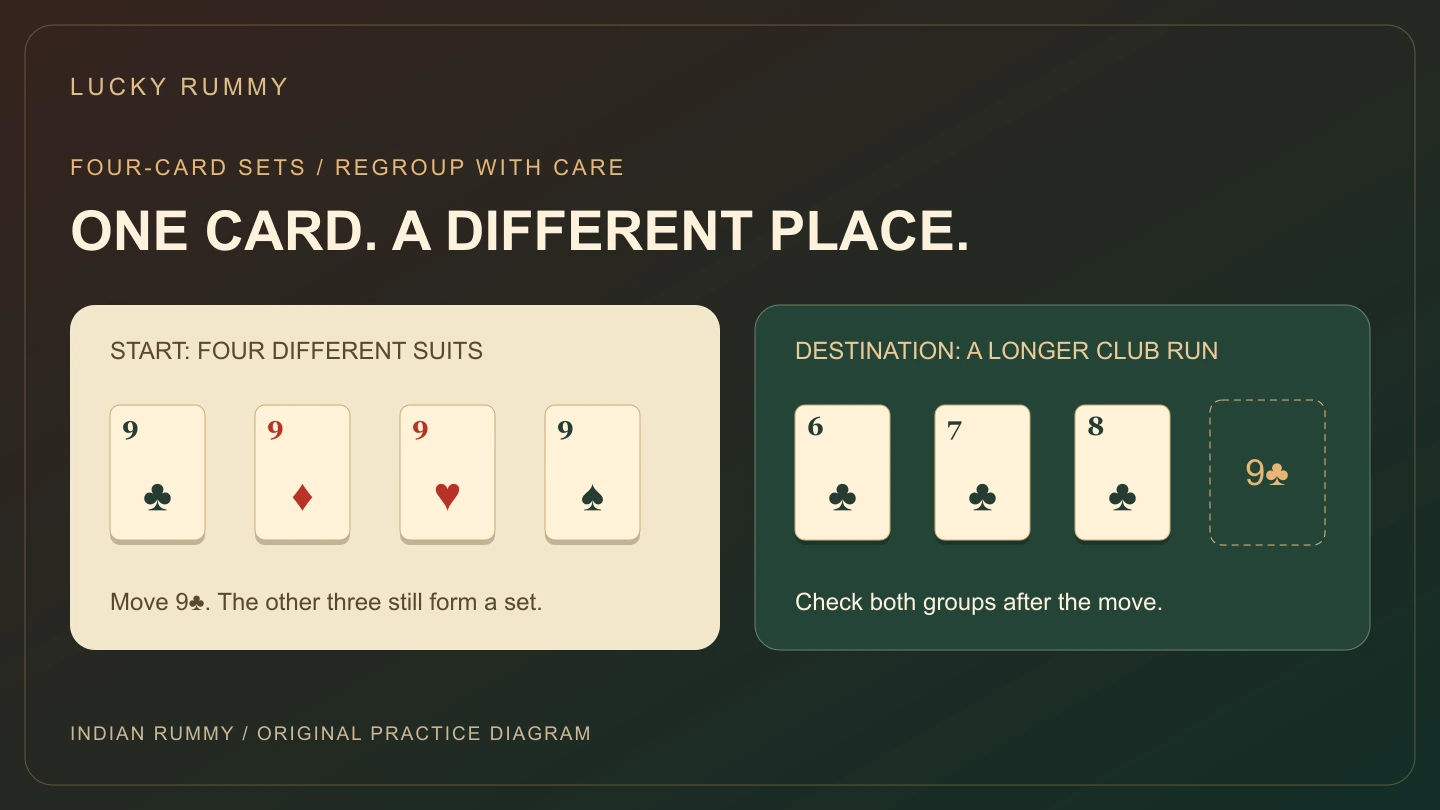
Four cards of the same rank can look like one card too many if you learnt sets through three-card examples. Under a rule that permits four different suits in a set, the fourth card has a valid place. It may also be useful elsewhere. The question is what happens to the whole hand when you move it.
This offline exercise assumes natural three- or four-card sets, consecutive same-suit sequences, and no jokers or wild rank. A complete thirteen-card arrangement needs at least two sequences, including a pure one. These are stated practice rules, not confirmation of a particular Lucky Rummy mode.
Check four suits before counting four cards
Place 9♣ 9♦ 9♥ 9♠ together. The ranks match, and each suit appears once. Under our assumptions, all four belong to one set. Now replace 9♠ with a second physical 9♥. You still have four nines, but not four different suits. That replacement fails the set test.
Count suit identities, not red and black colours. Hearts and diamonds are distinct suits even though both are red. A card from another deck does not acquire a new suit. The duplicate-card guide explains how to label physical copies.
Use the fourth card in a complete hand
Build this thirteen-card practice hand: 2♥ 3♥ 4♥ / 5♣ 6♣ 7♣ / J♦ Q♦ K♦ / 9♣ 9♦ 9♥ 9♠. The lengths are 3 + 3 + 3 + 4 = 13. There are three natural sequences and one four-card set. No card is left over, and none is used twice.
Do not remove a nine just to make every group look like a three-card example. Doing so leaves twelve cards. A set’s validity is not determined by whether it has the same length as the neighbouring groups.
Compare two ways to use the same thirteen cards
Reset the hand to 6♣ 7♣ 8♣ / 2♥ 3♥ 4♥ / J♦ Q♦ K♦ / 9♣ 9♦ 9♥ 9♠. Keeping the four nines together gives another valid 3 + 3 + 3 + 4 arrangement.
Now move only 9♣ into the club sequence. You have 6♣ 7♣ 8♣ 9♣ / 2♥ 3♥ 4♥ / J♦ Q♦ K♦ / 9♦ 9♥ 9♠. The set has three cards, the club run has four, and the total is still thirteen. Both arrangements work under the stated rules. This move changes the grouping; it does not create an extra card or a stronger guaranteed outcome.
Know when moving a card breaks the hand
Try moving 9♦ instead of 9♣ into 6♣–7♣–8♣. That proposed four-card run mixes suits, so it is invalid. Restore 9♦ to its set before continuing. Numeric order alone is not enough.
Then consider this separate six-card fragment: 6♣ 7♣ 8♣ / 9♣ 9♦ 9♥. Moving 9♣ to the club run leaves only 9♦–9♥. The remaining pair is not a set. The move that preserved a four-card set in the previous exercise does not preserve a three-card set here. The starting size matters.
Keep the rule boundary explicit
Before adopting this exercise, check the table’s permitted set lengths and joker restrictions. Do not infer that a fifth natural nine is valid: with four ordinary suits, it repeats a suit. Joker-extended sets require a separate rule check and are outside this lesson.
For practice, record the set before the move, the destination group and the cards left behind. Recount the full hand after each change. Use the sequence-length lesson for longer runs and the declaration checklist for the final audit.
Rule reference: Taj Rummy’s tutorial, Sets and Declaration, which describes three- or four-card sets. The hands and regrouping exercises above are original and use no stakes.