
A hand can look unfamiliar after its suits change while keeping exactly the same grouping structure. Relabelling every suit consistently is a useful way to check whether you understand the relationships between cards or merely recognise a favourite diagram.
This is an offline worksheet exercise using ordinary sequences and different-suit sets. Twos are wild, but neither hand contains a two or a printed joker. No suit-specific bonus or special identical-card rule is enabled. Do not apply the conclusion to a format with additional suit-dependent rules.
Write a one-to-one replacement key
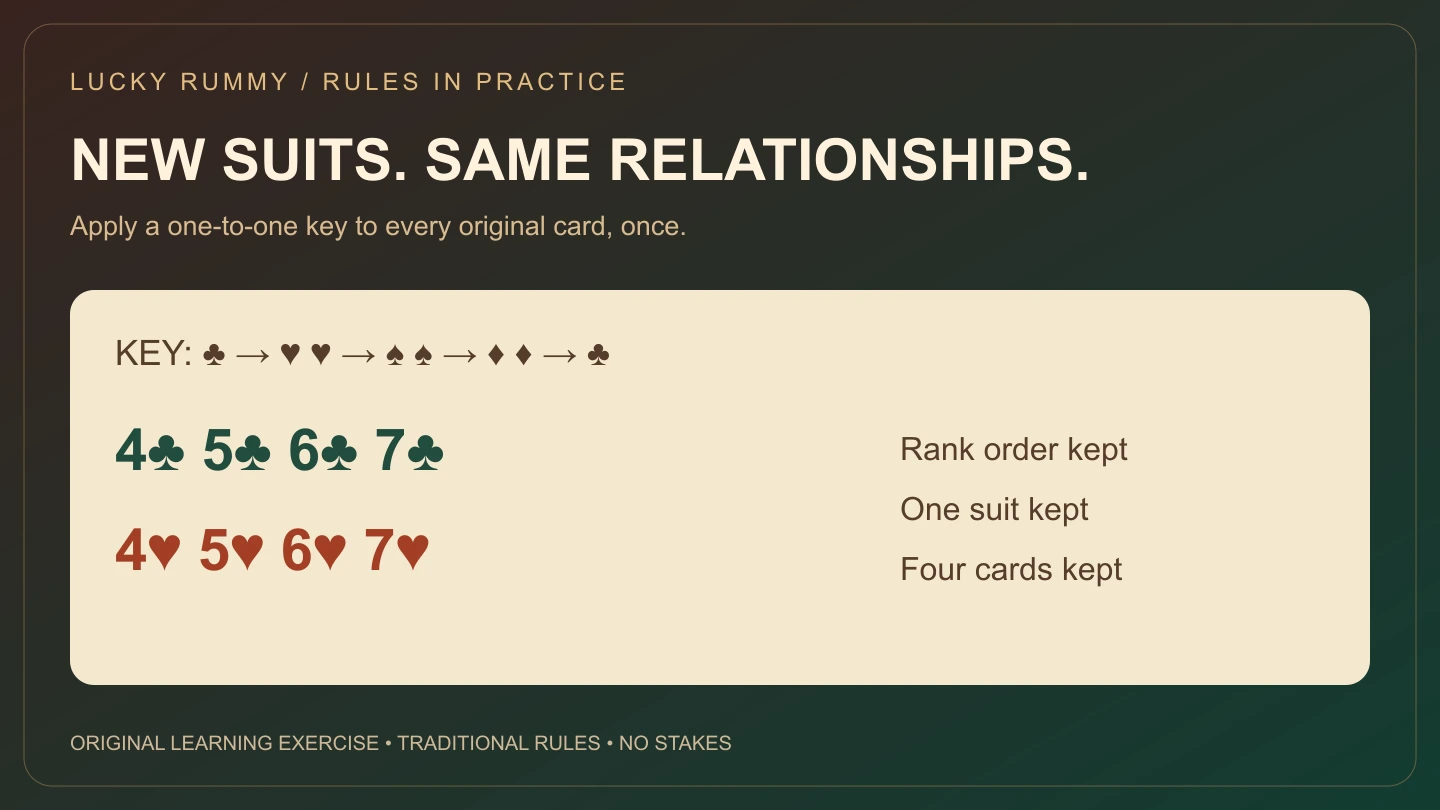
Use this key: clubs → hearts, hearts → spades, spades → diamonds, diamonds → clubs. Every old suit has exactly one new suit, and no two old suits lead to the same new suit. Keep ranks unchanged.
Apply the key to each original card once. For example, 4♣ becomes 4♥. Do not then convert that new heart again to a spade in the same pass. Work from the original list into a separate answer column, rather than repeatedly overwriting a single symbol.
Transform a complete hand
Start with 4♣ 5♣ 6♣ 7♣ | 9♥ 10♥ J♥ | Q♣ Q♦ Q♠ | 3♣ 3♦ 3♠. There are thirteen cards: a four-card natural sequence, a three-card natural sequence and two three-suit sets. Each physical card has one place.
After the replacement, the hand is 4♥ 5♥ 6♥ 7♥ | 9♠ 10♠ J♠ | Q♥ Q♣ Q♦ | 3♥ 3♣ 3♦. Check each card against the original row before regrouping. The count remains 4 + 3 + 3 + 3 = 13, with the same ranks and no new duplicate card.
The first two groups still have consecutive ranks within one suit. Each set still contains one rank in three different suits. Thus the stated grouping requirements remain satisfied. The exercise has changed the appearance of the hand without changing those relationships.
Explain why a partial change is different
Reset the original hand and change only 5♣ to 5♥. The first fragment becomes 4♣ 5♥ 6♣ 7♣. This is not the same operation as relabelling every club. The proposed four-card sequence is broken because one card has a different suit.
That observation diagnoses the displayed group; it is not a general rule that any single-card replacement makes every possible arrangement invalid. To judge a whole changed hand, inspect all possible uses of its actual cards. Keep the limited claim separate from a broader conclusion.
Reverse the key to check your transcription
The reverse key is hearts → clubs, spades → hearts, diamonds → spades, clubs → diamonds. Apply it once to every card in the transformed list. You should recover the original inventory exactly, including the order if you kept the rows fixed.
If the sequence checks pass but a queen has disappeared, the transformation was recorded incorrectly. A one-to-one suit key preserves equality and difference of suits; it does not excuse missing a physical card. Use our duplicate-card guide when multiple copies are present.
For another paper exercise, choose a different one-to-one suit key and write the answer before moving any cards. The self-test routine can help you check the explanation. This method is a reasoning check, not a prediction of a game’s outcome.
Definition reference: Pagat: Indian Rummy, Runs and sets. The transformation, proof by relationships and paired inventories are original analysis.