
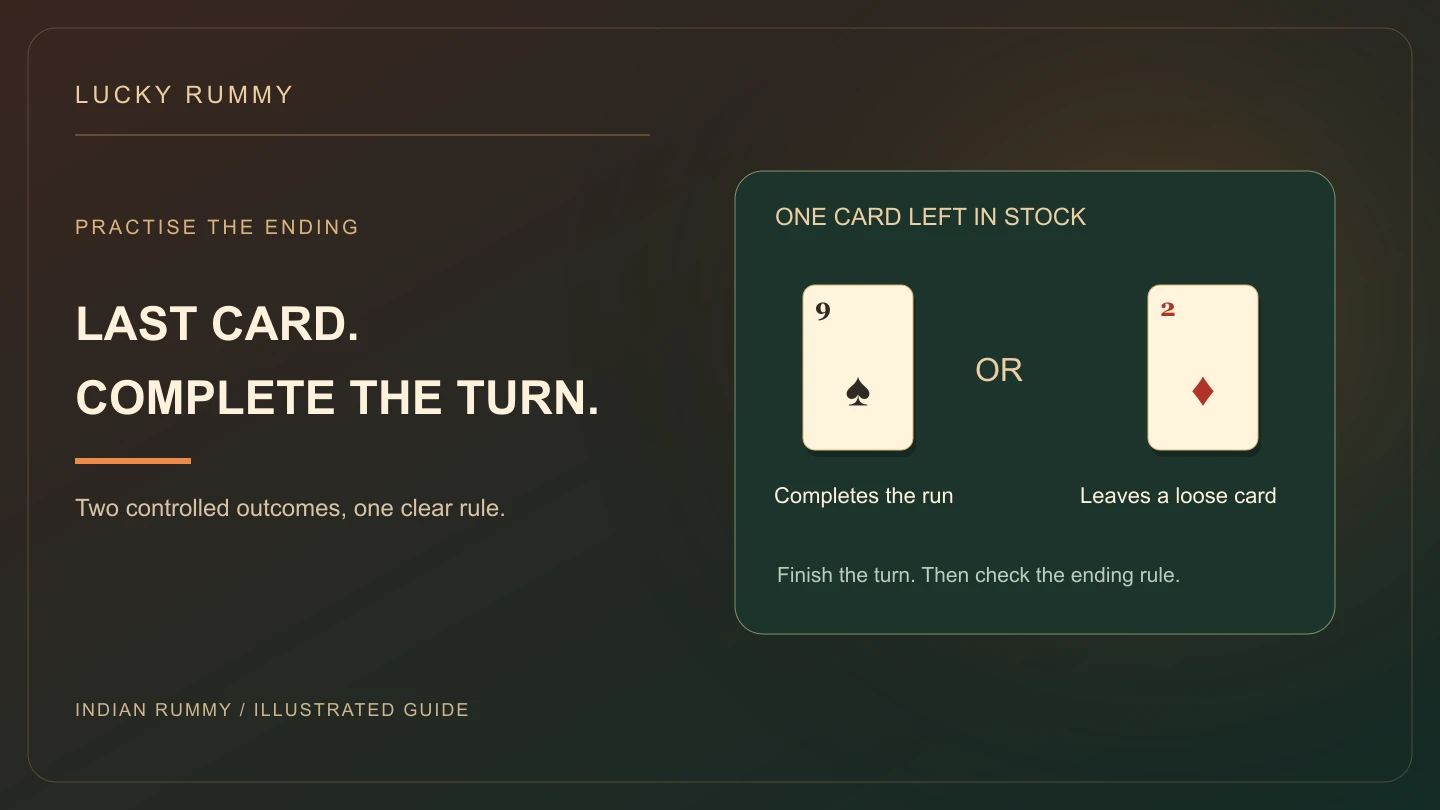
The last face-down card creates a different question from the usual “Which card should I discard?” You also need to know when the hand ends. Do not improvise an answer by turning the discard pile over. First identify the exhaustion rule for the format you are practising.
This no-stakes exercise uses the Indian Rummy convention in the reference below: if nobody declares by the end of the turn that takes the final stock card, the game is void and has no winner. Other tables may specify different procedures. This article does not describe an independently verified Lucky Rummy app feature.
Count the stock separately from the open pile
Write three headings on a worksheet: “stock before”, “draw source” and “stock after”. If two stock cards remain and a player takes the open discard, the stock still contains two. If the player draws from the stock instead, it contains one. Moving a card from a hand to the discard pile does not replenish the face-down stock.
Try this short trace with no cards being returned to the stock: start at three; draw from stock, leaving two; take the open card on the next turn, leaving two; draw from stock, leaving one; finally draw from stock, leaving zero. Four turns have occurred, but only three stock cards have been consumed. Keep “turns elapsed” and “stock draws” in different columns.
Pause before the final draw
Prepare this thirteen-card teaching hand, with no wild card used: 3♣ 4♣ 5♣ | 8♥ 9♥ 10♥ | Q♦ Q♥ Q♠ | 6♠ 7♠ 8♠ | K♣. There are four complete three-card groups plus one loose king. Count the actual cards rather than the divider marks.
For a controlled demonstration, put 9♠ as the only card in the face-down stock. The learner knows its identity because this is a constructed puzzle, not a random or hidden-information game. Ask them to explain what they would check after drawing it, before they touch the card.
Finish the turn before applying the ending condition
After drawing 9♠, the hand contains fourteen cards. Set aside K♣ as the discard. The remaining thirteen form 3♣ 4♣ 5♣ | 8♥ 9♥ 10♥ | Q♦ Q♥ Q♠ | 6♠ 7♠ 8♠ 9♠. All cards have a job, with natural sequences present. Under the stated convention, the final stock draw can therefore be followed by a valid declaration; zero stock alone did not cancel that opportunity.
Reset the original thirteen-card hand and change the final stock card to 2♦. Drawing it produces fourteen cards, but discarding either loose K♣ or 2♦ leaves the other ungrouped. There is no valid declaration in this constructed case. At the end of that turn, the stated exhaustion rule applies. Do not award victory merely to the player with the smallest loose card.
Keep a boundary check beside the puzzle
The exercise assumes no player drops and no cards are added back to the stock. If a format includes such a return, the stock count must be updated at that event. Similarly, a rule requiring a fresh stock would be a different rule, not an extension you can silently attach to this example.
Read the relevant table instructions before applying this lesson online. For the ordinary turn, use our open-versus-closed-deck guide; for the grouping check, use the declaration checklist. The practice-table setup helps keep the indicator and piles distinct.
Rule reference: Pagat: Indian Rummy, The Play. The stock trace and paired final-card exercises are original teaching examples.