
“I already know rummy” is not a substitute for reading the rules of a new format. Familiar names can hide different procedures. A useful rule sheet is short enough to consult but precise enough to settle a concrete example. Here is a method for building one without copying a whole manual.
The worksheet below is a learning tool, not a new set of house rules. It does not identify the options offered by Lucky Rummy. Use the instructions attached to the exact table or game you are considering, and leave unanswered questions marked as unresolved.
Record the source before recording the answer
At the top of a page, write the game name, format name, source address and date checked. Add four columns: “question”, “rule location”, “answer in my words” and “example to test”. A missing answer should stay blank or say “not confirmed”. Do not fill it with the rule from a different app because that rule feels familiar.
For an offline lesson, use the written instructions your group has agreed to follow. For an online table, read its own current help and format-specific instructions. If two official sections appear to conflict, record both passages and ask the operator to clarify. A short promotional caption is not enough to settle a technical edge case.
Turn one broad question into a precise one
Instead of writing “How do jokers work?”, ask “If the indicator is a printed joker, which ordinary ranks, if any, become wild?” The reference below documents more than one convention for that situation. That makes it a useful test of whether your sheet contains an actual answer or merely a remembered habit.
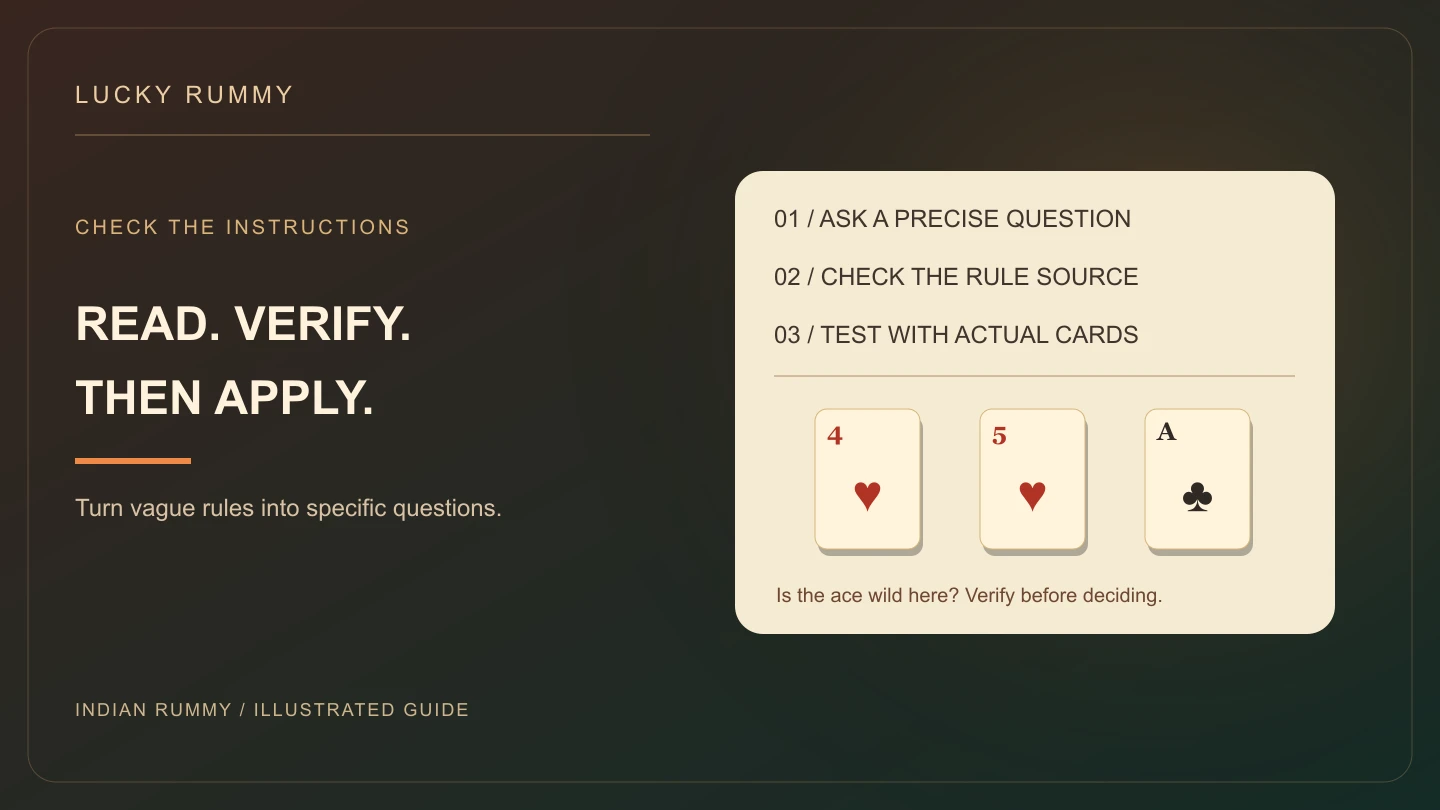
Use 4♥ 5♥ A♣ as a small test fragment. If the selected rule explicitly makes aces wild in that situation, A♣ can stand for 6♥ in this fragment. If aces are not wild, those three natural cards do not make a same-suit run. The fragment is not a thirteen-card declaration, and the substitution does not make it a pure sequence.
Do not infer the selected convention from this example. The example checks the answer you have already verified. Read the joker guide for arranging substitutes after the applicable rule is known.
Separate card rules from procedure rules
Make one section for card interpretation and another for actions. Card questions include which cards are wild and how aces can be used. Procedure questions include what counts as a completed turn, what happens when the stock is exhausted, and what the interface expects when submitting a declaration.
For each procedure, write a starting state and an observable ending state. For example: “one stock card remains; a player draws it; no declaration follows”. Then look up the prescribed outcome. If the instructions are silent, do not invent a reshuffle or a winner. The source of uncertainty is the missing rule, not your ability to count the last card.
Use a second person to test the sheet
Hand the worksheet to a practice partner without explaining your intended answers. Ask them to solve the joker fragment using only the written sheet. If they must ask what “special joker” means, replace that phrase with the exact card or condition. If they confuse a sample with a confirmed table rule, label the sample more clearly.
Keep the sheet focused on decisions where a different answer would change an action. Avoid filling it with generic slogans. Put detailed card examples in a separate notebook so the short reference remains readable.
Update the rule, then revisit the affected exercise
When an instruction changes, date the amendment and identify which example it affects. Recheck that example before using an old lesson again. Do not carry a past screenshot forward as proof of a current rule.
Start from our rules overview for vocabulary. Use the Indian Rummy and Gin comparison when changing games entirely. The worksheet’s purpose is to expose uncertainty early, not to promise better results.
Reference: Pagat: Indian Rummy, Deal and Variations, for the existence of differing printed-indicator conventions. The worksheet and diagnostic fragment are original learning exercises.