
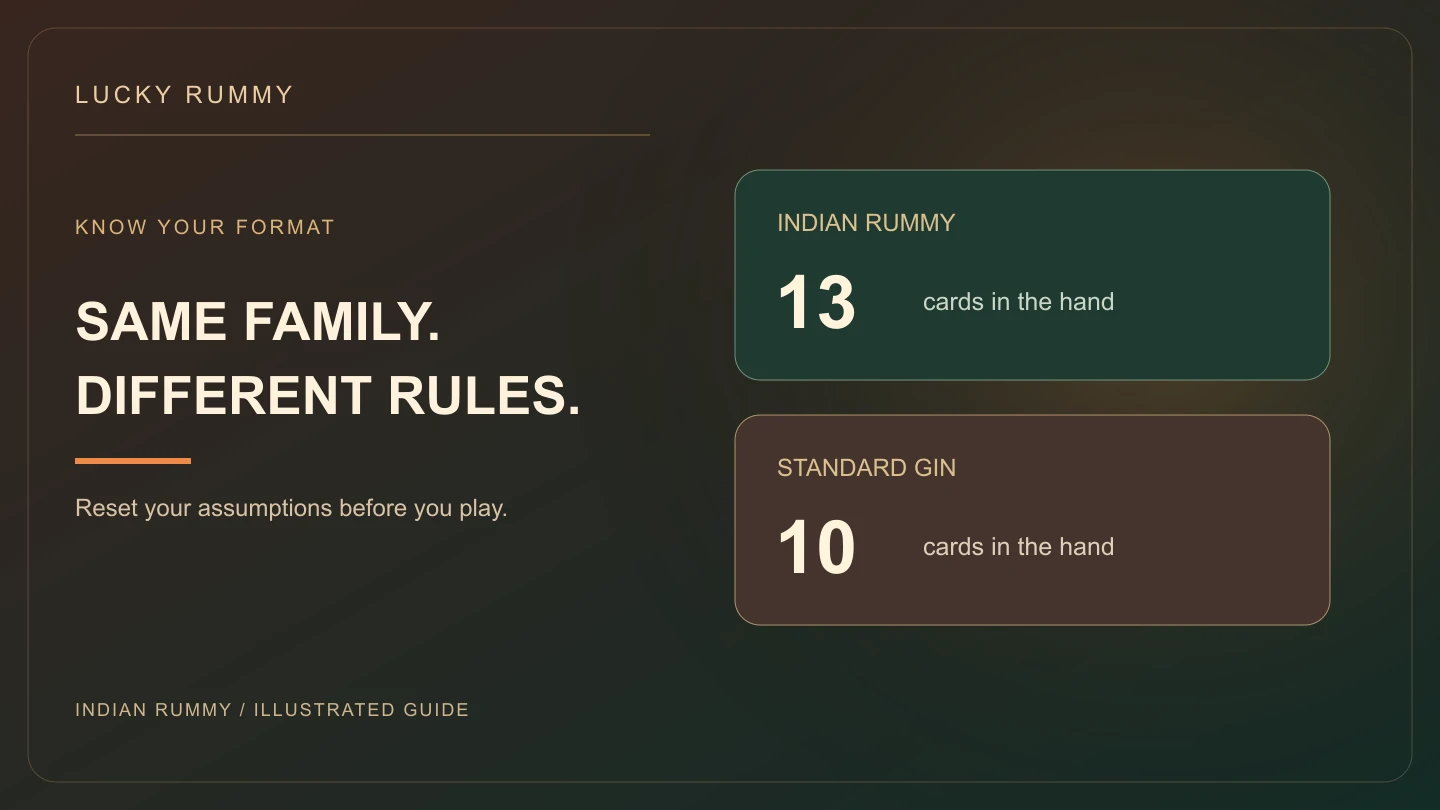
A familiar draw-and-discard rhythm can make two rummy games feel interchangeable. They are not. A move that legally ends a Gin hand may leave an Indian Rummy hand unfinished. When learning a new format, first replace the assumptions you brought from the old one.
This comparison uses the standard Gin and Indian Rummy descriptions linked below. House rules and named variants can differ. It does not establish which formats Lucky Rummy offers. Use it as an offline learning exercise, then check the rules of the specific table you intend to use.
Start with a different hand-size label
The referenced Gin game starts each player with ten cards; the Indian version uses thirteen. Write “Gin: 10” and “Indian: 13” on separate worksheets. A complete ten-card arrangement cannot simply be submitted as a thirteen-card hand. Likewise, a worked thirteen-card example is not a Gin starting hand.
Try counting 3♣ 4♣ 5♣ | 7♦ 7♥ 7♠ | 9♠ 10♠ J♠ | 2♦. There are ten cards: three groups of three plus one loose card. The count is appropriate to the Gin exercise, but it does not establish that the hand meets another game’s ending condition.
Do not import knocking into a declaration
Under the ordinary Gin rule used here, a player can knock with at most ten points of deadwood after discarding. In the ten-card example, the lone 2♦ contributes two deadwood points, so it meets that threshold. Knocking is not the same as going gin, which leaves no deadwood. Meeting a knock threshold also does not guarantee a favourable score against the opponent.
Now build a separate Indian practice hand by adding K♥ 6♦ Q♣ to those ten cards. You have thirteen, but the four loose cards do not become a valid group merely because the rest looks tidy. There is no permission to carry the Gin knock threshold into this hand. The Indian convention used here requires all thirteen cards grouped, including two sequences with at least one pure sequence.
That is the central transfer mistake: a low leftover count answers one game’s question, not the other’s. For the Indian hand, use the declaration checklist rather than a remembered Gin threshold.
Give the ace a fresh rule check
Standard Gin uses the ace low. The Indian convention discussed here permits both low and high runs without wrapping around. Put Q♥ K♥ A♥ on one practice card and A♥ 2♥ 3♥ on another. Label the first “not a Gin run; allowed under the stated Indian convention” and the second “a run in both”. Neither label authorises K♥–A♥–2♥.
Do not carry an ace’s point value from one score sheet to another either. This article is about identifying rule changes, not settling scores. The Indian ace exercises provide a separate set of grouping drills.
Treat joker assumptions as a separate question
The standard Gin deck in the reference has 52 ordinary cards, without jokers. The referenced Indian format uses printed and designated wild cards. Before borrowing a diagram from a tutorial, inspect whether a symbol represents an actual natural card or a substitute. A diagram with a joker may be teaching a different game from the one you have selected.
For an offline check, show a friend 4♦–5♦–PJ and ask them to name the game and substitution rule before calling it complete. If PJ has no role under the chosen rules, the explanation must stop there. Recognising that missing premise is more useful than memorising “jokers are helpful”.
Keep a three-line reset note
Before changing formats, write the starting hand size, the ending requirement and the ace/joker rules. Then inspect one worked hand against those lines. If a guide says “knock”, “deadwood” or “declare”, identify the exact game before following its advice. Read the Indian Rummy overview for the rest of the sequence requirements.
Rule references: Pagat: Gin Rummy and Pagat: Indian Rummy. Worksheets and example hands are original. Cover: an editorial comparison diagram, not a game screenshot.