
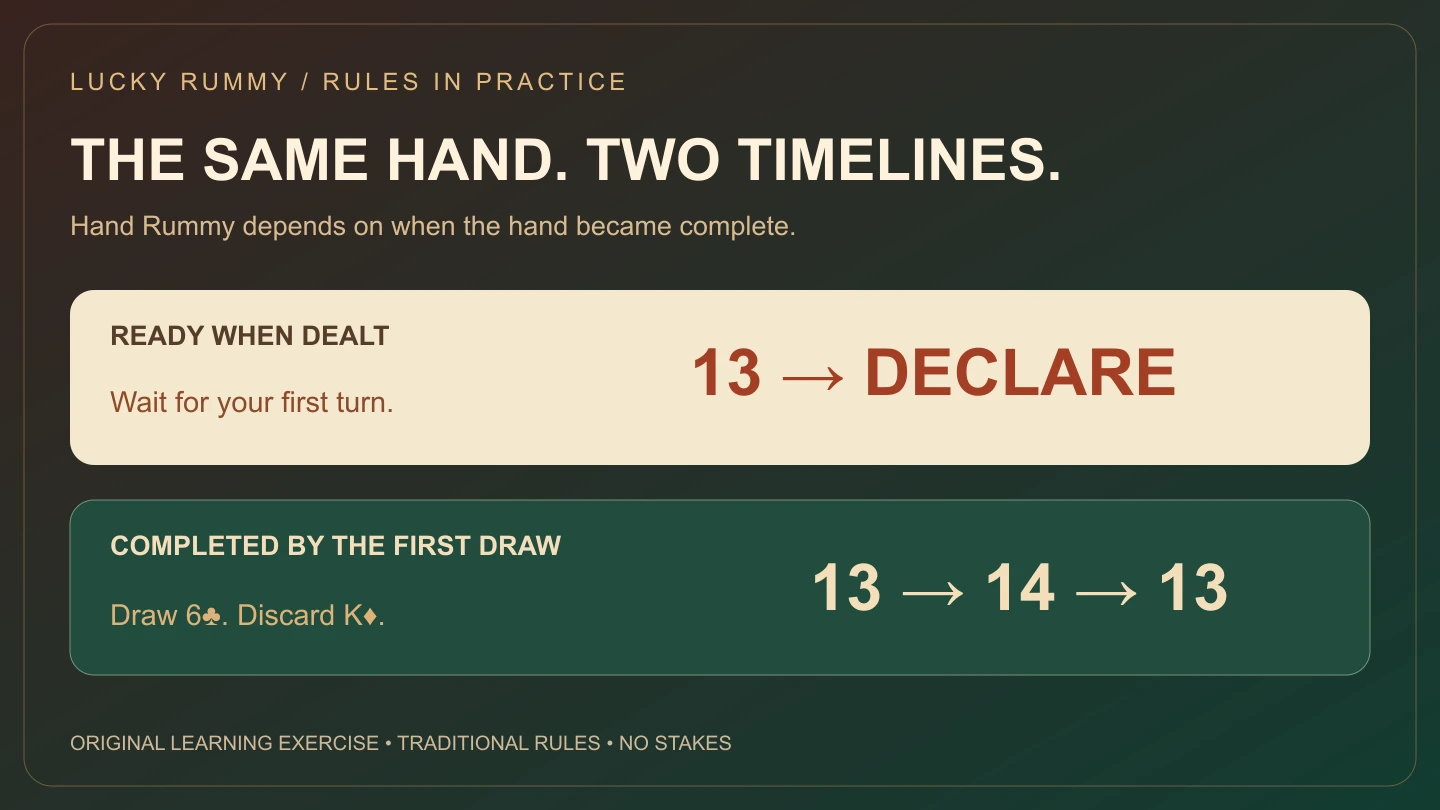
Two players can finish with exactly the same thirteen cards but reach them by different routes. One may have received a complete hand in the deal; the other may need a draw and discard. A photograph of the final cards cannot establish which happened.
Pagat describes a traditional Hand-Rummy procedure for a complete dealt hand: declaration on the player’s first turn instead of drawing. This article uses that convention in a no-stakes lesson. Some formats use different terminology or procedures. Do not assume an app offers this option because a guide gives it a name.
Check the dealt hand before touching either pile
Use this original practice hand, with twos designated wild: 4♣ 5♣ 6♣ | 8♥ 9♥ 10♥ J♥ | Q♣ Q♦ Q♠ | 3♣ 3♦ 3♠. All thirteen cards already belong to valid groups: two natural sequences and two different-suit sets. No joker substitution is needed.
On the worksheet, write “dealt complete; draws taken: zero”. Under the cited Hand-Rummy procedure, the player waits for their first turn and declares without drawing. Discovering the arrangement while another player is acting is not permission to interrupt that player’s turn.
Keep the count at thirteen throughout this example. Do not manufacture a fourteenth card just to imitate the familiar draw-and-discard rhythm. The distinction being practised is the exception’s timing, not a shortcut for incomplete hands.
Change the starting hand, then follow an ordinary turn
For a second scenario, replace 6♣ in the dealt hand with K♦. The player now starts with 4♣ 5♣ K♦ in the first section, followed by the same ten other cards. That first section is incomplete, and the king cannot join any other group to complete this hand.
On the player’s first turn, suppose they draw 6♣ from the stock. The count becomes fourteen. They discard K♦, leaving precisely the thirteen-card display from the first scenario. This is a finish completed by a first draw, not a hand that was complete when dealt.
Write the sequence explicitly: “dealt incomplete; drew 6♣; discarded K♦; thirteen cards complete”. This record shows why the same final picture does not prove the same route. It also identifies the drawn card and the different discarded card without relying on memory.
Audit the evidence, not just the final layout
For each scenario, ask a partner to identify the dealt cards, whether a draw occurred, and the point at which the player was entitled to act. Give them only the final layout first. They should say that the timing cannot be recovered from that evidence alone. Then reveal the starting snapshot and action record.
Do not infer a score, bonus or payment from the phrase “first turn”. The reference discusses separate scoring conditions and variations; those are outside this exercise. No numeric reward or penalty is assigned here, and no commercial game feature is being confirmed.
Keep a short record for the next exercise
Use four fields: starting thirteen cards, draw if any, discard if any, and final grouping. Mark an unused field “none under the stated procedure” rather than leaving an ambiguous blank. If your chosen game requires a different action, write that rule before rehearsing the example.
The draw-and-discard guide explains the ordinary turn. Use the declaration checklist to validate the final groups and the practice journal to preserve what actually happened.
Reference: Pagat: Indian Rummy, The play and Scoring. The matched hands and timeline audit are original examples.