
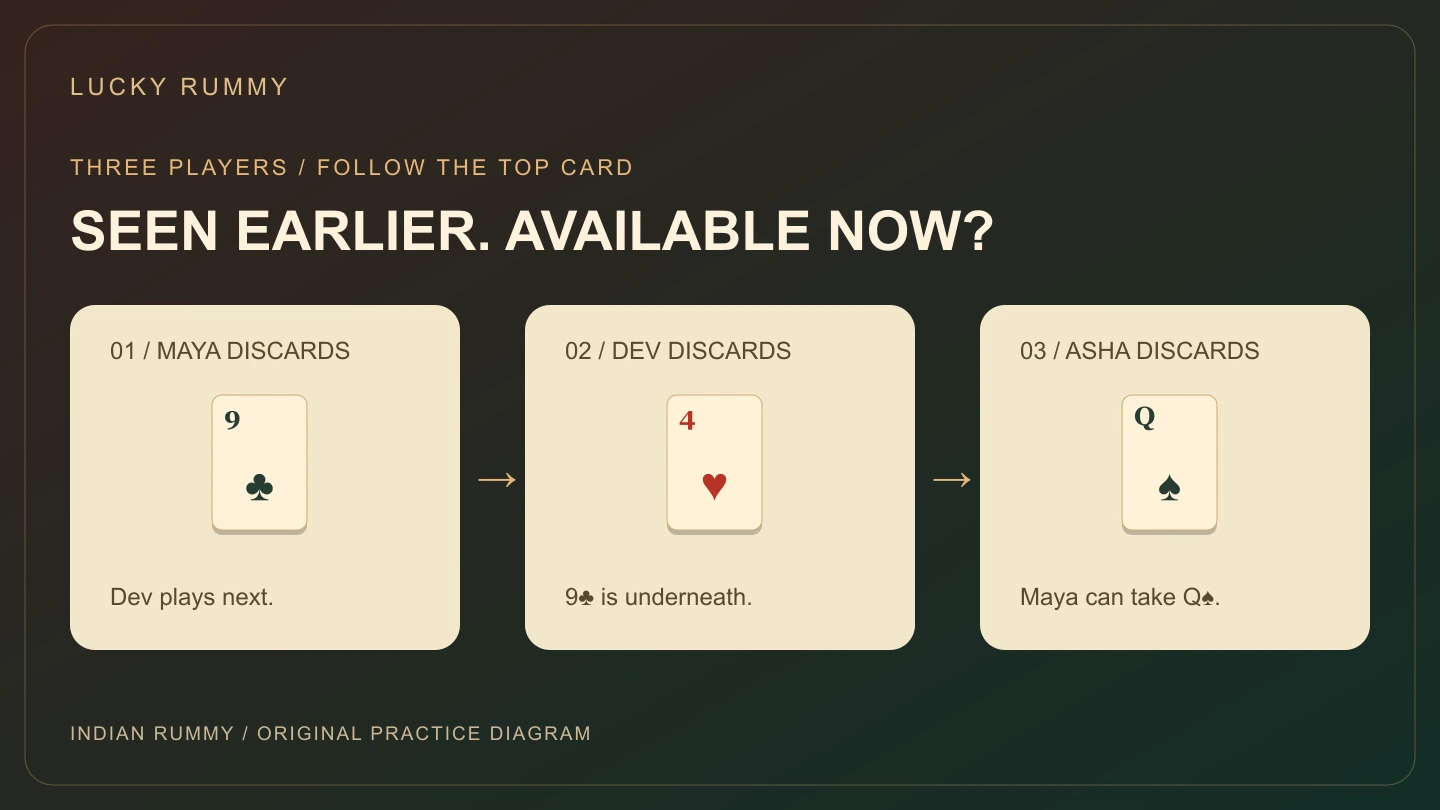
You remember seeing 9♣ on the discard pile. By your next turn, is it still an available draw? A memory of the card is not enough: other players may have covered it or picked it up. A short timeline makes the difference visible.
Use a no-stakes tabletop lesson with three labelled seats: Maya, Dev and Asha. Fix the order as Maya → Dev → Asha → Maya. This is the stated order for the exercise, not a claim about every app’s seating display. Set aside an ordinary deck with no wild rank and use only the cards named below for the demonstration.
Start with one visible card and one clear question
Begin immediately after Maya discards 9♣. Dev is next. For this lesson, a player may take the current top discard or draw from the closed stock, then discard one card. Older cards underneath the top are not selectable. Our question is only “What is the top card now?”
Write three columns on paper: completed turn, action observed and new top card. Do not add guesses about whether a player needs a suit or is close to finishing. Those are different questions, covered in the pickup-clues guide.
Follow two intervening turns
Dev’s turn: Dev draws an unseen card from the closed stock and discards 4♥. The pile is now 9♣ underneath 4♥. Record the new top as 4♥. You know neither the identity of Dev’s stock draw nor why Dev chose this discard.
Asha’s turn: Asha takes the visible 4♥ and then discards Q♠. After the pickup, 9♣ is briefly exposed; after the completed turn, Q♠ covers it. Record Q♠ as the new top. Asha’s removal of the covering card did not reserve 9♣ for Maya or let Maya interrupt Asha’s turn.
Maya’s next turn: the open-pile choice is Q♠, not 9♣. If Maya draws from stock and discards 6♦, the next player, Dev, sees 6♦ on top. The ledger’s completed-turn entries are therefore Maya: 9♣ → Dev: 4♥ → Asha: Q♠ → Maya: 6♦.
Track the pile separately from the hands
At the end of this demonstration, the discard pile contains 9♣, Q♠ and 6♦ from bottom to top. The 4♥ was removed by Asha. There were four discards but one pickup, so the pile contains three cards. This small count is a useful check against accidentally leaving a picked-up card in your written pile.
“Asha picked up 4♥” is an observation. “Asha has a heart sequence” is an inference that the exercise does not establish. Likewise, Dev’s stock draw stays unknown even though the discard is public. Keep unknown entries marked unknown rather than filling them with a plausible story.
Try a change that exposes the memory error
Reset to Maya’s initial 9♣. This time Dev takes 9♣ and discards 4♥. Asha draws from stock and discards Q♠. At Maya’s next turn, Q♠ is again the top card. The visible ending is the same, but 9♣ is no longer buried in the discard pile: Dev picked it up.
The two histories show why a current screenshot cannot reconstruct every earlier action. In the first history the pile has 9♣ underneath Q♠; in the second it does not. An honest practice record retains the observed pickup rather than treating both histories as identical.
Use a five-minute accuracy drill
Ask a partner to read either timeline slowly while you move the actual cards. After each completed turn, say the next player and point to the top discard. Then reconstruct the pile bottom to top. Check the cards physically before looking at the written answer.
If you lose track, mark the record incomplete and restart the exercise. Do not convert uncertain memory into a precise count of unseen cards or a live-game probability. For the action rules, see drawing from the two piles; for keeping cards assigned correctly, see the card-ownership lesson. This drill trains turn-by-turn accuracy and makes no promise about results.
Rule reference: Pagat: Indian Rummy, The play, for top-card drawing and discarding. The named-player timelines and record-keeping drill are original.