
A sequence can be structurally correct without having earned points. In Rummy 500, where a card is when play ends matters. Counting a run you meant to put down as though it had already been melded changes the score incorrectly.
This no-stakes worksheet uses the scoring described by Pagat: credit cards actually melded and subtract cards still held, including held cards that could form a meld. No more melding is allowed after play ends. Use numbered cards at face value and J, Q and K at ten here; no aces or jokers appear.
Freeze the positions before adding
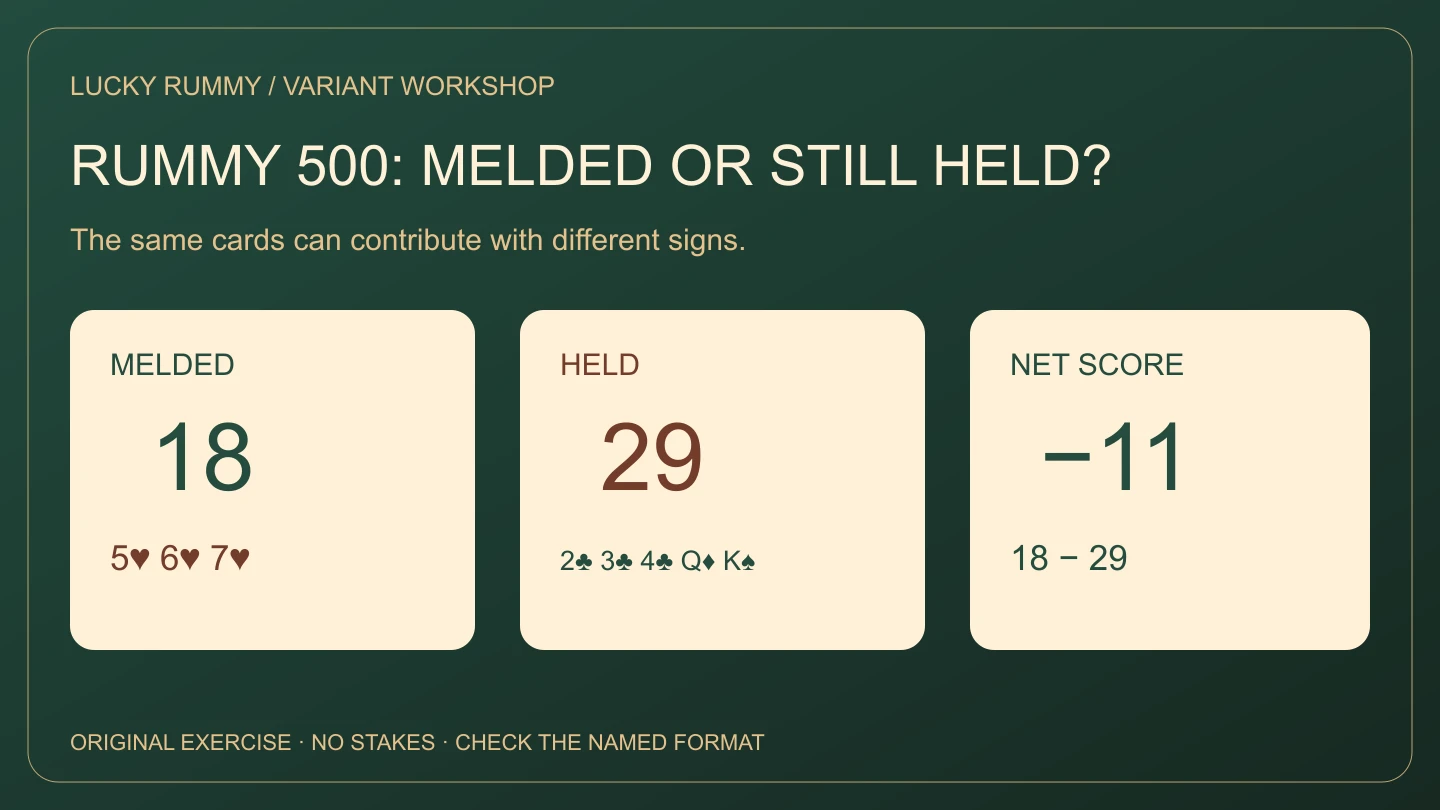
Imagine another player has just ended the hand. Your only previously melded cards are 5♥ 6♥ 7♥. Your held cards are 2♣ 3♣ 4♣ Q♦ K♠. These are a supplied end-of-hand snapshot, not a starting deal or a complete turn history.
Draw two labelled boxes: MELDED and HELD. Put each physical card in its actual box. The three clubs look like a complete sequence, but they belong in HELD because they were not put down before the ending event. Do not move them while checking the arithmetic.
Keep both subtotals and their signs
The melded subtotal is 5 + 6 + 7 = 18. The held subtotal is 2 + 3 + 4 + 10 + 10 = 29. The score for this hand is therefore 18 − 29 = −11. A minus sign is a valid result under this selected scoring system, not evidence that the addition must be wrong.
If the supplied score before this hand was 60, the new cumulative score is 60 + (−11) = 49. Keep “this hand: −11” separate from “running total: 49.” These are paper scores, not money, and the example does not decide who wins the whole session.
Compare a different snapshot, not a late correction
For a separate exercise, suppose the three clubs had already been legally melded on an earlier turn. Now the melded subtotal would be 18 + 9 = 27, with only Q♦ and K♠ still held for 20. The hand score would be 27 − 20 = 7.
The difference between the two snapshots is 18 points, not nine. Those club cards contribute −9 when held and +9 when melded, a change of 9 − (−9) = 18. That explains the arithmetic; it does not let you revise the first snapshot after the hand ended.
Catch three worksheet errors
Crediting the clubs while also subtracting all five held cards gives 27 − 29 = −2. That counts the same cards on both sides. Removing them from the held subtotal without crediting them gives 18 − 20 = −2, which counts them on neither side. Both mistakes accidentally produce the same wrong answer.
Check the inventory as well as the score: eight physical cards must occupy exactly one of the two boxes in either snapshot. Correct addition cannot repair incorrect classification. If your format uses a different card-value schedule, rewrite the value key and recalculate rather than retaining these totals.
This lesson does not say to expose every available meld immediately; that is a different decision involving the game state. Learn the Rummy 500 pickup procedure, and use the rule-sheet check before transferring scoring assumptions between variants.
Reference: Pagat: 500 Rummy, The Scoring. The snapshots and error calculations are original. These rules are not presented as verified Lucky Rummy features.