
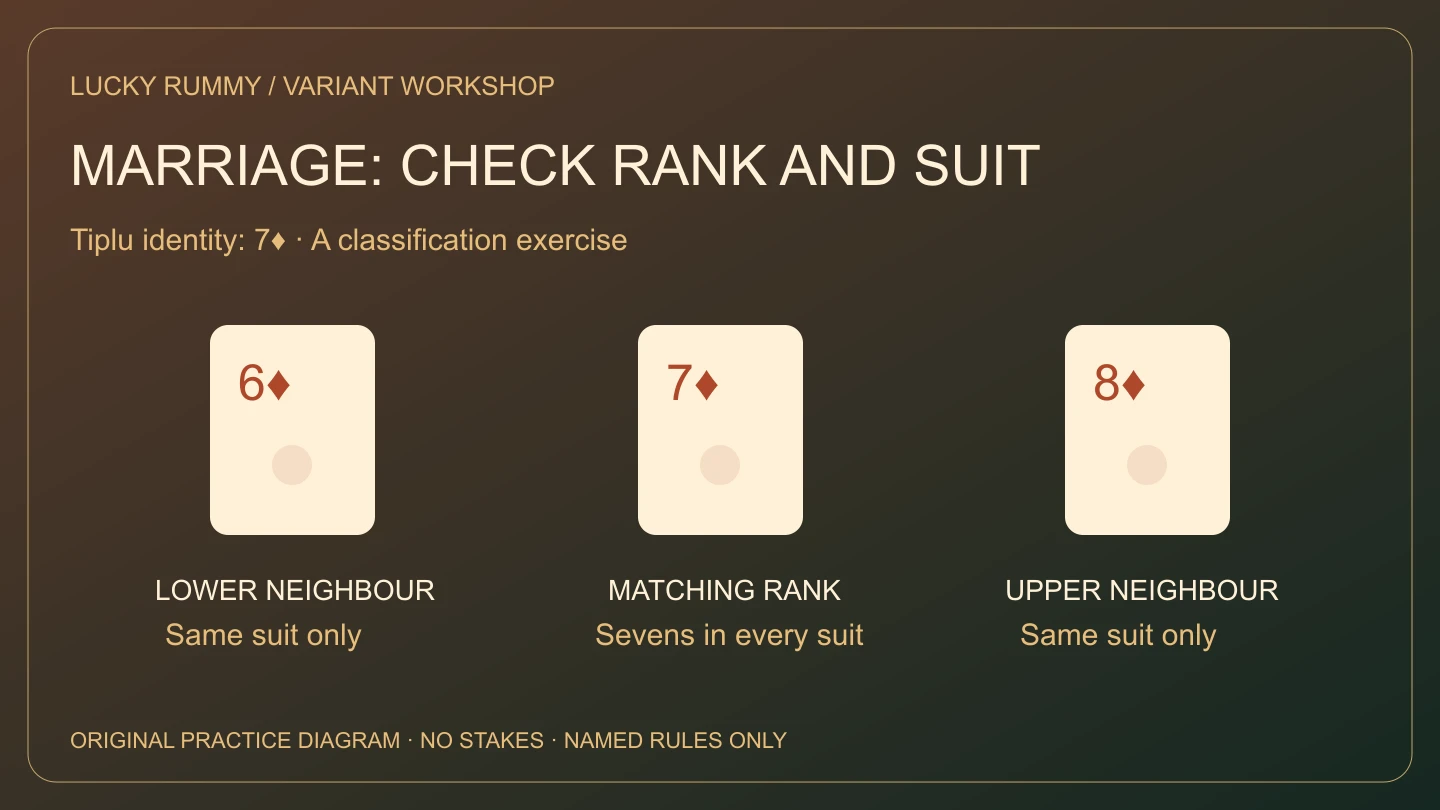
A wild-card rule can depend on both rank and suit. In the Marriage form of Rummy, checking only the number can miss an eligible neighbouring card; checking only colour can incorrectly include another suit. Write the indicator’s full identity before sorting any cards.
This no-stakes classification lesson follows the Marriage variant described by Pagat. It is not a general rule for every 21-card game and is not a claim that Lucky Rummy offers Marriage. We assume the learner is already entitled to know the tiplu; the procedure for seeing it and the game’s scoring are separate topics.
Turn one tiplu into a precise list
Set the tiplu identity to 7♦. Under the selected rule, its rank is wild in every suit; the immediately lower and higher ranks are additionally wild only in the tiplu’s own suit. Here those neighbours are 6♦ and 8♦.
Write the six qualifying rank-and-suit identities: 7♣, 7♦, 7♥, 7♠, 6♦, 8♦. This list names identities, not how many physical copies are available. Never add imaginary copies to a hand just because the game uses multiple packs.
Classify twelve supplied cards
Use this practice sample: 6♦ 7♦ 8♦ 7♣ 7♥ 7♠ | 6♣ 8♥ 4♠ 5♠ 6♠ Q♣. It contains twelve cards and is deliberately only a sample, not a complete dealt hand. The sample’s 7♦ is a separate physical copy from the indicator card.
Make two columns. The first six cards belong in the wild column. The other six belong in the ordinary column. Verify each card against the written list before counting the columns: six plus six equals twelve.
Why is 8♥ ordinary? It is red like 8♦, but its suit differs from the tiplu’s suit. Why is 7♣ wild? Its suit differs, but its rank matches the tiplu. Finally, 6♠ is not wild here even though it lies next to a seven in rank. The neighbour condition includes a suit requirement.
Change only the indicator’s suit
Keep the sample unchanged and replace the written tiplu identity with 7♣. The four sevens remain wild. Now 6♣ joins them, while 6♦ and 8♦ no longer qualify. The other qualifying neighbour would be 8♣, but that card is absent from the sample.
The new sample count is therefore five wild and seven ordinary cards. Do not write six merely because your list of possible qualifying identities still has six entries. An identity allowed by a rule and a card actually present in a sample are different counts.
Separate classification from grouping
Return to the original 7♦ identity. The sample’s 4♠ 5♠ 6♠ is a natural three-card sequence. Mark it without borrowing cards from the wild column. The fact that six other cards are wild does not explain how the rest of a full hand should be grouped.
Likewise, a wild card’s possible substitute roles are not extra physical cards. First classify what you hold; only then assign roles under the selected game’s grouping rules. The joker-role worksheet illustrates this distinction with a different, explicitly stated Indian Rummy exercise.
Use a short spoken check
For each candidate, ask: “Same rank? If not, immediately adjacent rank and same suit?” Then check whether that physical card is actually present. Read diamonds and hearts by name if the symbols are small, using the suit-reading drill.
Reference: Pagat: Marriage, Combinations and Terminology. The twelve-card sample, indicator-suit comparison and count audit are original. This is a recognition exercise, not a complete Marriage rules guide or a prediction of a result.