
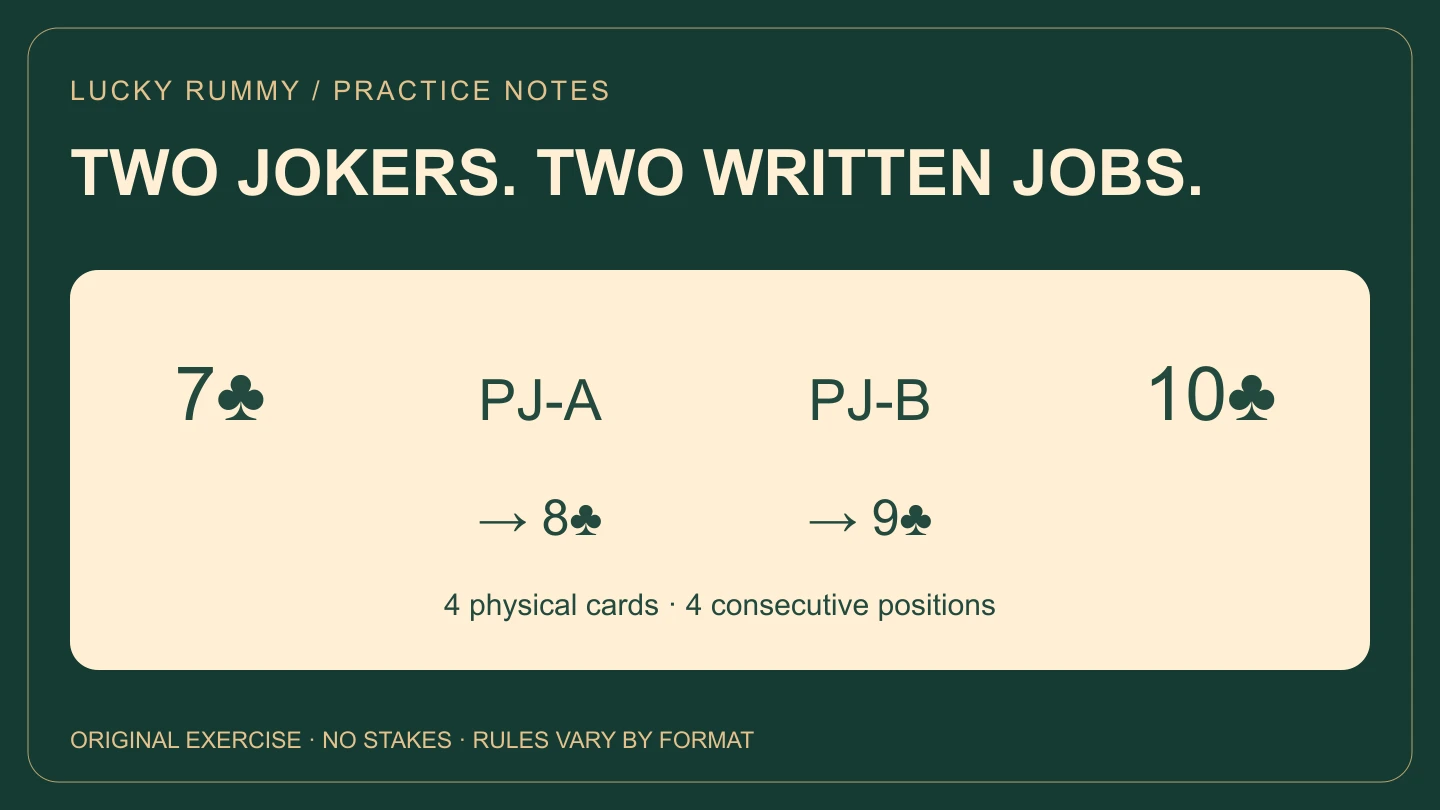
“The jokers fill the gaps” is a starting idea, not a complete explanation. With two substitutes in one group, write a separate job for each. That makes it possible to check the proposed sequence without relying on how neatly the cards are arranged.
Use a no-stakes paper exercise with two printed jokers, labelled PJ-A and PJ-B so they remain distinguishable. Twos are the wild rank, but no two is in the hand. The selected convention permits multiple substitutes in a sequence; confirm that permission for your own format. This is not a description of Lucky Rummy’s controls or joker limits.
Write physical identity and represented role separately
Start with 7♣ PJ-A PJ-B 10♣. There are four physical cards. The intended consecutive rank positions are 7, 8, 9 and 10, all clubs. Write PJ-A → 8♣; PJ-B → 9♣. Read the four positions back as 7♣, 8♣, 9♣, 10♣.
The written 8♣ and 9♣ describe roles, not two extra cards taken from the deck. Keep PJ-A and PJ-B in the inventory. Counting both the jokers and their role labels would turn four physical cards into six imaginary ones.
Swapping the two role labels also works: PJ-A can represent 9♣ and PJ-B 8♣. That gives another explanation of the same group, not a second group you can count at the same time. It remains an impure sequence because both jokers are substitutes.
Use the roles inside thirteen cards
Check this complete arrangement: 4♥ 5♥ 6♥ | 7♣ PJ-A PJ-B 10♣ | Q♣ Q♦ Q♠ | 8♦ 8♥ 8♠. The group sizes are 3 + 4 + 3 + 3 = 13. The hearts provide a pure sequence, the club group provides another sequence, and the queens and eights form separate three-suit sets.
The represented 8♣ is not borrowed from the set of eights; that set uses the three physical cards 8♦, 8♥ and 8♠. No card crosses group boundaries. Our joker allocation guide covers the broader choice of where a substitute might be useful.
Test a wrong label and an impossible gap
First assign both jokers to 8♣. The readback becomes 7♣, 8♣, 8♣, 10♣. Nine is missing and eight repeats, so that explanation fails. Restore the two different roles before continuing.
For a separate comparison, change the physical 10♣ to J♣ and keep the other three cards. A sequence containing both 7♣ and J♣ must include 8♣, 9♣ and 10♣ between them. Two jokers cannot occupy those three missing positions. A four-card group cannot span five consecutive ranks here.
This rejects that proposed four-card group. It does not claim to have searched every rearrangement of a larger hand. Do not silently add a third joker to repair a worksheet that supplies only two.
Audit the explanation in reverse
Cover the role column and count physical cards; then cover the physical labels and read the proposed ranks and suits. These are different checks. Finish by pointing to the pure sequence elsewhere in the full hand and applying the declaration checklist.
Rule references: RummyCircle’s impure-sequence examples and Pagat’s runs and sets. The labelled hand, gap tests and reverse audit are original exercises.