
An ace beside a king and a two can look connected when you fan the cards in your hand. On the table, however, that attractive shape may not be a sequence. The useful habit is to read ranks in order before deciding which cards belong together.
This is an offline learning exercise for Indian Rummy formats that allow both ace-low and ace-high runs. All illustrated cards are ordinary natural cards; none is acting as a wild joker. Confirm your table’s rules before using these examples. We are explaining card arrangements, not claiming a particular Lucky Rummy game mode or interface.
Read the ace as an endpoint
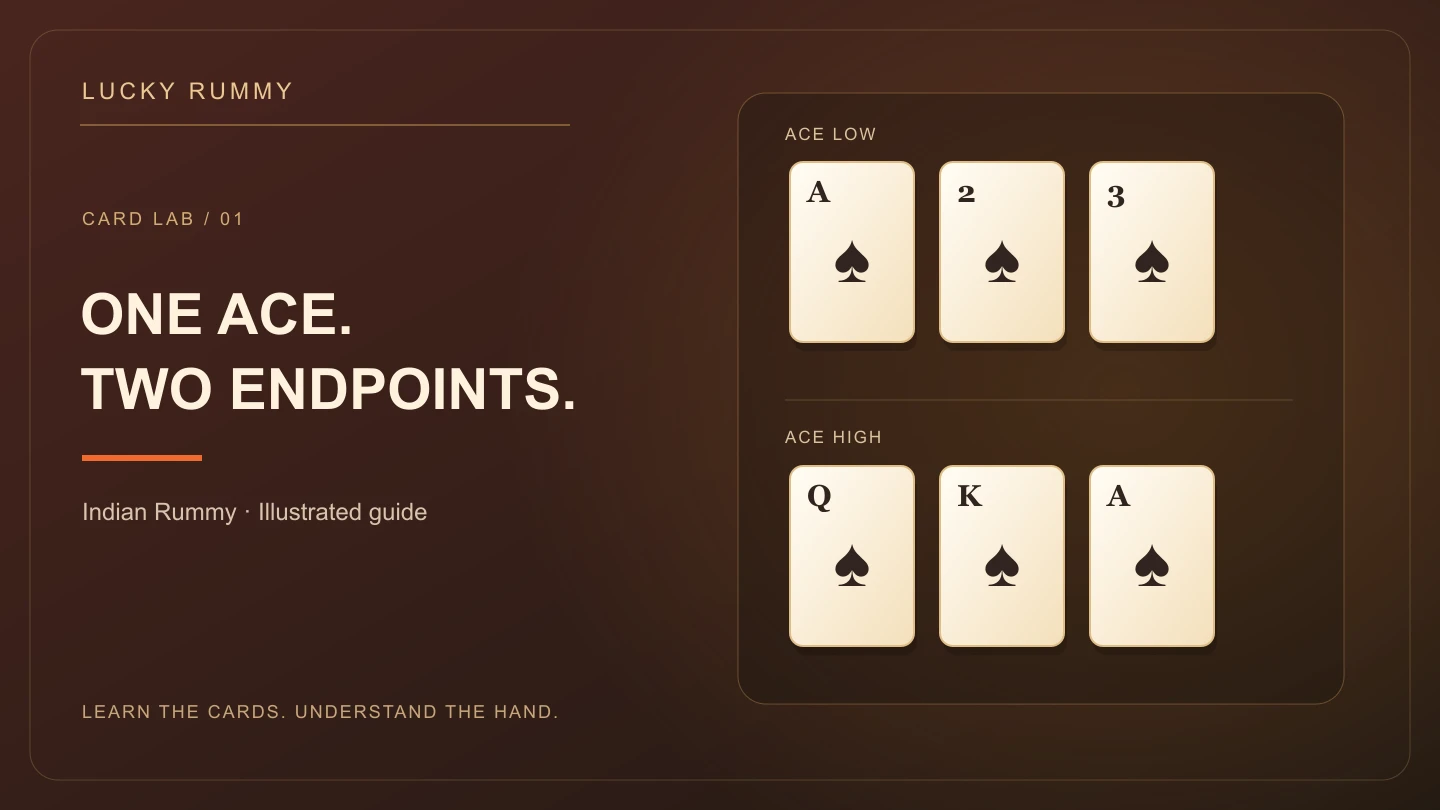
Under the convention used here, A–2–3 and Q–K–A of one suit are valid runs. K–A–2 is not: the rank order does not loop around. Start by placing the ace at one end of the proposed run, then read each neighbouring rank aloud. For a refresher on suits and natural runs, see our pure sequence guide.
Exercise 1: a useful pair is not a completed run
Lay out A♠ 2♠ 4♠. Resist calling this a low sequence simply because all three are spades. The jump between two and four reveals the missing rank. Adding 3♠ gives you A♠–2♠–3♠–4♠; replacing 4♠ with 3♠ gives a shorter complete run.
These are two different exercises. In the first you have added a physical card, so the hand count changes. In the second you have exchanged one. Writing down which operation you performed prevents a correct-looking diagram from hiding an incorrect total.
Exercise 2: the long row that needs two groups
Now use six cards: J♥ Q♥ K♥ A♥ 2♥ 3♥. Putting them in one uninterrupted row is misleading. Leave a clear gap after K♥ and arrange J♥–Q♥–K♥ separately from A♥–2♥–3♥. You have two natural three-card runs, with each physical card assigned once.
Try the alternative arrangement J♥–Q♥–K♥–A♥. It leaves only 2♥–3♥. That pair is unfinished, even though the first run has become longer. This is why a longer sequence is not automatically the better grouping: compare what remains, rather than admiring the largest group.
Exercise 3: one ace, two competing plans
Take Q♣ K♣ A♣ 2♣ 3♣. You can use A♣ with the high cards or with the low cards, but one physical ace cannot do both jobs. Put a small marker beside the chosen group and list the two unused cards. Then change the allocation and list the leftovers again.
If another A♣ is added in a multiple-deck practice exercise, the situation changes: one copy can join Q♣–K♣ and the other 2♣–3♣. Label them “copy 1” and “copy 2” in your notes. The extra option comes from an extra card, not from counting the original ace twice.
Apply the split to a complete hand
Consider J♥ Q♥ K♥ | A♥ 2♥ 3♥ | 6♣ 7♣ 8♣ | 10♣ 10♦ 10♥ 10♠. It contains 13 cards. In a format that accepts a four-card different-suit set, the arrangement has three natural runs and a set of tens. Moving A♥ into the first group would strand 2♥–3♥; the improvement in one group would create a problem elsewhere.
Use the declaration checklist to audit the entire hand after a rearrangement. A single correct ace group does not establish that all the other cards are ready.
A five-minute practice routine
Shuffle the six hearts from Exercise 2, sort them, and explain your grouping without looking at the answer. Next remove 3♥ and say exactly what remains unfinished. Finally return 3♥ but replace A♥ with A♦. The low group now has a suit mismatch. Learning to name the defect is more useful than merely labelling the hand “wrong”.
Practise without stakes and stop when attention drops. These exercises develop recognition; they do not predict a winning draw or guarantee a result. Continue with the beginner guide if you are still learning the order of a turn.
Rule reference: Pagat: Indian Rummy, Runs and sets. The exercises, alternative arrangements and practice routine are original editorial examples. Cover: an original card diagram, not a game screenshot.