
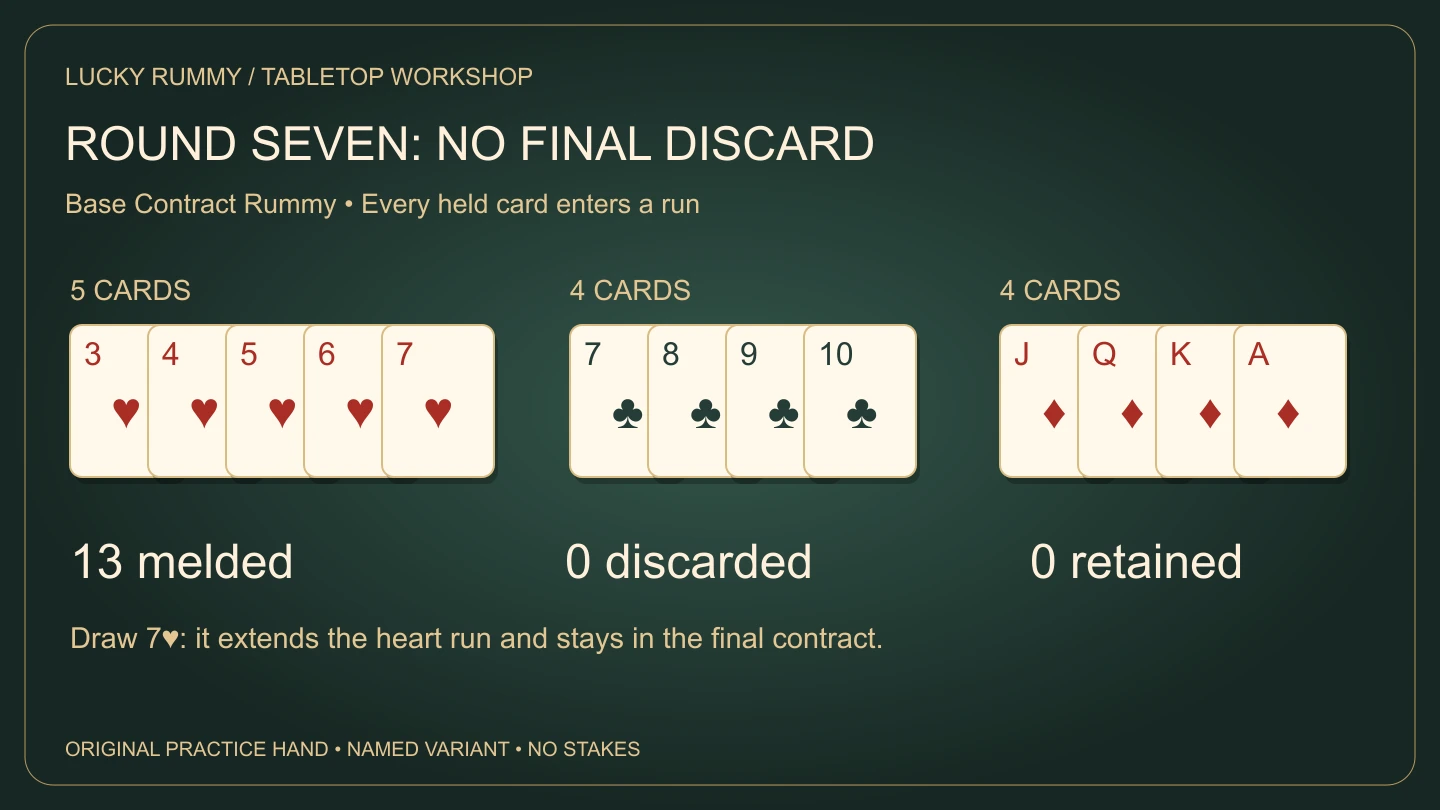
A tidy row of three runs can still leave the final contract unfinished. This no-stakes exercise focuses on the last card in round seven of base Contract Rummy. It is a tabletop lesson, not a statement about Lucky Rummy app modes or the declaration procedure in Indian Rummy.
In the base version described by Pagat’s Contract Rummy rules, round seven requires three runs and all held cards must be melded together. Each run has at least four cards; longer runs are allowed here. A successful finish has no discard. The separately described “May I?” variant changes this ending condition, so check the named version before applying the lesson.
Start with twelve cards, not a finished diagram
Lay out 3♥ 4♥ 5♥ 6♥ / 7♣ 8♣ 9♣ 10♣ / J♦ Q♦ K♦ A♦. These are twelve cards, arranged as three four-card runs in different suits. No joker is involved. Nobody has taken an extra out-of-turn packet in this exercise. Although the rows look complete, do not skip the normal draw.
For the first branch, draw 7♥ from the stock. You now have thirteen cards. Slide it next to 6♥ and read all three rows aloud: 3♥ 4♥ 5♥ 6♥ 7♥, then 7♣ 8♣ 9♣ 10♣, then J♦ Q♦ K♦ A♦. The diamond ace is at the high endpoint, not between king and two.
Finish with a 5+4+4 count
The proposed contract uses 5 + 4 + 4 = 13 physical cards. All three rows are same-suit consecutive runs, and none shares a physical card with another. Expose them together. Your hand becomes empty, and the round ends without putting a card onto the discard pile.
Do not remove 7♥ just to preserve the familiar draw-then-discard rhythm. That would turn a thirteen-card finish into a twelve-card display with a separate discard, which is not this round’s required finish. On a worksheet, use three destinations: melded 13, discarded 0, retained 0. The zero in the discard column is the important result.
Change only the draw and test the failure
Reset the original twelve cards. Draw 2♠ instead of 7♥. You now have the same three runs plus one isolated spade. The three runs do not absorb 2♠, and there are no other spades or jokers in the hand to give it a different route. You cannot expose the twelve cards and treat the loose spade as the finishing discard.
Keep the contract unexposed and discard 2♠ as an ordinary, non-finishing turn. Twelve cards remain in hand. This is not a contradiction: the no-discard exception concerns the successful all-card finish, not every unsuccessful turn during round seven. The two branches share the same starting hand but reach different legal actions after the draw.
Make the audit harder without changing its purpose
Shuffle the order of the thirteen cards from the successful branch and ask a partner to reconstruct three runs. Have them point to the exact destination of 7♥ before exposing anything. Then replace it with 2♠ and ask for a reasoned rejection. An answer that merely says “three runs” misses the spare-card problem; an answer that names all thirteen destinations resolves it.
This example uses different suits to avoid the separate restriction on contiguous same-suit contract runs. It also excludes out-of-turn pickups: with extra cards, do not assume thirteen is the total; count the actual hand. Compare the round-one opening lesson to see why its minimum-card opening cannot be copied here. Use the rule-sheet checklist to record the round and variant. The original cover is a teaching diagram, not a game screenshot.