
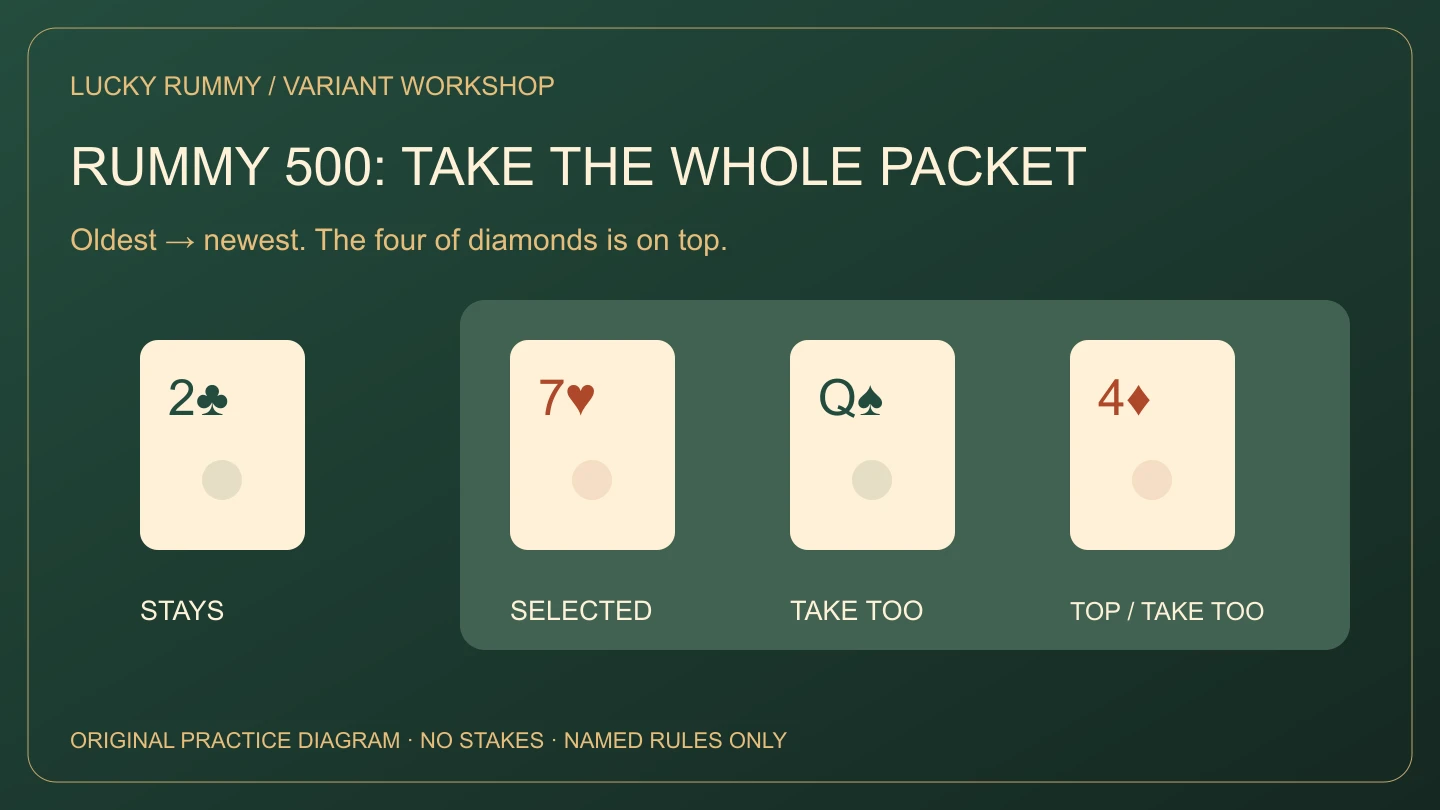
A useful card halfway down a discard pile is not always available on its own. In Rummy 500, reaching that card can bring unwanted cards into your hand too. A good practice check counts the entire pickup before admiring the meld it creates.
This no-stakes lesson uses Pagat’s described Rummy 500 rule: a buried discard must be melded immediately, and every card above it must also be taken. It is a variant-specific exercise, not a Lucky Rummy feature or a permission to reach into an Indian Rummy discard pile.
Mark the top before choosing a card
Lay out a practice pile in this order, oldest to newest: 2♣ → 7♥ → Q♠ → 4♦. Mark 4♦ as the top. The arrows show the order of discarding, not the direction in which you may select cards freely.
Give the learner this seven-card hand: 5♥ 6♥ 3♣ 9♦ J♣ K♦ A♠. All are natural cards. There are no existing table melds in this exercise. We are checking one ordinary turn; special calls, scoring and going-out variations are outside its scope.
Write the pickup as a packet
To reach 7♥, take 7♥, Q♠ and 4♦. Only 2♣ remains in the discard pile. You cannot take just 7♥ and leave the two newer cards behind. Write “three cards drawn,” rather than recording only the card you wanted.
Your hand temporarily contains 7 + 3 = 10 cards. Immediately put down 5♥ 6♥ 7♥ as a new meld, satisfying the use requirement for the buried card. Seven cards remain held: 3♣ 9♦ J♣ K♦ A♠ Q♠ 4♦.
For this supplied practice move, discard K♦. Six cards remain in hand, three are in your face-up meld, and the discard pile is now 2♣ followed by K♦ on top. This is a legal count under the selected procedure, not a recommendation that K♦ is always the best discard.
Balance all eleven physical cards
The initial scene contains seven hand cards and four pile cards: eleven altogether. Afterwards it contains six held cards, three melded cards and two discard-pile cards: 6 + 3 + 2 = 11. No stock draw occurred, so nothing else enters this small scene.
This catches two plausible-looking mistakes. If your final hand still has seven cards, the outgoing K♦ may not have been removed. If Q♠ and 4♦ remain in the old pile as well as your hand, you have copied them instead of moving them. Check locations, not just the largest number.
Test whether you can use the selected card
Reset everything, then replace the starting 6♥ with 6♣. Taking the same packet no longer lets you display 5♥–6♥–7♥: you do not hold 6♥. With the supplied inventory and no existing table melds, 7♥ has no immediate valid meld. Merely hoping to draw 6♥ later does not satisfy the chosen pickup rule.
The failed attempt explains why “I can see a useful card” is not a complete move description. Name the exact meld first, then account for the extra cards. A different pile or an existing meld could change the answer, so retain those facts in your worksheet.
Keep the format label beside the exercise
The Indian Rummy draw walkthrough uses a different draw procedure. Do not transfer this packet pickup into that exercise. Our rule-sheet check helps record which version you are practising.
Reference: Pagat: 500 Rummy, The Play. The eleven-card scene, changed-suit test and conservation check are original. Completing one meld does not guarantee a successful game.