
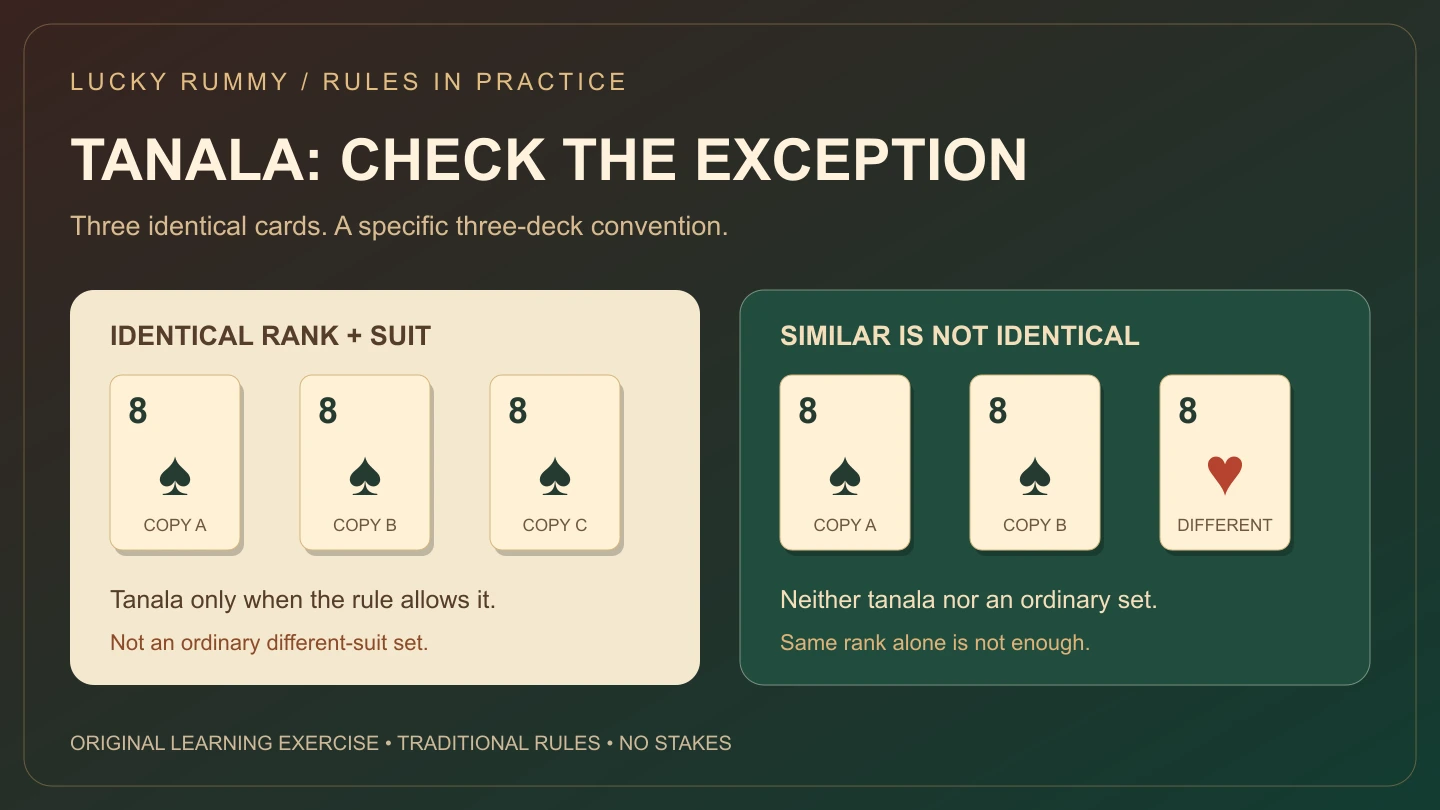
Three copies of 8♠ are not an ordinary set of different suits. Yet a particular traditional Indian Rummy convention gives that exact group a separate name and role: tanala. The exception is worth learning because applying it at the wrong table changes whether a hand is complete.
This is an offline, no-stakes lesson about the three-deck convention documented by Pagat. It does not establish that Lucky Rummy, or any other app, accepts tanala. Confirm the rule for the specific game before treating identical cards as a valid group.
Separate a special combination from an ordinary set
In the cited convention, three identical cards form a tanala, treated as equivalent to a pure sequence. An ordinary set instead needs matching ranks in different suits. Write those definitions on separate lines; calling both groups a “set” hides the exception.
Label three physical 8♠ cards A, B and C on a teaching worksheet. The letters identify copies, not extra ranks. All three cards still have the same rank and suit. A standard two-deck pack supplies only two copies of that exact card, so it cannot supply this natural triple.
Build a complete thirteen-card example
Assume the tanala convention is explicitly enabled, and twos are wild. Lay out 8♠ A-copy, 8♠ B-copy, 8♠ C-copy | 3♥ 4♥ 5♥ 6♥ | J♣ J♦ J♥ | 9♣ 9♦ 9♥. No card in the display is wild. Count the sections: 3 + 4 + 3 + 3 = 13.
The triple eights provide the special pure-sequence equivalent. The hearts provide another sequence. Each remaining section is a three-suit set. Every physical card belongs to exactly one group. This arrangement satisfies the stated combination requirements when the tanala exception applies.
Now remove only that exception from the worksheet. Keep all thirteen cards unchanged. The triple eights are neither consecutive ranks nor a different-suit set. The hearts remain valid, but the hand no longer has a legal home for all its cards. The printed faces alone cannot tell you which rule sheet the table uses.
Test the near-miss before memorising the name
Replace the C-copy of 8♠ with 8♥. The fragment is now 8♠ 8♠ 8♥. It has three equal ranks, but it is not three identical cards, and it repeats a suit. Under the stated rules it qualifies as neither a tanala nor an ordinary set.
As a separate repair exercise, replace one of the two spades with 8♦. The resulting 8♠ 8♦ 8♥ is an ordinary set. It does not inherit tanala’s sequence role. In the full example, you would then have the hearts sequence and three sets, so the required second sequence would still be missing.
Record the exception with the deck count
Before a practice deal, record whether tanala is permitted and whether it counts toward the sequence requirement. If the instructions do not answer those questions, leave the example unresolved instead of importing a familiar house rule.
Read the duplicate-card guide for tracking physical copies and the rule-sheet exercise for documenting variations. The useful habit is to name the exact exception before using it to validate a hand.
Reference: Pagat: Indian Rummy, Runs and sets. The complete hand and both replacement exercises are original teaching examples.