
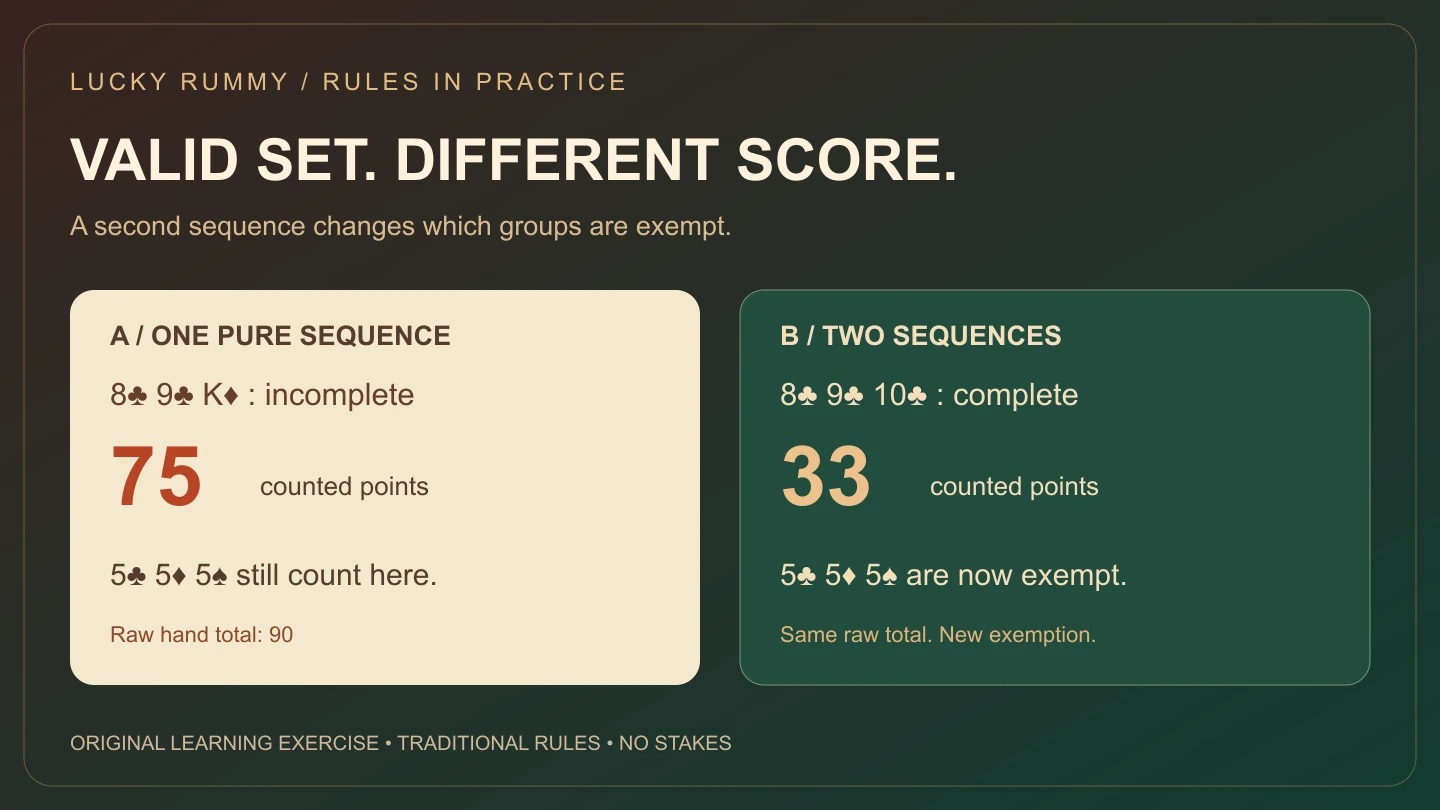
Three matching cards can form a perfectly good set and still contribute points when someone else finishes. Group validity and scoring exemption answer different questions. To see the difference, keep one set fixed while changing a separate part of the hand.
We use Pagat’s traditional Indian Rummy scoring convention for the exercises below, with no stakes. This is a study of one published rule, not a universal scoring calculator or a statement about Lucky Rummy’s app. A format’s own current instructions govern its exclusions, caps and special penalties.
Write the exemption condition beside the hand
In this convention, a pure sequence exempts its own cards. With a pure sequence plus a second sequence, other valid sequences and sets can also be excluded. Merely arranging three equal ranks together does not establish that second condition.
For both examples, let twos be wild. There are no twos or printed jokers in either hand, so no card below scores zero as a joker. Numbered cards use their face values; J, Q, K and A count as ten. The indicator is outside the thirteen-card hand.
Hand A: a valid set, but only one sequence
Lay out these thirteen cards: 4♥ 5♥ 6♥ | 8♣ 9♣ K♦ | 5♣ 5♦ 5♠ | 3♦ J♠ A♣ Q♥. The bars show the study layout. They do not automatically make each section a valid group.
The hearts make a pure sequence worth 15 before exclusions. The three fives are a valid set worth 15. But 8♣ 9♣ K♦ do not form a sequence: the king has the wrong rank and suit for that fragment. There is no second sequence elsewhere in this hand.
Exclude only 4♥ 5♥ 6♥ under the selected rule. The cards counted are 8♣ 9♣ K♦, the three fives and the four loose cards. Their subtotals are 27, 15 and 33, making 75. As a cross-check, the raw total is 90, and 90 minus 15 is 75.
That 75 is the counted-card subtotal for this exercise. We have not applied a cap or any separate penalty. The fives did not become an invalid set; they simply did not qualify for an exemption in this hand.
Hand B: replace one king with a ten
In a new comparison snapshot, replace K♦ with 10♣. Keep every other card. The hand becomes 4♥ 5♥ 6♥ | 8♣ 9♣ 10♣ | 5♣ 5♦ 5♠ | 3♦ J♠ A♣ Q♥. This is a teaching substitution between snapshots, not permission to exchange cards during play.
Now the club cards form a second sequence. The two sequences and the set of fives are all exempt under the selected convention. Only 3♦ J♠ A♣ Q♥ remain, totalling 3 + 10 + 10 + 10 = 33.
The raw hand total is still 90: K♦ and 10♣ each carry ten. The counted subtotal nevertheless fell from 75 to 33. The difference is 42, made up of the newly exempt club sequence’s 27 and the set’s 15. No card value changed; the exemption condition changed.
A lower subtotal is not a declaration
Hand B still contains four ungrouped cards. Having the required sequences does not make the whole thirteen-card hand ready. A declaration must account for every card in valid, non-overlapping groups under the applicable rules. Consult the declaration checklist before treating a scoring exercise as a finished hand.
For a final paper test, change the loose 3♦ in both snapshots to 4♦. It creates no new group here. Each counted subtotal increases by one, to 76 and 34, while their difference stays 42. If your answer changes by a different amount, check whether you accidentally exempted the fives in Hand A.
Use our card-points worksheet for the arithmetic method and the rules overview for group definitions. Always record the inclusion rule before recording the sum.
Reference: Pagat, Indian Rummy: Scoring. Both complete hands, the one-card comparison and the checking exercise are original.