
You can add every card correctly and still misunderstand a rummy score. There are two separate questions: what are these cards worth, and which of them does this table actually count? Keep those questions on different lines of your practice sheet.
This guide is an arithmetic exercise, not a payout calculator. It uses the common values below, while the rules shown at your table govern scoring eligibility, penalties and limits. We are not confirming a Lucky Rummy scoring mode, entry fee or reward. Practise with physical cards or a paper hand, without stakes.
Write a small value key first
For this exercise, ordinary numbered cards carry their printed value; J, Q, K and A count as 10 each. A recognised printed or wild joker counts as zero under the referenced convention. Confirm the wild rank before adding anything. Do not treat a card as a joker merely because it would fill a useful gap.
On paper, write the card, its assigned value and the reason in three columns. This takes slightly longer than mental arithmetic at first, but lets you find the exact source of a discrepancy instead of repeatedly adding the same mistaken numbers.
Example 1: add loose cards in small batches
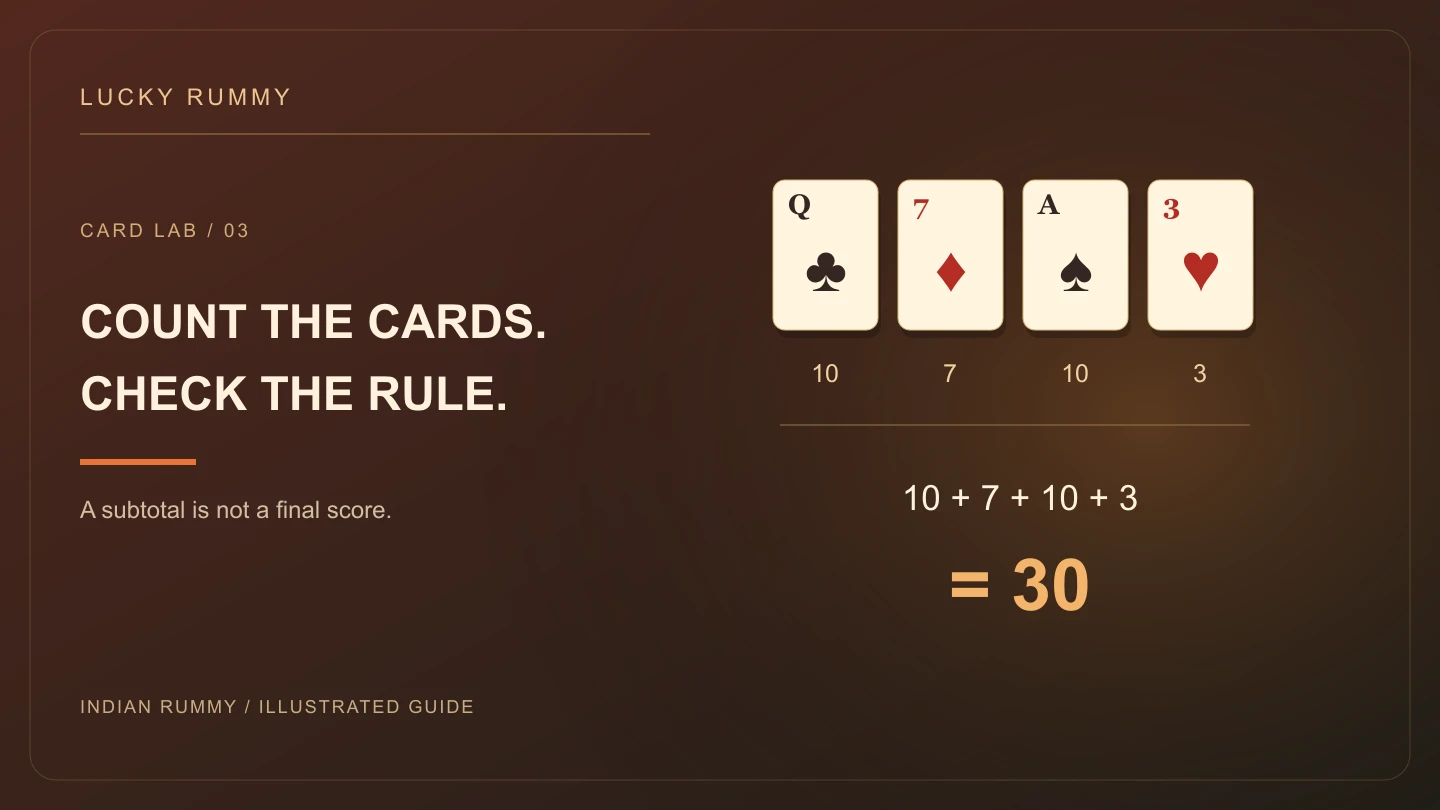
Suppose a scoring exercise asks you to total Q♣ 7♦ A♠ 3♥, with none designated wild. Write 10 + 7 + 10 + 3. Pair the two tens for 20, and seven plus three for 10. The subtotal is 30. Calling the ace “low” does not turn its value into one under this value key.
Check the sum in another order: 10 + 7 = 17, then 17 + 10 = 27, then 27 + 3 = 30. Independent grouping is a useful check; looking at the first answer again is not. If you obtain 21, inspect the ace value before blaming the addition.
Example 2: change one assumption, then recalculate
Keep exactly those four cards, but now explicitly designate sevens as wild in the exercise. The terms become 10 + 0 + 10 + 3, giving 23. Write “7♦ is wild” next to the zero. Without that annotation, someone reviewing the sheet cannot tell whether you applied a rule or accidentally skipped a card.
Changing the wild rank changes the value assignment; it does not prove that the rest of a hand is valid. A zero-point card is not a substitute for checking the required sequences. Use our joker allocation guide for that separate problem.
Example 3: distinguish the raw total from chargeable cards
Lay out 2♣ 3♣ 4♣ | 6♥ 7♥ 8♥ | 9♣ 9♦ 9♠ | Q♦ A♥ 5♠ 2♦. No rank is wild here. The group subtotals are 9, 21, 27 and 27. The raw total of all 13 cards is therefore 84.
That is not automatically an 84-point result. If a hypothetical worksheet explicitly exempts the first three valid groups and counts only the four remaining cards, the counted subtotal is 27. If it uses a different exemption rule, you must apply that rule instead. The figure 84 describes the cards before exclusions; 27 describes one stated selection of them. Neither number is a universal settlement instruction.
Use two passes, then check the table rules
In pass one, identify the cards included in the calculation and cross out excluded groups only when the scoring rules justify it. In pass two, assign values and add them. Keep any cap or separate penalty on a third line rather than silently replacing your subtotal. Do not import a cap from another app or format.
For a quick self-test, replace Q♦ in the last example with 4♦. The four-card subtotal becomes 4 + 10 + 5 + 2 = 21, and the raw hand total falls from 84 to 78. The six-point difference is a useful cross-check. It says nothing about a monetary reward or the probability of winning.
Finish by explaining your result in a sentence: “These four cards were included under the stated rule, and their values total 21.” If you cannot name the inclusion rule, label the answer a raw subtotal. For grouping questions, return to the rules overview and declaration checklist.
Rule references: card values in RummyCircle’s rules and joker values in Pagat’s Indian Rummy scoring section. Worked sums and the worksheet method are original. Cover: an editorial arithmetic diagram, not a game screenshot.