
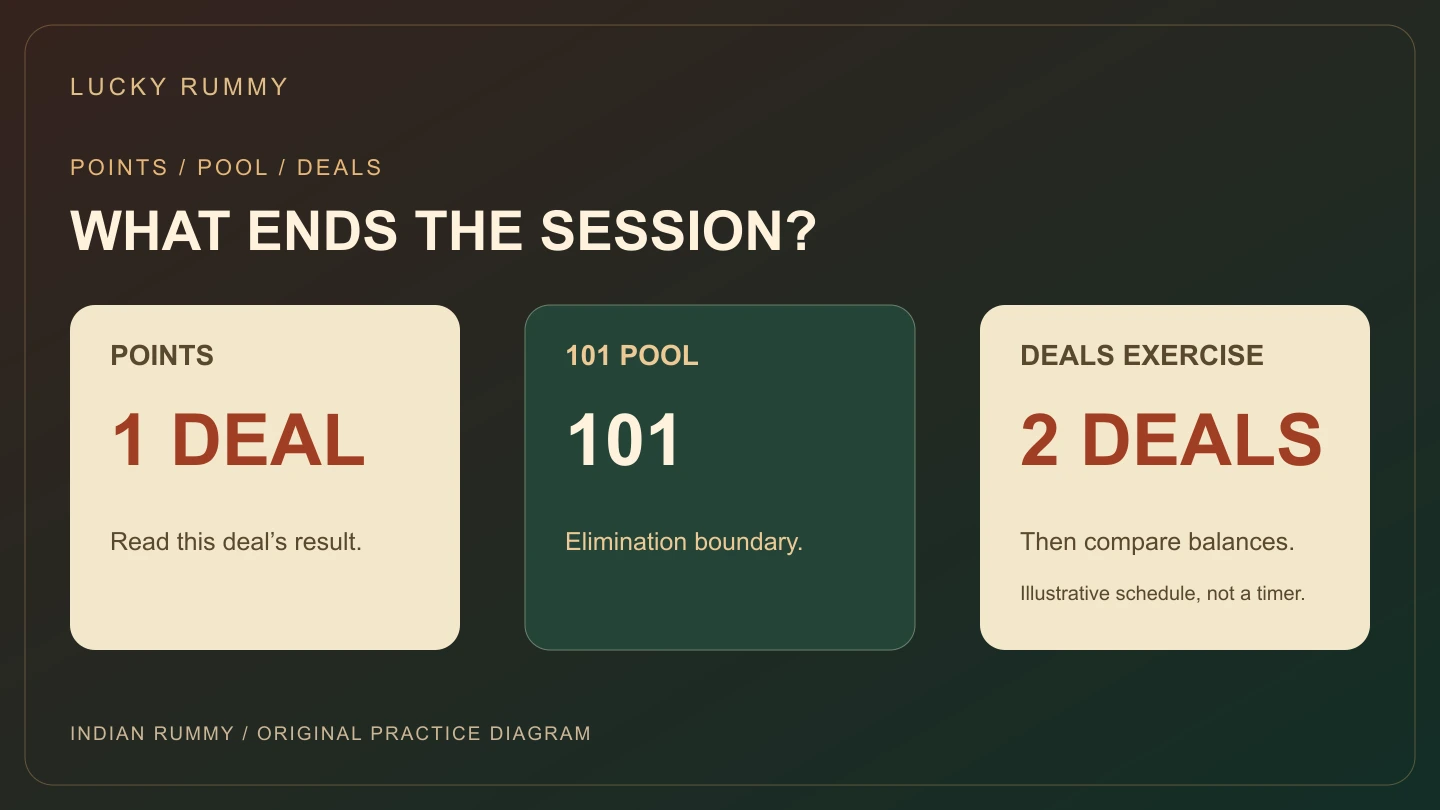
Winning one hand and winning a session are different things. A scoreboard can show penalty points, accumulated penalties or a chip balance. Before comparing two numbers, identify which of these the table is recording.
This guide explains format terminology through invented, no-stakes arithmetic exercises. It does not confirm that Lucky Rummy offers any named format, nor describe cash entry, payouts or regional availability. The table’s current rules decide scoring exceptions, ties and the actual endpoint.
Points: read the result of one deal
In a single-deal Points format, a completed deal produces its own result. For our worksheet, write A: 0, B: 18, C: 27 after a valid finish by A. These are that deal’s penalty scores. If a separate next deal ends A: 12, B: 0, C: 8, do not automatically apply a Pool elimination rule to the sum of the two rows.
You can total rows privately to review practice, but that personal statistic does not change the format. Label each row with a deal number so a later reader does not mistake an old result for an active running total.
Pool: carry penalties forward to a threshold
For a simplified 101 Pool exercise, start a player on 72 accumulated points. Add a deal penalty of 28: the total is 100, still below 101. Reset to 72 and instead add 29: the total is exactly 101. Under a rule that eliminates at 101 or more, that second result reaches the boundary.
Do not read “101 Pool” as 101 deals, a target to score, or an instruction to reset after each hand. Our worksheet omits re-entry, splits and exceptional endings. When practising elimination arithmetic, state that omission instead of silently importing those options from another table.
Deals: count the scheduled deals, then read the ranking rule
A fixed-deal session has a pre-agreed number of deals. RummyCircle’s cited explanation ranks players by their final chip balances. Use this two-deal teaching ledger: A and B each start with 200 counters. In deal one, move 30 from B to A: A has 230 and B has 170. In deal two, move 50 from A to B: A has 180 and B has 220.
Both players won one deal in this invented ledger, yet B finishes with more counters. Counting hand wins would miss that distinction. The total stays 400 after every transfer; a total of 410 would reveal an arithmetic error. The transfer amounts are given inputs, not derived hand penalties or money.
Check whether a different ruleset displays chips or cumulative penalty points: “higher is better” cannot be carried from a chip balance to a penalty total. A fixed deal count also does not guarantee a fixed number of minutes. Turn lengths and any tie-break rule still matter.
The format label does not repair an invalid hand
For a basic grouping check, consider 3♥ 4♥ 5♥ / 6♣ 7♣ 8♣ / 9♦ 10♦ J♦ Q♦ / K♣ K♦ K♠, with no affected wild rank. It contains thirteen cards, three natural sequences and a different-suit set. Changing 5♥ to 5♠ breaks the first sequence; calling the table Pool or Deals does not fix that group.
This is a structural example only. Use the declaration checklist for a complete check, and the card-points exercise before attempting penalty calculations.
Write three labels before practising
At the top of your score sheet, write the scoring unit, what carries into the next deal and the stopping condition. Then add the tie rule and any exceptions from the specific table. If one of these is unknown, leave it as a question for the rule-sheet check, rather than guessing.
Sources: RummyCircle’s Points, Pool and Deals explanations. They support the format distinctions; all worksheet numbers and card examples here are original. No format guarantees a result.