
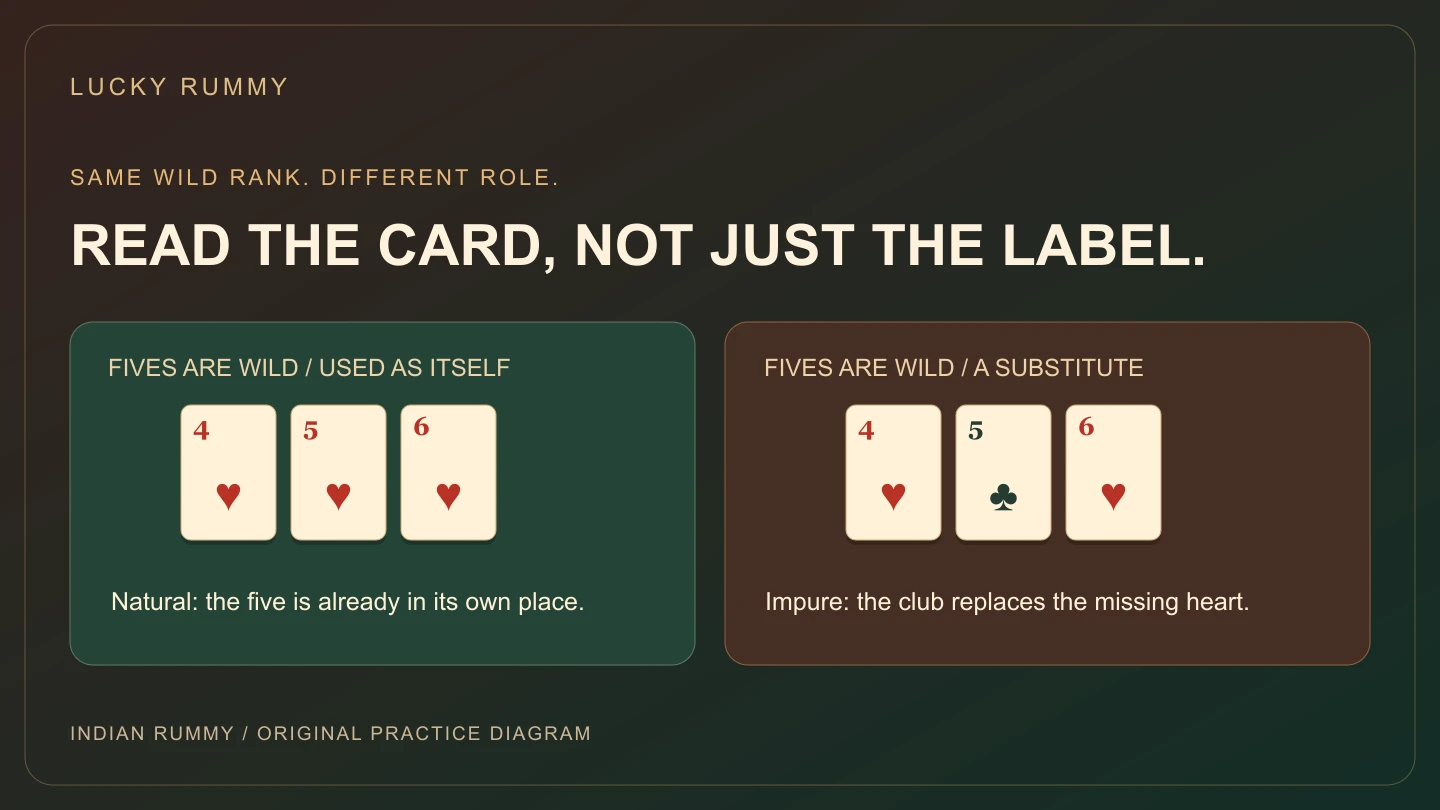
A card can be designated wild without acting as a substitute in every arrangement. The distinction is easy to miss when a learner labels all such cards “jokers” and stops reading their printed rank and suit. Instead, ask what the card is doing in this particular group.
This lesson adopts the convention described in the reference below: a designated wild-rank card used as itself can belong to a natural run. Confirm that convention in your chosen format. The examples are offline exercises, not a statement about Lucky Rummy’s unverified game settings. They exclude special combinations from other variants.
Write the wild rank before looking at the group
For this exercise, designate fives as wild. Write that on a separate note. A 5♥ is therefore eligible to substitute, but it still has a printed identity: five of hearts. The note gives it an additional possible role; it does not erase its own identity.
Now display 4♥ 5♥ 6♥. Read only the printed ranks and suits: four, five, six, all hearts. The middle card already occupies its own position, so no missing card needs a substitute. Under the stated convention this is a natural, or pure, run.
Change the suit while keeping the wild rank
Replace 5♥ with 5♣, leaving 4♥ and 6♥ unchanged. The club cannot serve as the natural five of hearts. It can complete the run only by using its wild ability to represent that missing heart. The arrangement can be an impure run under this exercise’s rules; it is not the same natural run as before.
Write two labels: “printed identity: 5♣” and “represented identity: 5♥”. Different identities reveal the substitution. If you merely write “five”, you hide the suit change that explains the answer. For the broader distinction, revisit the pure sequence guide.
The right suit alone is not enough
Use 9♥ 10♥ 5♥. All three cards have heart symbols, but five is not the next natural rank after ten. If the wild five represents J♥, the group is completed through substitution. The right colour and suit do not turn that replacement into a natural jack.
Apply a two-question test to any proposed natural run: are the actual printed suits the same, and do the actual printed ranks advance consecutively? Only then ask whether a wild substitution is needed. This order prevents the word “joker” from deciding the answer before you inspect the cards.
See why the distinction matters in a whole hand
Keep fives wild and let PJ mean a printed joker. Arrange 4♥ 5♥ 6♥ | 8♣ 9♣ PJ | Q♣ Q♦ Q♠ | 2♠ 3♠ 4♠ 5♠. The total is thirteen. The hearts are natural, PJ can represent 10♣, the queens form a three-suit set, and the four spades are natural with 5♠ serving as itself.
The hand has natural runs despite containing designated wild-rank cards. Now examine each group by its job, not by counting how many cards have a wild label. The label count alone cannot tell you whether the pure-sequence requirement has been met.
For a contrasting full-hand arrangement, use 4♥ 5♣ 6♥ | 8♣ 9♣ PJ | Q♣ Q♦ Q♠ | 2♠ 3♠ 4♠ 5♦. Count thirteen again. In this displayed grouping, 5♣ replaces 5♥ and 5♦ replaces 5♠; PJ remains a substitute. None of the three displayed runs is natural. You cannot approve this layout as a valid declaration simply because each gap has a replacement. This diagnosis concerns the displayed grouping, not an exhaustive search of every possible rearrangement.
Practise explaining the role out loud
Return to the three-card examples and cover the answers. Say “used as itself” or name the exact missing card. Then write whether the run is pure under the stated convention. A precise explanation is more useful than memorising a blanket rule that wild cards always spoil purity.
Use the joker allocation guide for deciding where a substitute helps, and the declaration checklist for checking every group. Practise without stakes; correct identification offers no guarantee of a winning draw.
Rule reference: Pagat: Indian Rummy, Runs and sets, for wild cards used naturally. All comparison fragments and complete-hand exercises here are original.