
A joker on the table is not automatically available because you hold a matching rank. In this no-stakes British Kalookie exercise, identify the whole exchange before moving a card. This is a named tabletop variant, not an Indian Rummy rule or a confirmed Lucky Rummy app feature.
Under Pagat’s British Kalookie rules, a joker in a three-card set can be released using both missing natural suits. You must already have opened, and the released joker must immediately enter another meld or build. It cannot become a spare card in your hand. A four-card set containing a joker is closed against this exchange.
Prepare a table set and a separate hand
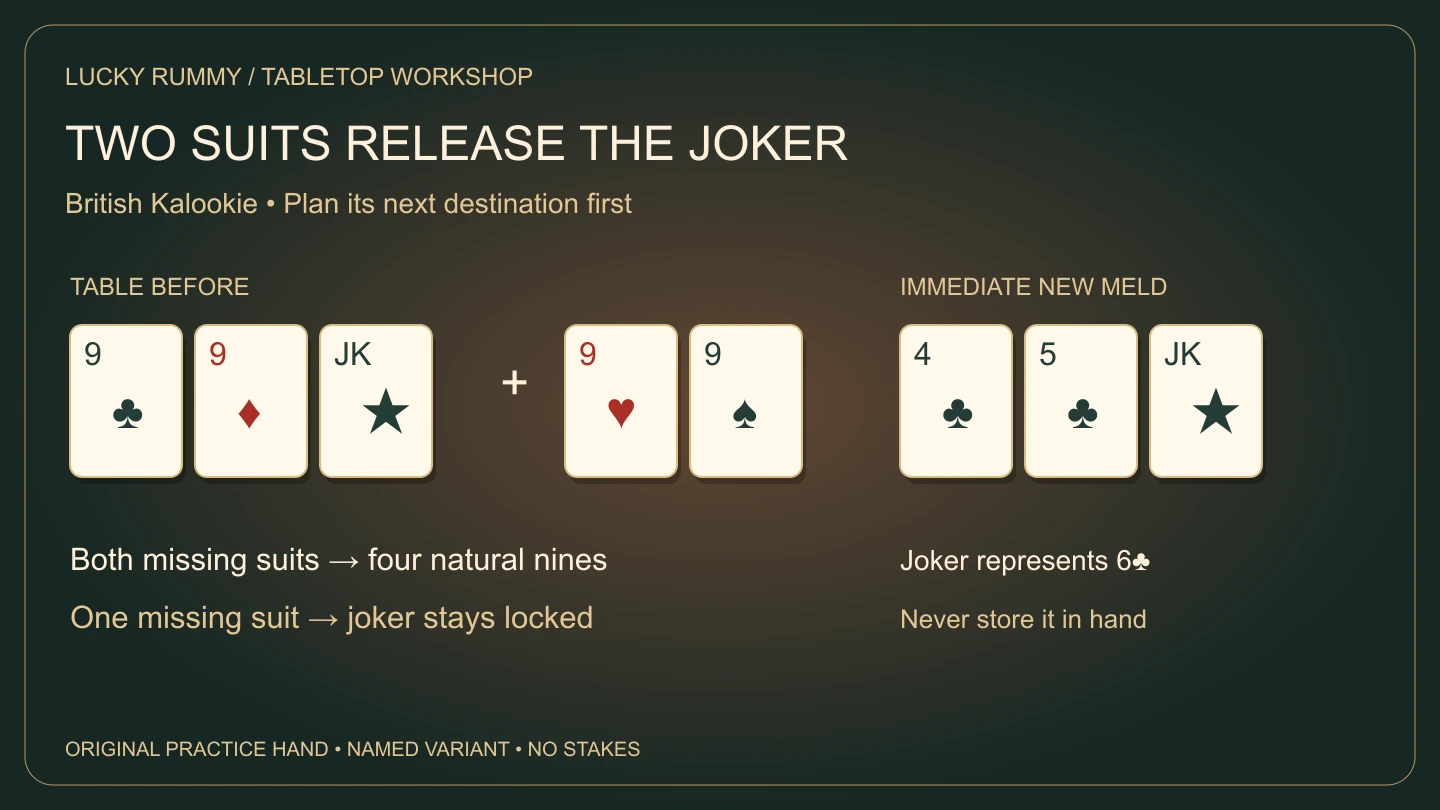
Another player has exposed 9♣ 9♦ Joker. You have completed your own qualifying opening on a previous turn. Your remaining hand before drawing is 9♥ 9♠ 4♣ 5♣ Q♦. Draw 2♥ from the stock. There are now six cards in your hand, plus the three-card set already on the table. The earlier opening stays elsewhere on the table and does not participate in this exercise.
Write the two missing suits beside the nines: hearts and spades. Next write a destination for the joker: 4♣ 5♣ Joker, with the joker explicitly representing 6♣. These are two different checks. Owning both nines permits the exchange; owning the two clubs supplies a place to use its result.
Complete the exchange as one connected action
Replace the table joker with both 9♥ and 9♠. The table set becomes 9♣ 9♦ 9♥ 9♠. Immediately place the released joker with 4♣ and 5♣ to form the declared club run. Do not pause with the joker mixed into the retained hand. Finish the turn by discarding Q♦. Only 2♥ remains in hand; announce that one-card remainder as required in this variant.
Audit the moving cards: six hand cards became two additions to the nines, two natural cards in the new run, one discard and one retained card. Thus 6 = 2 + 2 + 1 + 1. The joker was transferred from an existing table set, not drawn from the stock, so it is not a seventh original hand card. Across the participating hand and table, nine physical cards remain accounted for.
Reset before trying the one-nine shortcut
Return to the original table set. For a separate branch, replace 9♠ in the starting hand with K♠. After drawing 2♥, you hold only one missing nine. Adding 9♥ alone creates 9♣ 9♦ 9♥ Joker; it does not free the joker. That is a closed four-card set. Finding 9♠ on a later turn does not reopen it.
This branch also shows why a legal addition and a useful plan are different questions. You may choose not to make the addition. The exercise does not claim that retaining the nine always wins or is always optimal; it asks you to recognise the irreversible table shape before committing to it.
Check the destination before touching the table
Repeat the main branch with 4♣ 7♣ instead of 4♣ 5♣, and assume there is no other destination. One joker cannot fill both 5♣ and 6♣, so the proposed three-card run fails. Do not exchange first and hope to discover a home afterward. State the complete destination, verify the gap, and only then decide whether the action is available.
Review the 40-point opening exercise if the prerequisite is unclear. For a different task, our Indian Rummy joker-allocation guide concerns arranging cards in your own hand. Keep those two contexts separate. The cover is an original teaching diagram, not a game screenshot.