
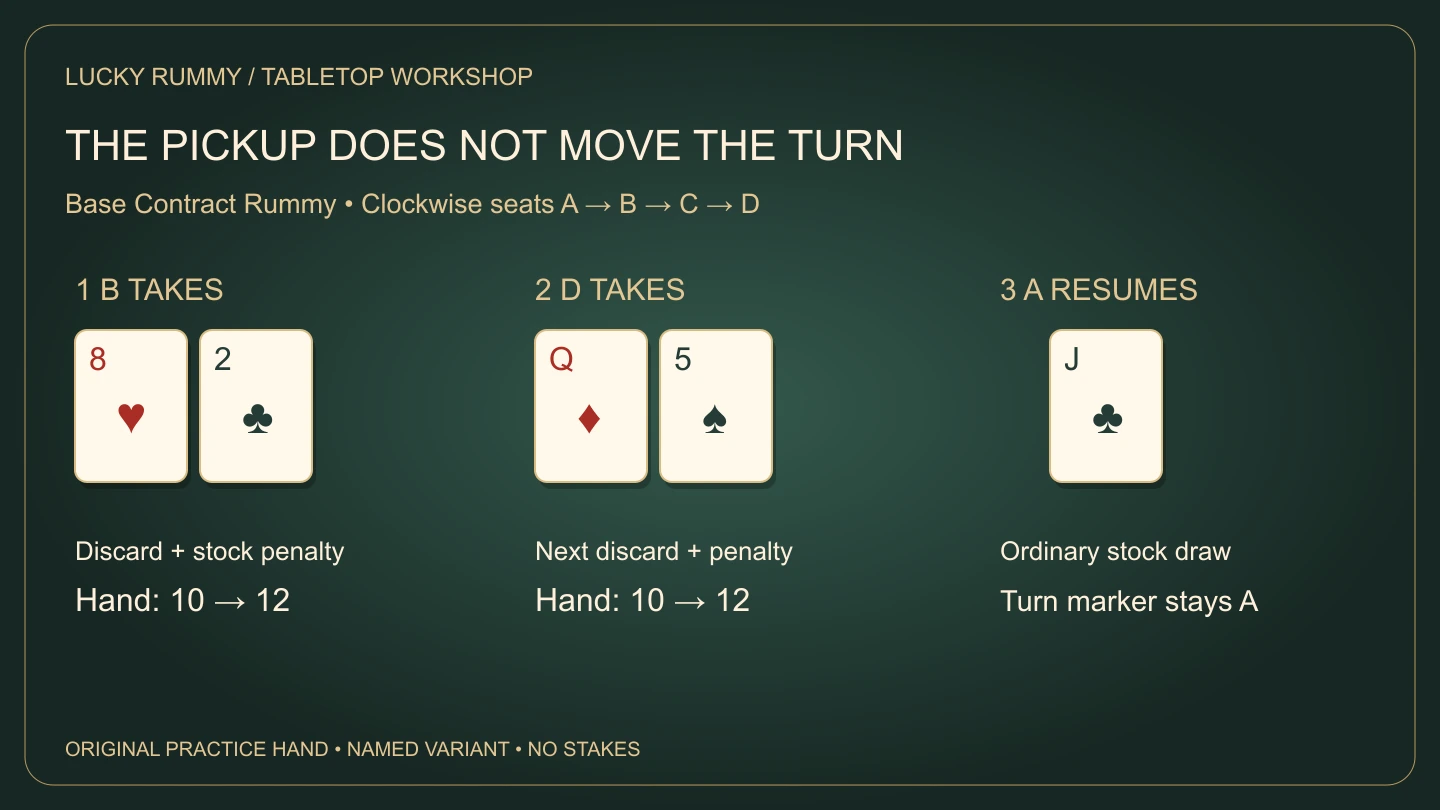
An out-of-turn discard pickup moves cards without moving the ordinary turn marker. Confusing those two events can give someone an extra turn or assign the next stock card to the wrong hand. This original tabletop drill separates the decision, the pickup and the resumed turn. Practise without stakes.
We use the base Contract Rummy procedure in Pagat’s rules. If the current player chooses stock, others may request the top discard; priority follows play order after that player. A successful out-of-turn requester also takes a stock penalty card. The original player waits until these requests finish. If the current player takes the discard instead, others do not get this opportunity.
Place a turn marker beside A
Seat four players in clockwise order A → B → C → D → A. It is A’s turn in an early round, and everyone currently holds ten cards. A chooses to draw from stock. Put a marker beside A but do not move a stock card yet. The top discard is 8♥, with Q♦ immediately underneath it. The prepared stock begins 2♣, 5♠, J♣ in that order.
The stock order is deliberately revealed to the observer in this teaching drill. It is not information a player normally knows. Keep the two piles labelled so that “next card” always names a specific pile. No player melds or lays off during the following scene.
Resolve the request before dealing the stock draw
Both B and D request 8♥. B has priority because B comes before D in the order after A. Give B the 8♥ and the top stock card, 2♣. B’s hand grows from ten to twelve. D receives nothing from this first request. A still has ten cards and the turn marker remains beside A.
Q♦ is now the top discard. For this example, only D requests it. Give D that queen plus the next stock card, 5♠. D also now holds twelve cards. This is a separate pickup of the newly exposed top card, not permission to search through the pile for any preferred card.
Resume A’s turn from the paused point
No one requests the next discard. A now draws J♣, the third card from our original stock list. A has eleven cards. Suppose A makes no meld and discards a K♦ already in hand; A returns to ten. The normal turn then passes to B. Do not jump to D merely because D made the most recent out-of-turn pickup.
Check the three participating hands: A finishes with ten, B with twelve, and D with twelve. C stays at ten throughout. Five cards entered hands from the piles: two discards and three stock cards. One card then left A’s hand. The four hands therefore grew from forty to forty-four cards. That calculation catches a forgotten penalty card.
Change the choice, then reset every pile
Restore the initial stock and discard order. This time A chooses 8♥ from the discard instead of stock. A receives that one card without an out-of-turn penalty card. B and D do not receive 8♥ or Q♦ through the interrupted-turn procedure. If A discards K♦ without melding, all four players still have ten cards and the stock still begins with 2♣.
For another rules check, ask whether B could take Q♦ immediately after B’s first pickup in the original scene. In this procedure the same player cannot take two successive discards out of turn. Do not use our later D pickup as evidence that one requester may simply collect the whole pile.
Record requests, recipients and stock cards in separate columns. A pickup is not itself an opening: see the complete-contract opening exercise before exposing groups. Our discard timeline lesson offers a different Indian Rummy context; do not transfer this out-of-turn permission to that game. The app’s support for this variant is unconfirmed. The cover is a teaching diagram, not a screenshot.