
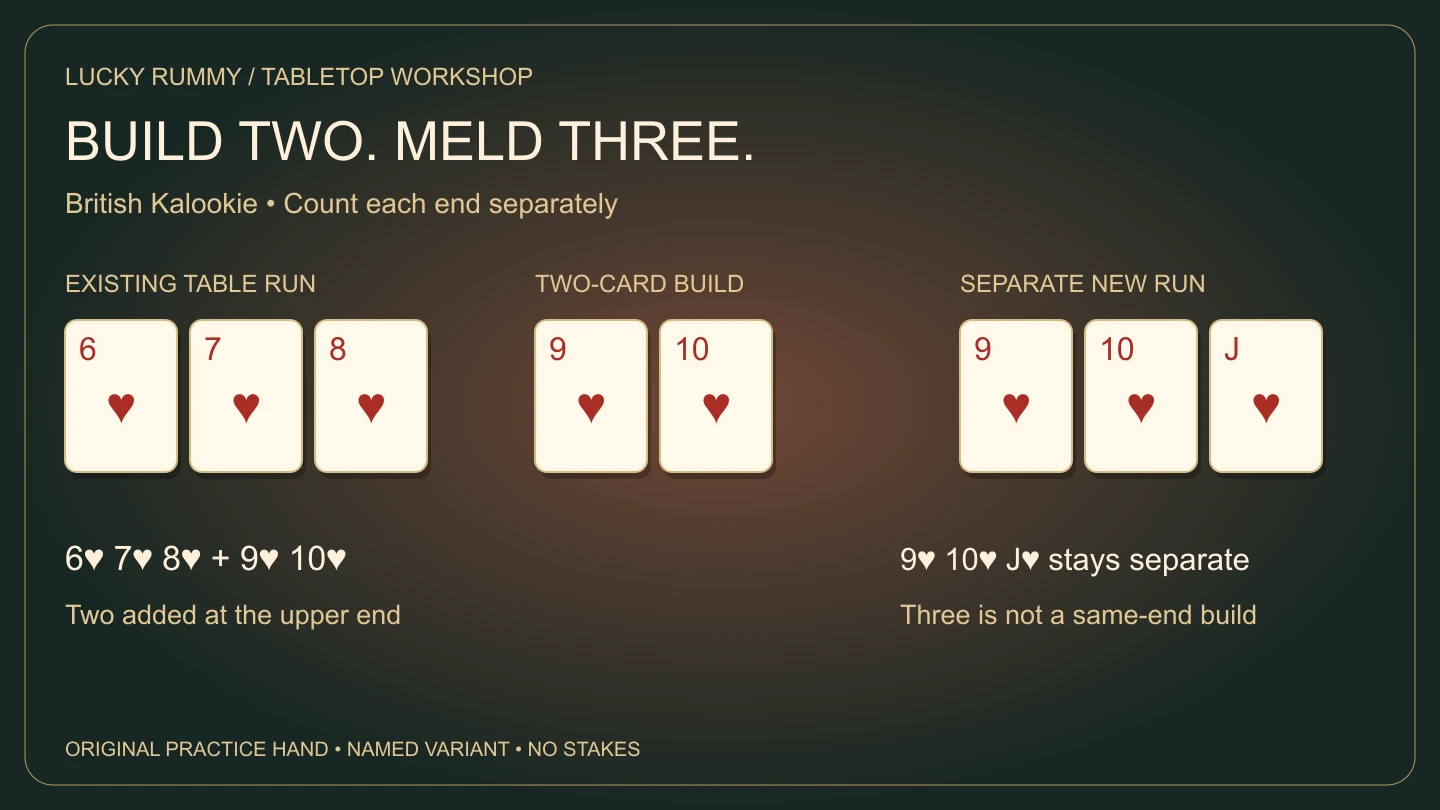
You hold three consecutive hearts that fit neatly after a run already on the table. Should you attach them all? In British Kalookie, the number of cards being added matters, even when the resulting row would have no gap. This lesson uses an original no-stakes exercise; it does not describe a confirmed Lucky Rummy app mode.
The boundary comes from Pagat’s British Kalookie building rules: after opening, you may build on table runs, but no more than two cards may be added to the same end of a run in one turn. Three or more consecutive cards go down as a new run instead. The limit is per end, not a blanket limit of two cards moved during the turn.
Decide the action before extending the row
Assume you completed your qualifying opening on a previous turn. A table run contains 6♥ 7♥ 8♥. Your remaining hand is 9♥ 10♥ J♥ 2♣ Q♦. Draw K♠ from the stock. There are six hand cards to manage, and none is a joker. The other cards from earlier play stay outside this small exercise.
Point to the upper end of the table run: 8♥. The proposed addition 9♥ 10♥ J♥ has three cards at that one end. Moving 9♥ first, then 10♥, then J♥ does not turn it into three separate turns. The count belongs to the whole turn, so that proposed build fails.
Use the three hearts as their own run
Place 9♥ 10♥ J♥ together in a separate row. They already form a valid natural run without borrowing 8♥ from the table. Leave the old 6♥ 7♥ 8♥ row intact. Discard K♠. Your retained hand is 2♣ Q♦, so the hand count balances as 6 = 3 newly melded + 1 discarded + 2 retained. Announce the two-card remainder as required by this variant.
Keep a visible gap between the two rows during practice. That gap represents two table melds, not a missing rank. The point is to choose the correct operation, rather than to hide an impermissible three-card build behind a different label. Do not take the old table cards back into your hand to redesign them.
Reset with only two connecting cards
For a separate branch, start with 9♥ 10♥ 2♣ Q♦ in hand and the original table run. Draw K♠. There are now five hand cards. Add 9♥ and 10♥ to the upper end of 6♥ 7♥ 8♥, then discard K♠. Two cards remain, and 5 = 2 built + 1 discarded + 2 retained. Here the addition itself is permitted because it uses only two cards at that end.
The branches remove different numbers of cards from different starting inventories. Do not use the first branch’s six-card total to check the second. Write the hand before the draw on paper, cross off each moved card once, and compare the two remaining cards at the end.
Check both ends separately
Try one final classification exercise. Against the original 6♥ 7♥ 8♥ run, consider 4♥ 5♥ at the low end and 9♥ 10♥ at the high end. That proposes two cards at each end, not four at one end. The per-end limit does not by itself reject it. This is an action check, not a complete turn: you would still need a legal hand, a draw and a final discard.
If you are still learning the prerequisite, work through the Kalookie opening-count lesson. The rule-sheet checklist helps keep this table-building permission separate from Indian Rummy hand grouping. These examples explain a rule boundary; they do not establish a universally best move. The cover is an original card diagram, not a game screenshot.