
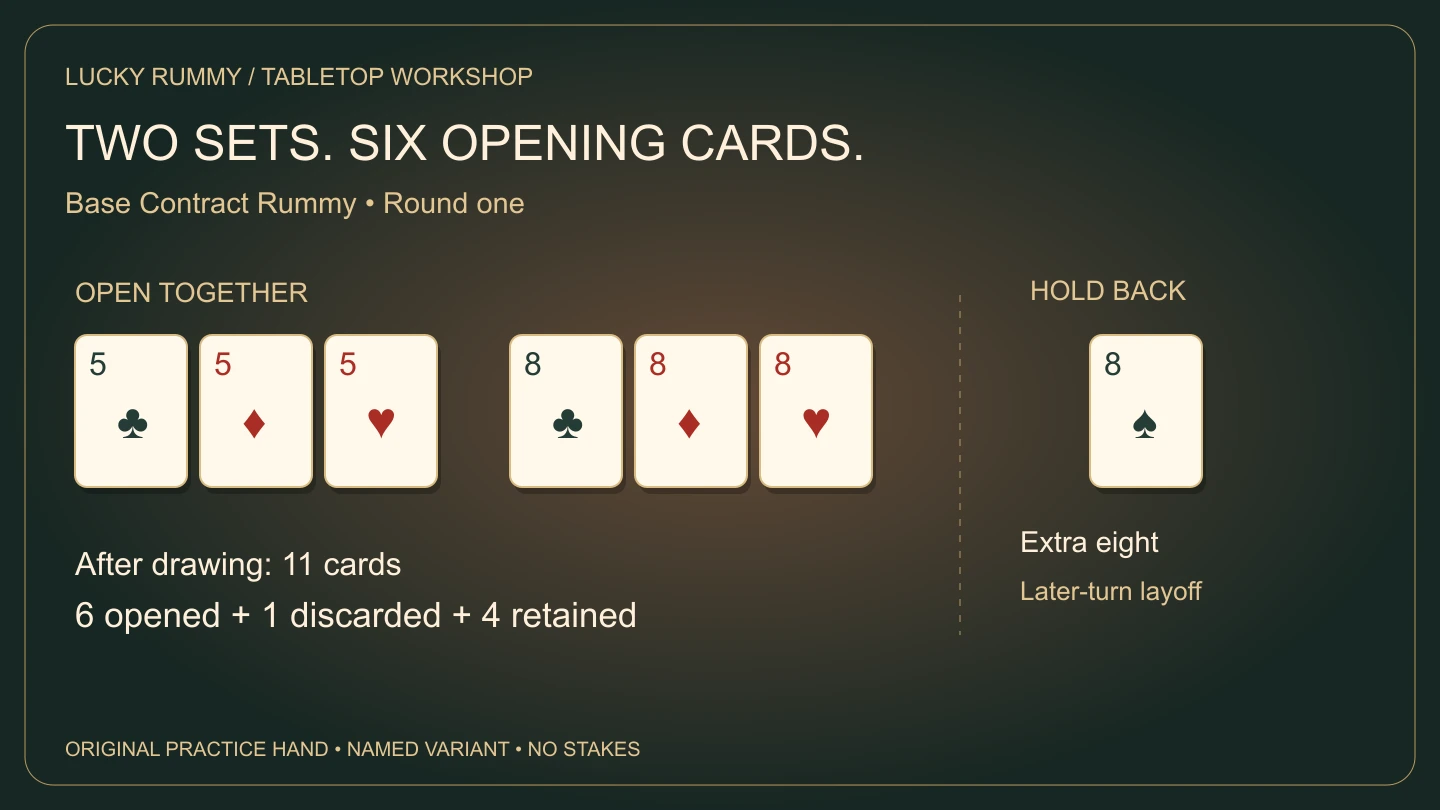
An extra matching card can be useful without being playable yet. This exercise examines the first opening in the base Contract Rummy rules described by Pagat. It is a no-stakes tabletop lesson about timing, not a Lucky Rummy app feature or an Indian Rummy declaration guide.
In this version, round one begins with ten cards and requires two three-card sets. Open the complete contract together, using the minimum six cards. Laying off extra cards becomes available on a later turn, not on the opening turn. Pagat’s Contract Rummy page also describes variants with different opening permissions; check which section your group follows.
Give the extra eight its own space
Arrange this ten-card hand: 5♣ 5♦ 5♥ / 8♣ 8♦ / 8♠ / 2♥ 4♣ 9♦ K♠. The separate 8♠ is still in the same hand; its spacing is a teaching device. For the main branch, draw 8♥ from the stock. Nobody makes an out-of-turn pickup in this exercise. There are now eleven physical cards to account for.
Write the opening as Set A = 5♣ 5♦ 5♥ and Set B = 8♣ 8♦ 8♥. These six cards meet the stated shape. Keep 8♠ next to the four unmatched cards, even though its rank clearly matches Set B. A matching rank answers where a card could go; it does not answer when it may go there.
Count the first turn before advancing
Place only the two selected three-card sets on the table. Discard K♠. The cards left in hand are 8♠ 2♥ 4♣ 9♦, so the count is 11 = 6 exposed + 1 discarded + 4 retained. You have opened the contract, not finished the round. Labelling this a win would lose track of four real cards.
Two tempting shortcuts both fail the stated timing test. Exposing only the fives does not complete the two-set opening. Exposing all four eights with the fives uses seven cards instead of the minimum six. Do not describe that seventh card as a same-turn layoff to evade the restriction.
Resume only if play reaches your next turn
Suppose nobody has gone out and the action returns to you. Draw 3♣ from the stock. Your five cards are now 8♠ 2♥ 4♣ 9♦ 3♣. Add 8♠ to the exposed eights, then discard 9♦. The retained hand is 2♥ 4♣ 3♣: three cards. This turn balances as 5 = 1 laid off + 1 discarded + 3 retained.
The earlier six-card opening is still on the table; it was not taken back and formed again. Put a small “opened on previous turn” marker beside it during practice. That marker is a memory aid for this lesson, not a proposed official game component. It helps distinguish two visually similar positions that have different action histories.
Reset for an incomplete-contract test
For a separate branch, remove 8♠ from the original ten-card hand and replace it with Q♦. Draw 3♣ instead of 8♥. You now have three fives but only two eights. Keep the fives in hand rather than treating them as half an opening. If you discard K♠, ten cards remain; none has been exposed. This branch tests completeness, while the main branch tests the timing of the spare fourth eight.
Ask a partner to record three things before moving cards: the required opening shape, the exact six selected cards, and whether an opening occurred on a previous turn. For a familiar contrast, see our four-card set lesson for Indian Rummy; its declaration context is different. Use the hand-change ledger to practise tracking the counts without importing one game’s permissions into another.