A total can be arithmetically right and still answer the wrong rules question. This tabletop exercise separates new combinations from cards added to an existing combination. Use counters or paper cards; no stakes are needed. It concerns British Kalookie as described by Pagat, not standard Indian Rummy and not a confirmed Lucky Rummy app mode.
For this named format, the opening requires new melds worth at least 40 points. Additions to table melds do not supply missing opening points, although building is possible after opening on that turn. Number cards count their printed values; face cards count 10. See Pagat’s British Kalookie rules for the full game.
Mark the hand and the table separately
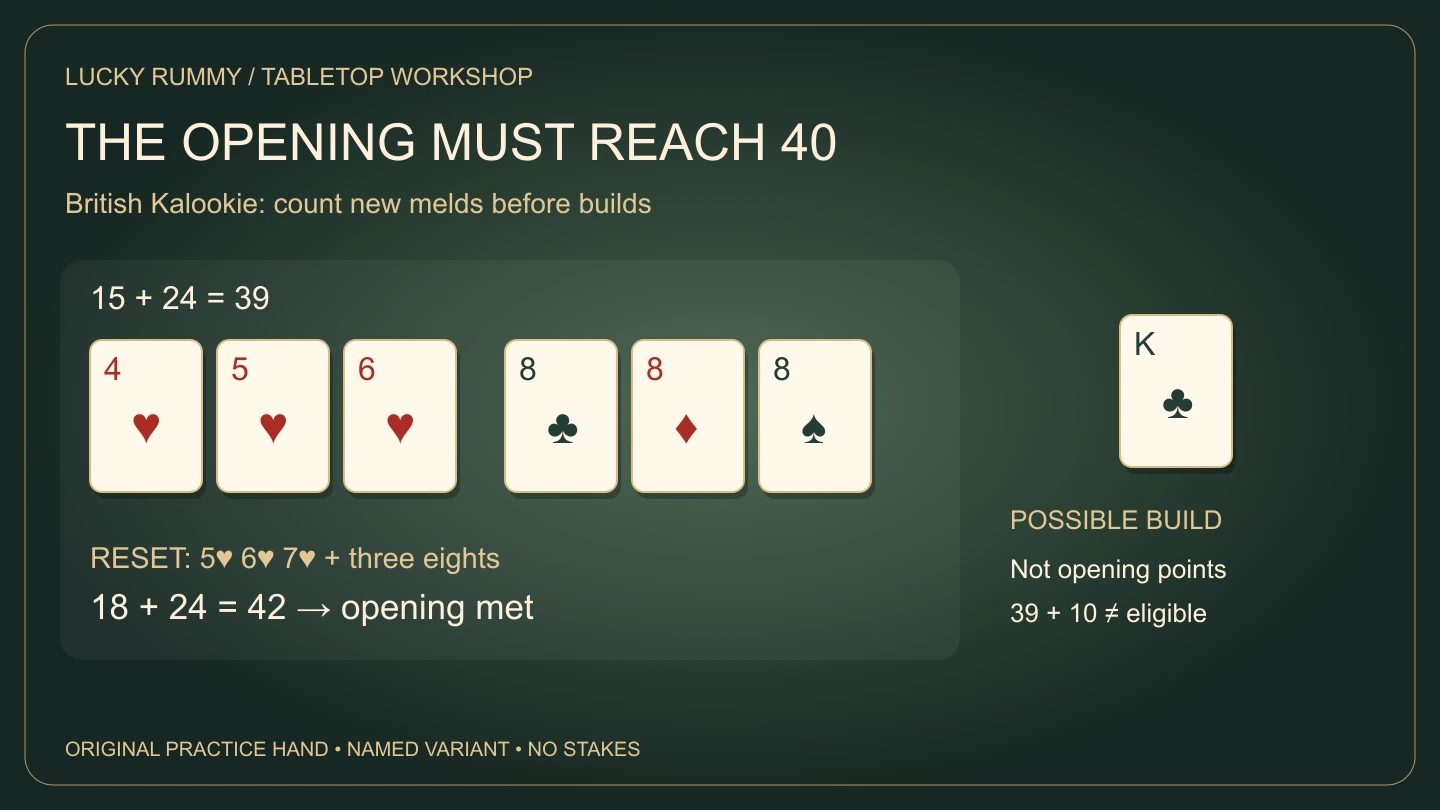
Start with these thirteen cards: 4♥ 5♥ 6♥ / 8♣ 8♦ 8♠ / K♣ / A♦ 2♠ 7♦ 9♣ J♦ Q♠. The slashes are worksheet separators. Across the table, another player has already exposed K♥ K♦ K♠. Your K♣ could extend that group, but it is not part of a new combination made entirely from your hand.
Write three headings on paper: “new melds”, “possible build”, and “cards retained”. Put 4♥ 5♥ 6♥ and the three eights under the first heading. Put K♣ under the second. Leave the last six cards under the third. Do not physically move any of them to the table yet: this is a proposed opening, not an accepted one.
Reject the tempting 49-point answer
The heart run contributes 4 + 5 + 6 = 15. The eights contribute 8 + 8 + 8 = 24. Together, the new melds total 39. Adding the king gives an attractive 49 on the worksheet, but the king belongs in a different column. The relevant comparison is 39 against 40, so this proposal falls short by one.
For a complete unsuccessful turn, suppose the stock draw is 2♦. There are now fourteen cards in hand. This draw creates no extra qualifying combination in the supplied layout. Keep the proposed melds in hand and discard Q♠. Count thirteen retained cards and zero newly exposed cards. Writing “49” must not cause seven cards to disappear from your hand.
Reset and test a genuinely different draw
Restore the original thirteen-card hand before the second branch. This time draw 7♥ from the stock. Replace the proposed heart group with 5♥ 6♥ 7♥, worth 18. Alongside the three eights, the new total is 18 + 24 = 42. Now the opening threshold is met without borrowing the king’s value.
Expose those six opening cards. You can then build K♣ onto the table’s three kings in this example. Discard Q♠. The retained cards are 4♥ A♦ 2♠ 7♦ 9♣ J♦: six cards. The audit is 14 = 6 opening cards + 1 build + 1 discard + 6 retained. Nothing was counted twice, and the opening subtotal remains 42 rather than 52.
Use the columns to diagnose the mistake
Cover the worked answers and ask a partner to identify which action the king belongs to. Then ask what changed between the two branches. The useful explanation is that 7♥ raised the new-meld subtotal by three through a different heart run; it did not change the opening rule. Repeat with the card positions shuffled so that visual proximity cannot decide the answer.
Keep this worksheet labelled “British Kalookie, 40-point opening”. Other variants require a different check. For a reusable record of that boundary, use our rule-sheet checklist. Return to the separate Indian Rummy rules guide when practising Indian Rummy declarations; this opening threshold should not be transferred to them.