
Two cards of the same rank are not necessarily an identical pair. The dublee route in the Marriage variant of Rummy requires a stricter match: each pair must contain two actual copies with the same rank and suit. Counting names without counting physical cards can create a pair that does not exist.
This no-stakes exercise follows Pagat’s described eight-dublee ending, not ordinary thirteen-card Indian Rummy. Eight real pairs occupy sixteen cards; the described finish allows five other cards plus a discard after the draw. Wild substitution cannot manufacture an identical pair. This does not confirm a Lucky Rummy game mode.
Prepare seven pairs and seven single cards
Use two physical copies of each of these seven identities: 3♣, 4♦, 5♥, 6♠, 8♣, 9♦, Q♥. Label the copies A and B on paper. The seven pairs use fourteen cards; the labels distinguish copies without changing their rank or suit.
Add seven single cards: J♠, 2♥, 7♣, 10♦, K♣, A♦, 3♥. Fourteen paired cards plus seven singles gives a starting inventory of twenty-one. None of the singles matches another single or one of the seven pair identities. Keep this entire inventory visible as a teaching diagram.
Supply the missing copy from the stock
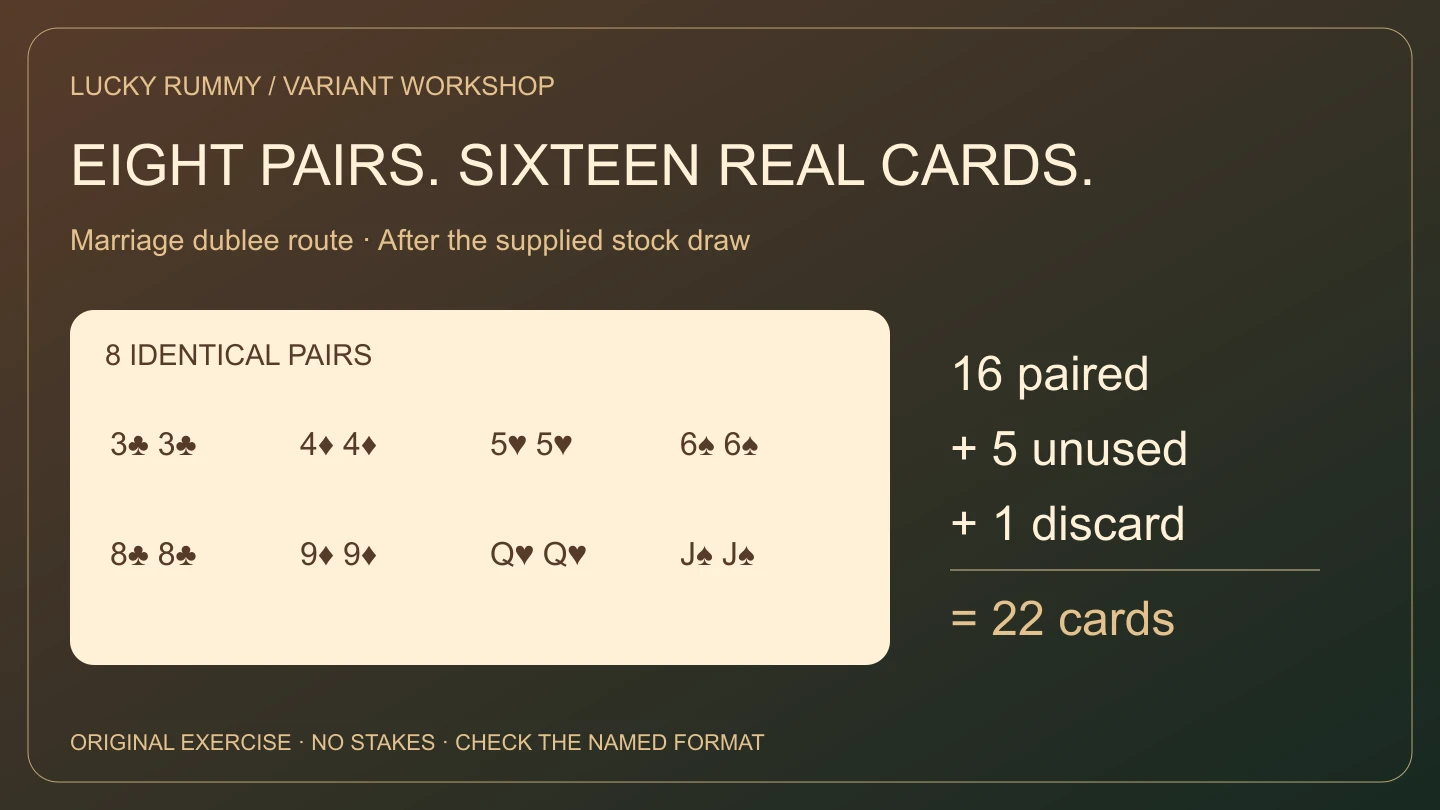
For the worked ending, supply a second physical J♠ as the stock draw. The original J♠ and the new J♠ now form the eighth pair. The other seven pairs stay unchanged. You have twenty-two physical cards immediately after drawing.
Lay out the eight pairs and designate A♦ as the discard. The five other unused cards are 2♥, 7♣, 10♦, K♣, 3♥. Audit the count: 16 paired + 5 unused + 1 discard = 22. The chosen discard is a supplied bookkeeping example, not a scoring recommendation.
This exceptional ending does not mean five loose cards are permitted in a standard Indian Rummy declaration. The format label changes the question. Keep the normal thirteen-card checklist separate from this named Marriage route.
Reject a same-rank substitute
Reset to the twenty-one-card starting inventory. Supply J♥ instead of J♠. The new jack shares a rank with J♠ but not its suit, so it does not form the eighth identical pair. The inventory now has seven pairs and eight singles.
Nor may you label some other wild card “J♠” to fill the space. An assigned role is not the second physical copy required here. Our Marriage wild-card classification lesson answers which cards are wild; that classification does not override this pair requirement.
Catch a shared-copy mistake
In a separate small test, lay out three copies of 3♣ labelled A, B and C. You can select A–B, A–C or B–C as a pair. You cannot count two of those choices simultaneously: they share a card. Three copies supply one disjoint pair and one spare card, not two pairs.
Check each pair with two questions: do both rank and suit match, and has either physical copy already been used? Put a tick beside each copy only once. This is more reliable than repeatedly circling the same printed identity.
Keep pickup permissions outside the count
The worked example deliberately supplies a stock card. It does not establish permission to take any visible discard. Marriage has additional dublee-route procedures, so check the relevant rules before practising a pickup from the open pile. Correct pair arithmetic alone does not authorise a move.
Reference: Pagat: Marriage, Dublees and Ending the Play. The complete inventory, wrong-jack test and copy audit are original exercises. No scores, payments or outcome promises are assigned.