
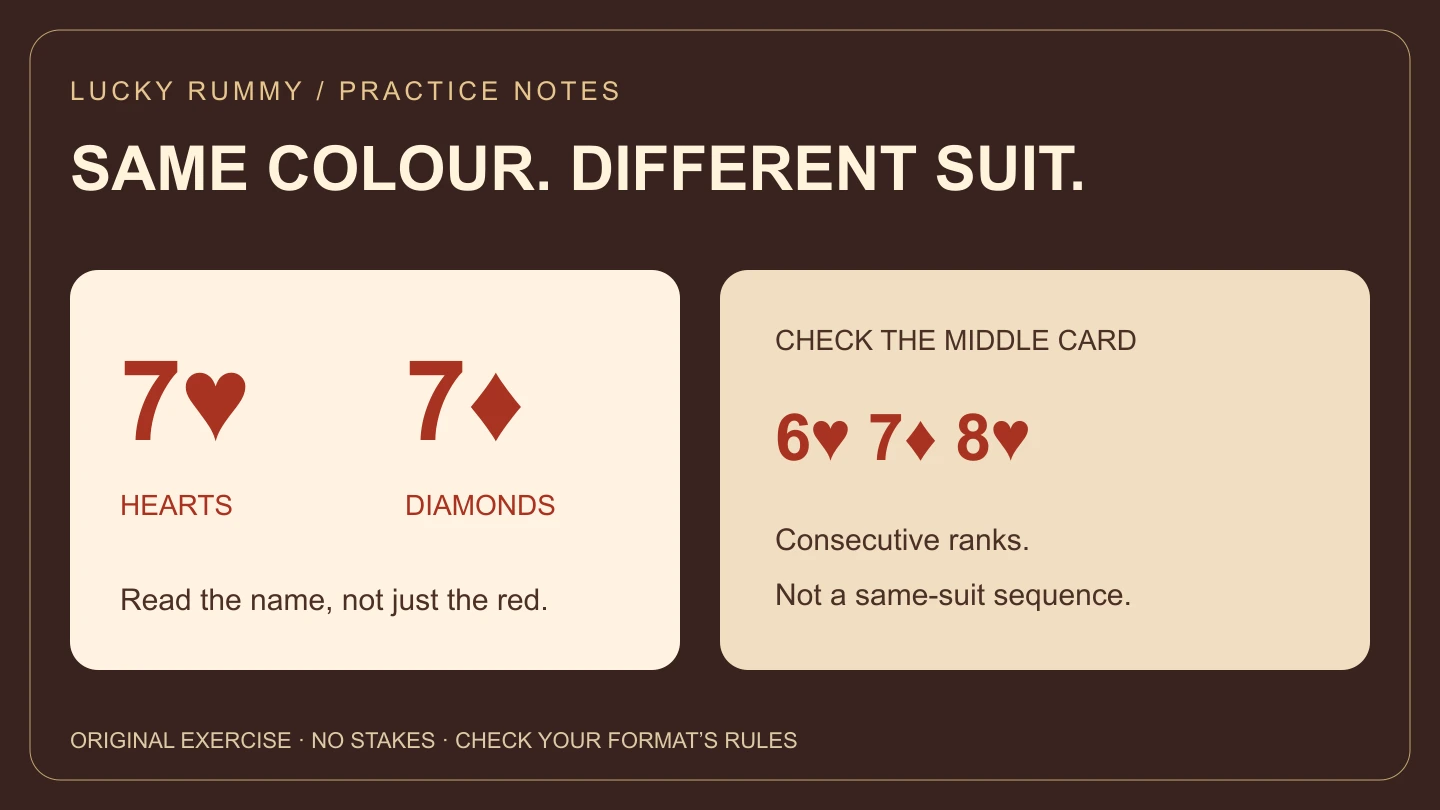
A red seven is not a complete card description. It could be 7♥ or 7♦, and those cards can do different jobs in a Rummy hand. When a small screenshot or a quick spoken explanation hides the suit, a correct-looking answer can rest on a transcription mistake.
This no-stakes drill checks card reading before strategy. Use ordinary runs of at least three consecutive cards in one suit, and sets of equal ranks in different suits. Twos are wild, with no twos or printed jokers in the examples. Check your game’s own rules separately; this exercise does not describe a particular app’s display settings.
Name both parts of every card
Read ♣ as clubs, ♠ as spades, ♥ as hearts and ♦ as diamonds. In a conventional two-colour deck, clubs and spades are both black; hearts and diamonds are both red. Colour narrows the possibilities but does not identify the suit.
Write 7♥ = seven of hearts and 7♦ = seven of diamonds on separate slips. Ask a partner to read them aloud without using “red seven.” For a text worksheet, append the suit name if a symbol is hard to distinguish. Increasing text size helps only if the source symbol itself is clear.
Test same-colour near misses
Compare 6♥ 7♥ 8♥ with 6♥ 7♦ 8♥. The first is a natural sequence. The second has consecutive ranks and three red cards, but it is not a same-suit sequence. The middle diamond cannot be treated as a heart merely because both are red.
Now compare Q♣ Q♦ Q♠ with Q♣ Q♦ Q♣. The first is a three-suit set. The second repeats clubs, so it fails the different-suit condition in this exercise. Two black queens in the first list are allowed because clubs and spades are different suits; two club queens in the second are not made different by being separate physical copies.
Read back a complete hand in two passes
Use 6♥ 7♥ 8♥ | 4♣ 5♣ 6♣ 7♣ | Q♣ Q♦ Q♠ | 9♣ 9♦ 9♠. Count 3 + 4 + 3 + 3 = 13. The first two groups are natural sequences; the last two are three-suit sets. No card is allocated twice.
First, read each rank and full suit name while a partner checks the source. Second, cover the source and explain each group using the written list. This separates reading the cards correctly from understanding the group. If the first pass is wrong, repair the transcription before grading the second.
For the error version, change only the written 7♥ in the first group to 7♦. The count remains thirteen and the rank totals do not change. Nevertheless, that displayed group is broken. Counting alone cannot catch a wrong suit. This example evaluates the shown layout, rather than claiming every possible rearrangement has been tested.
Handle unclear screenshots without guessing
If a symbol is cropped, blurred or obscured, record “suit unclear” and obtain a clearer source before solving. Do not invent the suit from the surrounding group you hope to build. In your own teaching sheets, keep rank and suit together, use adequate spacing, and supply text equivalents instead of relying on colour alone.
Keep a short correction such as “read spade as club,” rather than “bad strategy.” Repeat the missed pair once with full names. The duplicate-card guide explains why copies still need distinct accounting, while the pure-sequence lesson covers the grouping rule after the symbols are clear.
Rule reference: Pagat: Indian Rummy, Runs and sets. The reading procedure and error worksheet are original.