
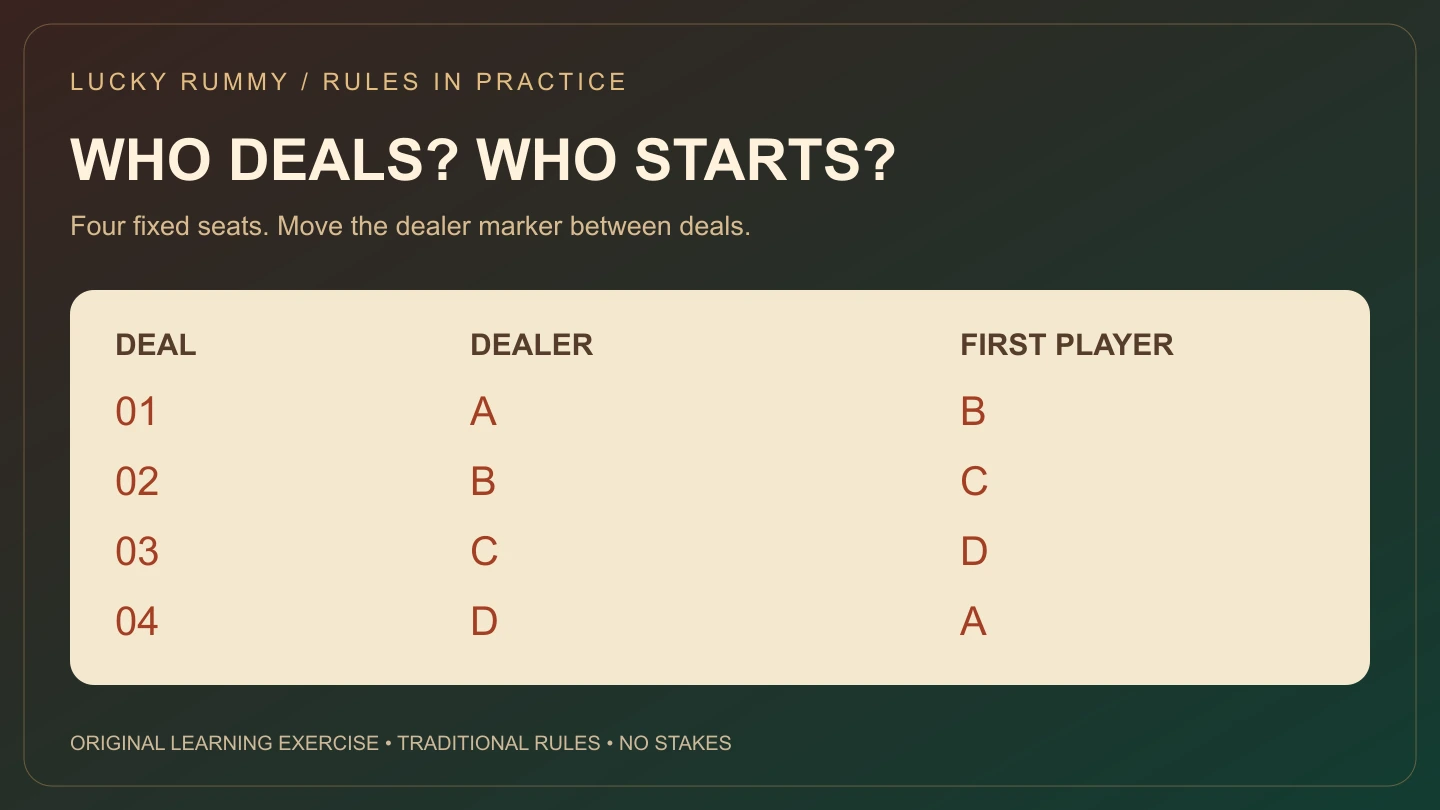
A familiar mistake at a practice table is to move the dealer marker correctly but let the same person act first again. Dealer, first recipient and first player are related roles, but they are not interchangeable labels.
This no-stakes lesson follows the counter-clockwise procedure documented in Pagat’s traditional Indian Rummy description. It does not establish the seating or interface behaviour of Lucky Rummy. If your chosen format specifies another direction, write that rule before using a different worksheet.
Define the order before drawing a diagram
Label four occupied seats A, B, C and D in counter-clockwise order as viewed from above. Write the cycle A → B → C → D → A. The letters name seats, not card ranks. Keep each learner in the same seat throughout this exercise.
For inward-facing players in this arrangement, the next seat in the written cycle is the seat to the current player’s right. Use the arrow as the reference instead of pointing toward the right edge of your screen. A diagram rotated on the table should not reverse the cycle.
Work through the first deal
Place the dealer marker at A. Under the selected procedure, the first card goes to B, then C, D and A. Repeat that distribution thirteen times, one card per person on each pass. The last card in the thirteenth pass goes to A.
Each player now has thirteen cards: 4 × 13 = 52 hand cards. That is not the complete pack count. With the stated two decks of 53 cards, a separate indicator and an opening discard leave 52 stock cards: 106 − 52 − 1 − 1 = 52. The two equal numbers refer to different locations.
B takes the first turn. The turn order is B, C, D, A, continuing around the same cycle while those players remain active. Do not make A act first simply because A dealt. Use numbered paper slips to rehearse the distribution without exposing real concealed hands.
Move the marker between deals, not between turns
After the first deal has ended and the cards are gathered for a new deal, move the dealer marker from A to B. Now C receives the first card and acts first. For the third deal, C deals and D starts; for the fourth, D deals and A starts.
The four rows of the answer key are dealer A / first B; dealer B / first C; dealer C / first D; dealer D / first A. Everyone has dealt once after those four completed deals. One trip around the players during a single deal is only a cycle of turns, not this four-deal round.
Catch a skipped seat before continuing
Give a partner the faulty distribution B, C, A, B. Ask which seat was skipped and which received two cards. D was skipped and B received two. In an open teaching drill, reset the slips and repeat the pass. This does not prescribe a remedy for an actual misdeal; use the relevant game’s procedure rather than quietly repairing concealed cards.
Keep a two-column note for dealer and first player beside the beginner turn guide. The practice-table setup helps check the other card locations. If a participant leaves, stop this fixed four-seat exercise and agree the next procedure separately.
Reference: Pagat: Indian Rummy, Deal and The play. The four-seat worksheet, arithmetic and error drill are original.