
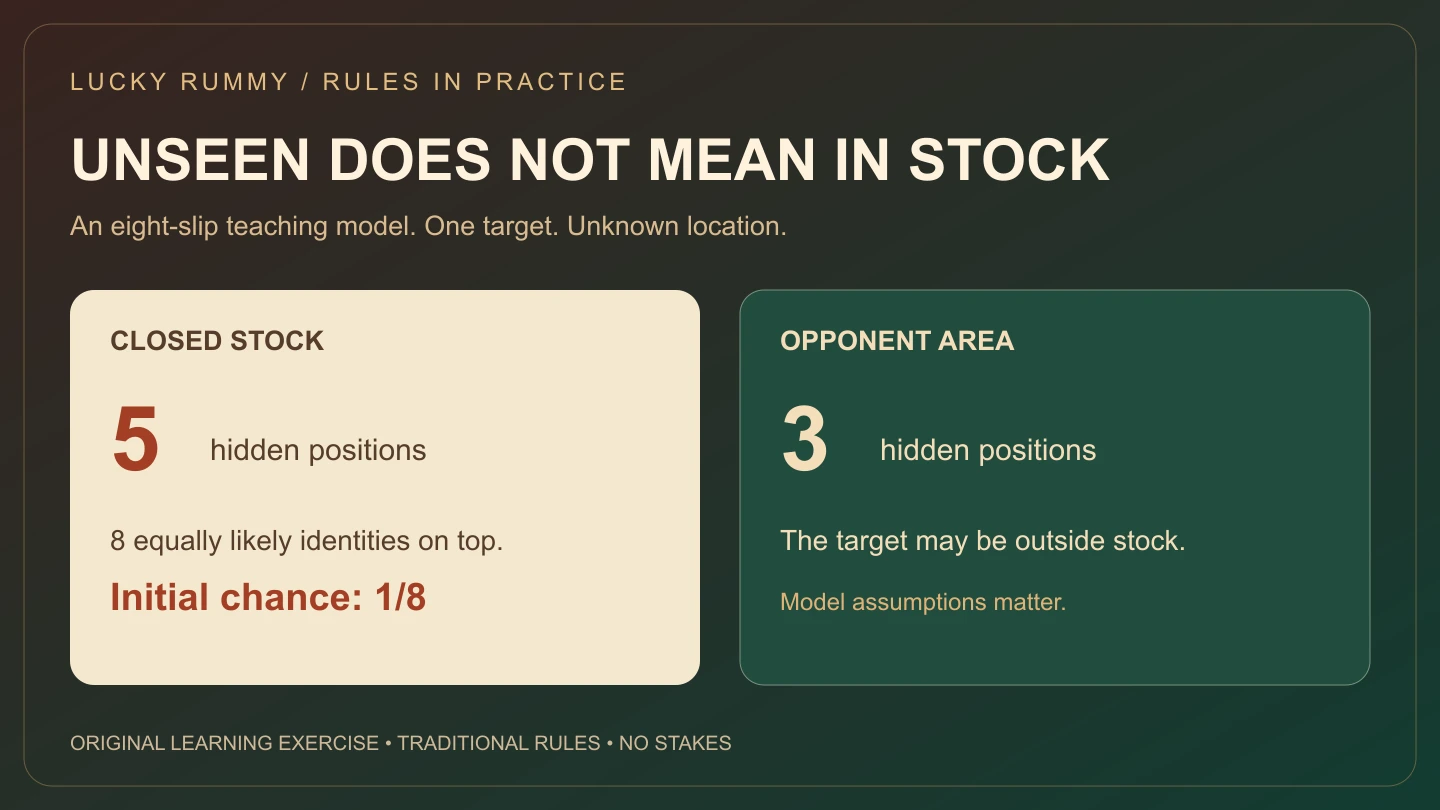
You can know how many cards remain in the stock without knowing which cards they are. Some unseen cards may be in another player’s hand. Treating every card you have not seen as a stock card confuses location with information.
This is a no-stakes counting lesson, not a live-game odds calculator. Pagat’s Indian Rummy description distinguishes concealed hands from the closed stock. The small model below deliberately reduces the hidden portion to eight cards so every assumption can be checked. It is not a complete rummy deal.
Define the hidden pool before drawing
Take eight paper slips representing eight different physical cards: 6♣, 2♦, 3♠, 4♥, 8♦, 9♣, J♥, K♠. Let 6♣ be the single target. Shuffle all eight slips uniformly, place five face down in a stock area and three face down in an opponent area. Do not inspect either group.
You know the stock has five cards. You also know eight card identities are still unlocated between the two areas. Those counts answer different questions. The target has not been confirmed as one of the five stock cards.
Compare three information states
Before seeing any positions, the chance that the top stock slip is the target is 1/8 under this random setup. Each of the eight equally likely slips could occupy that position. Using 1/5 would wrongly assume that the target is definitely in the stock.
Now imagine a teacher checks privately and tells you only that the target is somewhere in the five-card stock. Conditional on that new fact, the top-card chance becomes 1/5, provided the stock’s order remains random. If the teacher instead confirms that the target is among the opponent’s three slips, the top-card chance is zero.
These are three different information states, not three estimates to choose from according to preference. Write the new fact beside the fraction whenever you change the denominator.
Check the original answer another way
In the initial random model, the target is in the stock with probability 5/8. Given that it is there, it is on top with probability 1/5. Multiplying gives (5/8) × (1/5) = 1/8. This check accounts for the possibility that the card is outside the stock.
To test the model without chance, place each of the eight distinct slips on top once and shuffle the remaining seven beneath or into the other area. Across those eight controlled top positions, exactly one is the target. This is an illustration of equal possibilities, not a promise that eight random trials produce exactly one hit.
Why this does not become an exact table percentage
During actual play, players choose which cards to keep, pick up and discard. That history can change what is known about the hidden locations. A count of five stock cards alone does not establish our uniformly shuffled eight-slip model, nor does it establish that one target remains in the stock.
Keep a worksheet distinction between “known in stock”, “known elsewhere” and “location unknown”. If you only know a card has not been seen, put it in the last category. Identical copies also need separate physical counts; naming one rank and suit is not the same as counting all its copies.
The known-packet probability exercise starts from a different assumption: a specified packet. The opponent-pickup guide explains why an observation does not reveal a whole concealed hand. Use those lessons to state what you know before writing a fraction.
Reference: Pagat: Indian Rummy, The play, for separate concealed hands and stock. The eight-slip model and conditional calculations are original mathematical exercises, not product statistics.