
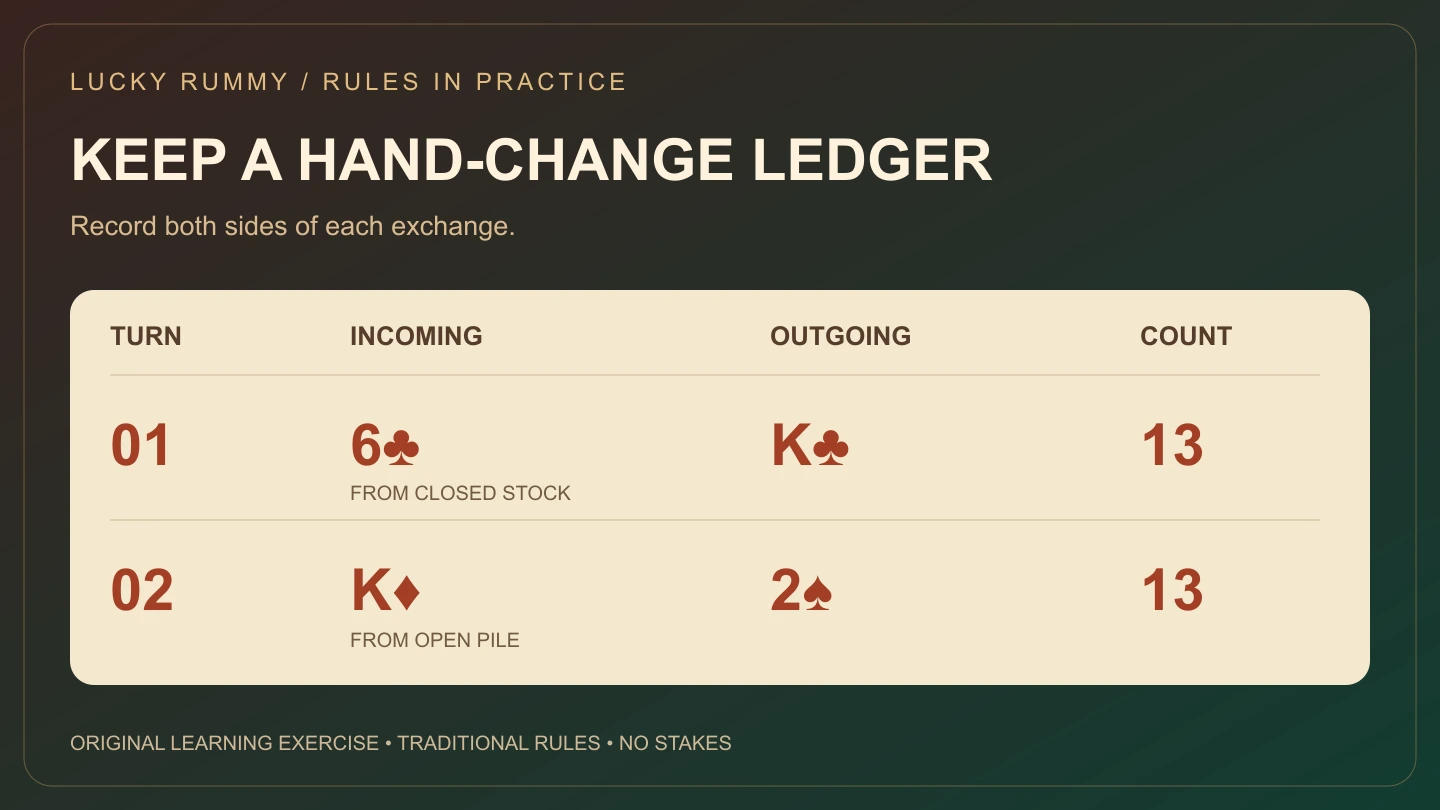
A hand can contain thirteen cards and still be recorded incorrectly. If you write down a new card but forget which old card left, the count may look right while the card identities are wrong. A short change ledger makes the error visible.
This offline exercise follows the ordinary thirteen-card draw-and-discard procedure described by Pagat. It is not a recommendation for a money game or a claim that Lucky Rummy provides a replay tool. Use paper and a face-up teaching hand, then check the exact rules of any format separately.
Write the starting inventory once
Start with 3♥ 4♥ 5♥ | 7♣ 8♣ | 9♦ 9♥ 9♠ | J♦ Q♦ | 2♠ 6♥ K♣. The bars are sorting aids, not declarations that every section is a valid group. There are thirteen physical cards. For this exercise, aces are wild, but none appears in this hand.
Give your sheet four columns: turn, incoming card and source, outgoing card, resulting hand. Keep the starting inventory above the table. You should be able to reconstruct the hand without needing a photograph from every turn.
Record the first change as an exchange
On your first turn, draw 6♣ from the closed stock and discard K♣. Write both actions before rearranging the cards. The intermediate count is fourteen; the ending count returns to thirteen.
The new inventory is 3♥ 4♥ 5♥ | 6♣ 7♣ 8♣ | 9♦ 9♥ 9♠ | J♦ Q♦ | 2♠ 6♥. Notice that 6♣ and 6♥ are different cards. A note saying only “picked six” is too vague to reproduce this state.
Apply the next change to the updated hand
Before your next turn, another player leaves K♦ on top of the open pile. Pick up that K♦ and discard 2♠. The final inventory becomes 3♥ 4♥ 5♥ | 6♣ 7♣ 8♣ | 9♦ 9♥ 9♠ | J♦ Q♦ K♦ | 6♥.
The hand still has thirteen cards, but 6♥ is ungrouped. Four three-card groups account for only twelve cards here. The ledger proves the inventory; it does not certify a declaration. Use the declaration checklist for that separate question.
Find a mistake by reversing the ledger
Ask a partner to undo turn two: remove K♦ and restore 2♠. Then undo turn one: remove 6♣ and restore K♣. The result must match the starting inventory card for card. If your reconstructed hand contains both kings or lacks 6♥, trace the corresponding incoming or outgoing entry.
A common transcription error is to remove 6♥ when adding 6♣. That preserves a total of thirteen but is not the recorded exchange. Checking only the number of cards cannot catch it. Compare rank and suit together on every line.
In a multi-deck lesson, assign identical copies worksheet labels such as A and B if the exercise requires tracking them separately. Do not mark the backs of playing cards. The duplicate-card guide explains that distinction, and the practice journal helps separate observed actions from later guesses.
Reference: Pagat: Indian Rummy, The play, for the ordinary draw-and-discard procedure. All inventories, exchanges and reverse-check steps above are original exercises.