
A player leaves a practice hand, and someone puts their cards beside the discard pile. Can the next player pick them up? The answer depends on the withdrawal procedure, not on where the packet happens to be lying. A dropped hand needs a recorded destination.
This lesson uses the packing procedure in Pagat’s traditional Indian Rummy description. It is an offline, no-stakes exercise. Online formats can use different drop rules, penalties and card handling; the examples do not describe a verified Lucky Rummy feature.
Identify the moment before moving the cards
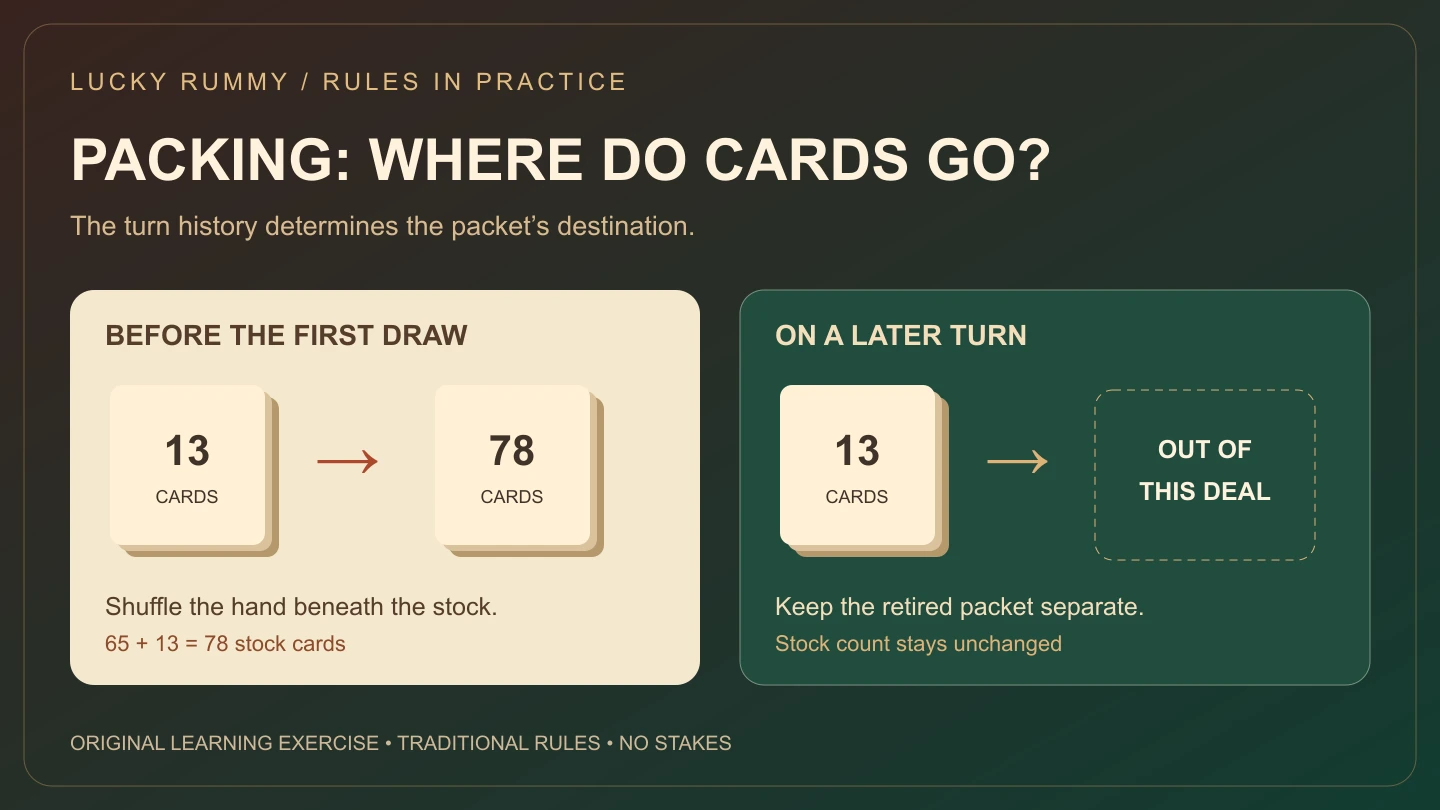
Under this particular procedure, packing happens at the start of a player’s turn instead of drawing. Packing before that player’s first draw returns their shuffled thirteen-card hand to the bottom of the stock. Packing on a later turn puts the hand aside, face down, outside the continuing deal.
The reference also assigns different point penalties to those cases. This exercise studies the movement of cards only. Do not treat its packet counts as a score or a payment instruction. For a different table, check its own instructions before moving anything.
Exercise A: the first draw has not happened
Set up an inventory with three hands of thirteen cards, one indicator, one open discard and a stock of 65 cards. The total is 39 + 1 + 1 + 65 = 106. Choose an ordinary indicator, such as 8♣, and keep it separate from the discard.
Before drawing on her first turn, Mira packs. Collect her entire thirteen-card hand as one packet. Shuffle that packet, then place it beneath the existing stock. Do not shuffle the whole stock or expose those cards as a new discard pile.
The new inventory is 26 + 1 + 1 + 78 = 106. Two players still hold thirteen cards each. The original top stock card remains the next stock draw; putting a packet underneath has not brought it to the top.
For a visible teaching check, give Mira a 4♦ among her thirteen cards. Mark its identity in the instructor’s private worksheet before shuffling the packet. It is now somewhere in the bottom thirteen cards, not necessarily last. Learners should not turn the stock over to find it during concealed play.
Exercise B: a later turn
Reset the complete pack. Use a separate, consistent snapshot from later in a three-player practice deal: 39 cards in hands, one indicator, four discards and 62 stock cards. Again, the total is 106. Dev has already completed a draw-and-discard turn.
At the start of Dev’s next turn, he packs. Put his thirteen cards face down in an area labelled “out of this deal”. The stock stays at 62. The check now reads 26 + 1 + 4 + 62 + 13 = 106, with the last term representing the retired packet.
If Dev held 4♦, that physical copy cannot later appear as a stock draw from this packet. Another copy may still exist in a two-deck game. Recording a retired copy therefore does not prove that both copies of the same rank and suit have gone.
Catch the two common bookkeeping errors
First, count thirteen cards before moving either packet. A player who has already drawn has a different turn state; do not quietly call that an early pack. Pause the exercise and consult the applicable procedure. Second, keep the retired area separate from the open discard pile. A face-down packet beside the pile is not a new legal pickup.
At the end of the lesson, reunite every area, including the retired packet, and count the full pack before the next deal. Our practice table setup explains the starting inventory. The discard-pile timeline explains why only the current open top card is available from that pile.
Reference: Pagat, Indian Rummy: Packing. The named players, inventories and two packet-tracing exercises are original teaching examples.