
A face-up teaching table makes every card easy to see. It can also teach the wrong habit if learners start treating the whole table as one shared hand. A useful lesson needs two labels for every visible card: whose card it is, and why it is visible.
This guide uses the concealed-hand Indian Rummy procedure described in the reference below. Players do not place completed groups on the table during ordinary play. An open teaching demonstration changes what learners can see; it does not silently change ownership or permit new moves. Check your selected format’s instructions rather than assuming this describes every rummy variant or Lucky Rummy setting.
Mark hand areas before revealing cards
Put down two paper mats labelled “my practice hand” and “partner’s practice hand”, plus separate stock, discard and indicator areas. Announce that the hands are open only for this demonstration. Do not use this open-information setup to simulate a normal hidden-information decision.
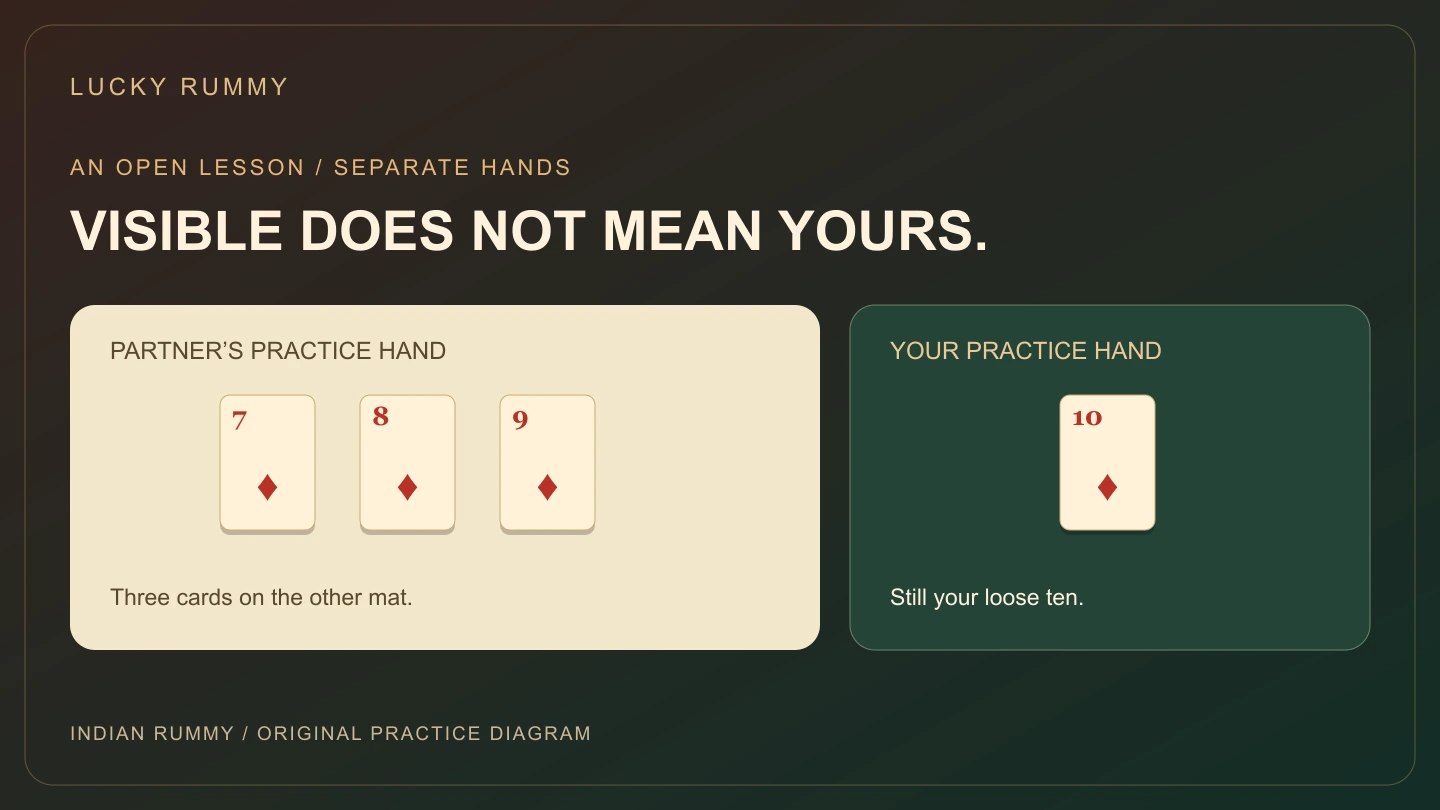
Place 7♦ 8♦ 9♦ on the partner’s mat and 10♦ on yours. These are fragments, not complete thirteen-card hands. The four ranks could form a natural run if one player actually held all four, but their locations show that nobody in this exercise holds that four-card group.
Do not attach a loose card to another hand
Move your 10♦ close to the partner’s row without transferring it, then ask what has changed. Only the display changed. The partner’s three cards have not become yours, and your loose ten has not acquired a place in your own complete hand.
Under the concealed-hand procedure used here, adding that ten to a partner’s exposed teaching run is not an extra way to get rid of it during a turn. Keep the normal draw-and-discard action separate from the lesson’s rearrangement. Some other rummy games have table-melding procedures; a familiar visual pattern is not permission to import them into this exercise.
Contrast another player’s card with the open discard
For a new fragment, put 10♦ J♦ in your hand area. First place Q♦ on the partner’s mat. It would be useful to your pair, but usefulness does not authorise taking it. Next reset the illustration and place Q♦ as the top discard instead. Under the stated ordinary pickup procedure, that location makes it a possible draw on your turn.
The rank and suit stayed the same; the card’s status changed. You did not discover a stronger sequence by moving it in the lesson. You changed which action the rules allow. Read the open and closed pile walkthrough for completing the turn after a legal pickup.
Audit one thirteen-card inventory
Count this practice hand: 3♣ 4♣ 5♣ | 8♥ 9♥ 10♥ | Q♣ Q♦ Q♠ | 2♠ 3♠ 4♠ | 10♦. There are twelve cards in four complete three-card groups and a loose ten. A partner displaying 7♦–8♦–9♦ elsewhere does not remove your loose card or complete your own thirteen-card arrangement.
If a learner claims the ten is “already used”, ask them to point to the group entirely inside their own mat. That question exposes the ownership error without guessing a future draw. Do not correct it by inventing a transfer from the other mat or by ignoring the thirteenth card.
End the demonstration explicitly
Before returning to concealed practice, collect the example fragments and reconcile the deck inventory. Remove the explanatory mats if they are no longer needed. A previously visible practice position should not be treated as secret knowledge about a newly dealt hand.
For a quick verbal check, point to a card and ask: whose card; visible for what reason; available through which permitted action? “I can see it” answers none of those questions by itself. “It would help me” answers a different question about usefulness.
Continue with the practice-table setup and whole-hand declaration check. Keep lessons offline and without stakes. Clear ownership prevents a learning mistake; it does not guarantee a game outcome.
Rule reference: Pagat: Indian Rummy, The play, for concealed groups and draw sources. The labelled mats, contrasting locations and inventory audit are original teaching exercises.