
A practice hand is harder to understand when nobody knows whether the face-up card is the discard or the joker indicator. Before studying a move, give every pile a clear job. This guide builds an offline, no-stakes learning table that you can pause, count and reset.
We use the two-deck, 13-card convention described in the source below: two standard decks, each with one printed joker. Other packs contain different numbers of jokers, and table procedures vary. This is a stated practice setup, not a claim about Lucky Rummy’s software or available modes.
1. Inventory the pack before shuffling
Make two separate stacks of 52 ordinary cards and add one printed joker to each. The total is 106 physical cards. Check that a third joker or an advertising card has not slipped in. If your decks have matching backs, mark their boxes rather than writing on individual card backs; a visible mark can reveal a card during play.
Use four empty hand areas for this exercise. Put paper labels in the centre for “indicator”, “stock” and “discard”. These labels are learning aids. They are not extra game cards and should never enter the shuffled pack.
2. Separate the indicator from the discard
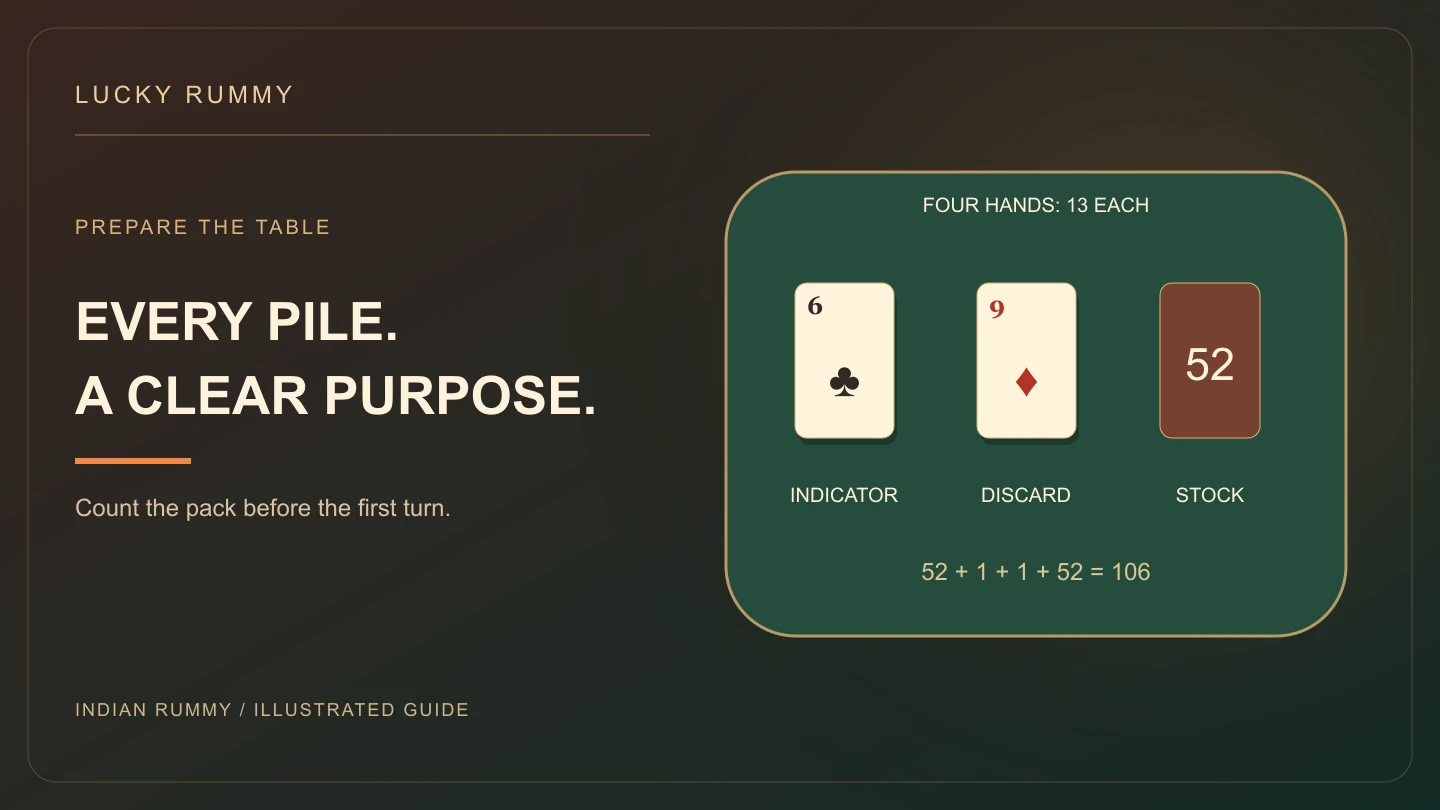
For the first teaching deal, deliberately choose 6♣ as the indicator and leave it face up in its labelled area. This is a controlled demonstration rather than a random deal. Under the selected convention, sixes are wild; the physical indicator stays outside the players’ hands.
The discard pile has a different purpose: its top card is a possible pickup on a turn. Draw an arrow on the indicator’s paper label saying “names the wild rank; not the open pickup”. A learner should be able to point to each area and explain its purpose before continuing. For ordinary play, use the selection procedure agreed for that table instead of choosing a convenient indicator.
3. Deal and prove the count
After setting aside the indicator, shuffle the remaining 105 cards. Deal thirteen to each of the four hand areas. Turn one further card face up to start the discard pile and place the rest face down as the stock. You should now have 52 cards in hands + 1 indicator + 1 discard + 52 stock cards = 106.
This equation catches a surprisingly common setup error. If you have counted the indicator as the first discard, your labels and arithmetic no longer describe the same arrangement. Pause and reconcile the pack. Do not fix an unexplained shortage by quietly dealing an extra card from a different deck.
Keep each learner’s thirteen cards together. Grouping a hand for study does not create communal melds that other players can borrow. If you want everyone to see an example, explicitly switch from concealed play to a face-up teaching demonstration.
4. Use a deliberately simple first display
Suppose the first discard is 9♦. Ask three questions: which card sets the wild rank, which card is available from the open pile, and where would an unseen draw come from? The answers are 6♣, 9♦ and the face-down stock respectively. Confusing 6♣ with 9♦ changes the meaning of the whole hand.
Next ask a learner to count their hand without making a move. Only after everyone has thirteen should you practise the draw-and-discard sequence. Keep the exercise free of money, scores and time pressure so a counting error can be investigated immediately.
5. Reset cleanly between exercises
Return every hand, both central piles and the indicator to the inventory area. Count 106 again. Collect any demonstration cards left beside a notebook before starting another deal. Use a fresh label if the wild rank changes; do not let yesterday’s note override today’s indicator.
For the next lesson, open the rules overview and the joker guide. Setup makes the table readable; it does not by itself establish a valid hand or predict a result.
Rule reference: Pagat’s Indian Rummy description, especially Players and Cards and Deal. The four-player inventory audit and labelled teaching exercise above are original examples.