
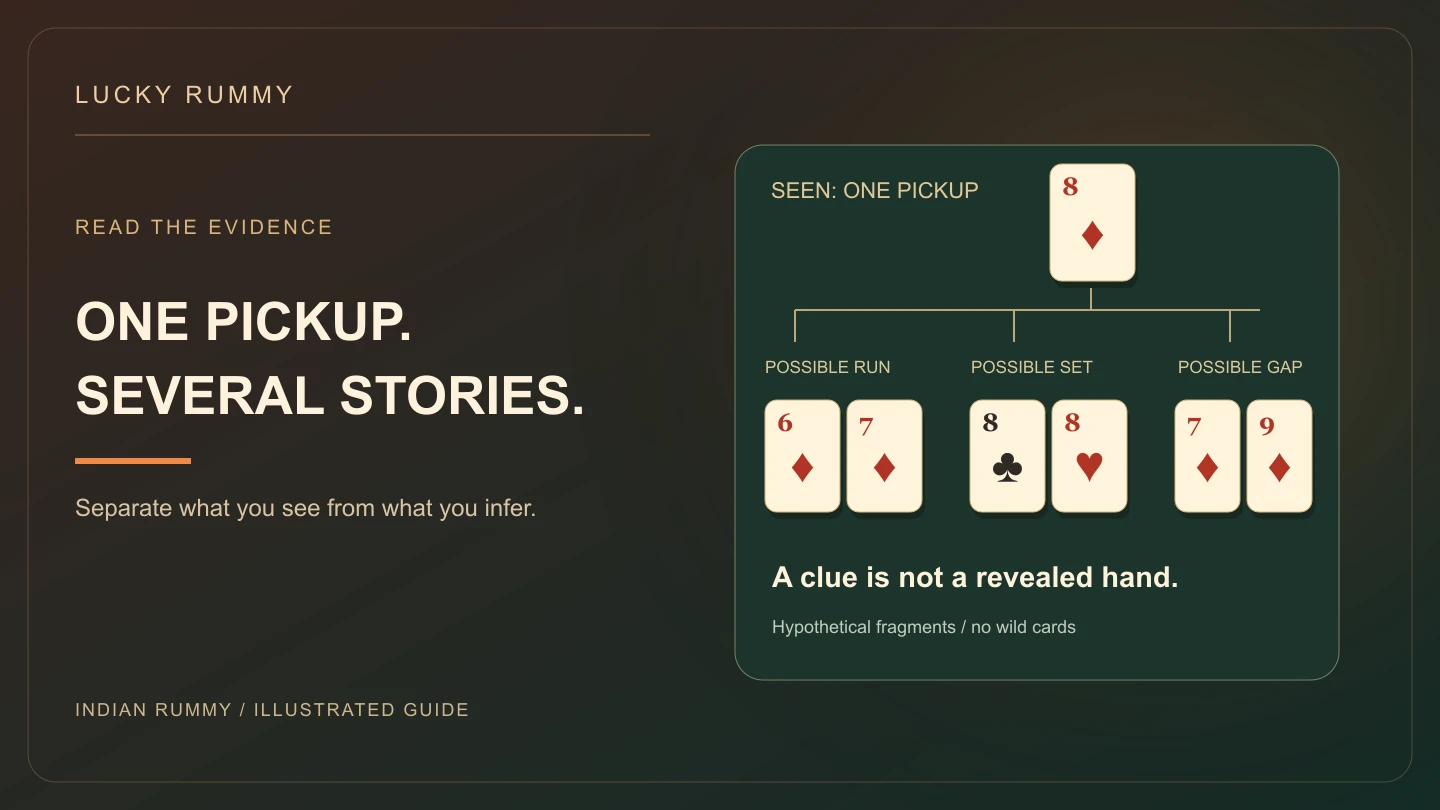
An opponent takes 8♦ from the open pile. It is tempting to think, “They must have 6♦ and 7♦.” That is one possible explanation, but it is not the observation. The observation is only that this player selected that visible card at that moment.
This offline lesson is about interpreting public information. It uses ordinary natural sequences and different-suit sets; none of the illustrated cards is wild. We deliberately reveal invented hand fragments for teaching. In a real game those fragments would remain unknown, and no outside tracking or assistance should be used where the table prohibits it.
Write the fact before the explanation
On a practice sheet, make two columns: “seen” and “possible”. Under seen, write “picked up 8♦”. Under possible, write a proposed use. Do not put “needs 9♦” in the seen column unless that need was actually established by information the rules made public.
The distinction sounds small, but it changes how confidently you should act. A public choice can narrow your attention without revealing an entire hand. For the mechanics of that choice, review the open-pile walkthrough.
Construct three explanations for the same card
Fragment A: an imagined opponent holds 6♦–7♦. Adding 8♦ completes a natural three-card run. Fragment B: another possible hand contains 8♣–8♥. The same pickup completes a set. Fragment C: a third contains 7♦–9♦, and 8♦ fills its internal gap.
These are alternative hidden situations, not three groups you know the player holds. All explain the same observed pickup. None proves the rest of a thirteen-card hand is complete. A player may also take a card for an unfinished plan, so even “they completed a group” is an inference rather than a certainty.
Put the three fragments on separate slips and have a practice partner choose one secretly. Reveal only the pickup. If you cannot identify the slip from that single fact, you have demonstrated the uncertainty directly rather than just being told to be cautious.
A passed discard does not certify a safe future card
Suppose 9♦ was visible on an earlier turn but the player chose the closed stock. Later you are considering a 9♦ discard. Their earlier choice does not prove the card is now useless: their hand may have changed, their priorities may have changed, or the earlier card may simply have been less attractive than an unknown draw to that player.
To illustrate a changing hand, begin with a hidden practice fragment 6♠–7♠ and then, in a later reconstructed position, use 7♦–8♦. This is not a claim about how the entire intervening game unfolded. It is a counterexample to the assumption that an earlier lack of interest permanently fixes a player’s needs.
Use clues to compare choices, not to invent certainty
When reviewing your own hand offline, first identify the cards that matter to your existing groups. Then compare the public clue against the weak candidates you already have. Do not tear apart a required pure sequence solely because one opponent picked up a diamond. The clue does not reveal every diamond in their hand.
If your candidates are 9♦ and K♣, the observed 8♦ pickup gives a reason to inspect the diamond connection, but not enough information for a universal discard recommendation. Your own groups, other public actions and table rules still matter. The full-hand discard example covers that separate decision.
Finish with a confidence test
For each interpretation, ask: what did I actually see; can I construct another legal explanation; what information would distinguish them? If the second answer is yes and the third is unavailable, retain uncertainty. Do not convert one pickup into an unsupported percentage or a claim that a card is “guaranteed safe”.
In your practice notes, record the original observation before revealing the teaching fragment. Credit yourself for a careful explanation even when your first guess was not the selected one. The exercise trains reasoning about incomplete information, not mind-reading or guaranteed results.
Rule reference: natural runs and sets in Pagat’s Indian Rummy rules. The alternative fragments and confidence exercise are original analysis. Cover: hypothetical explanations for one pickup, not an actual opponent’s hand.