
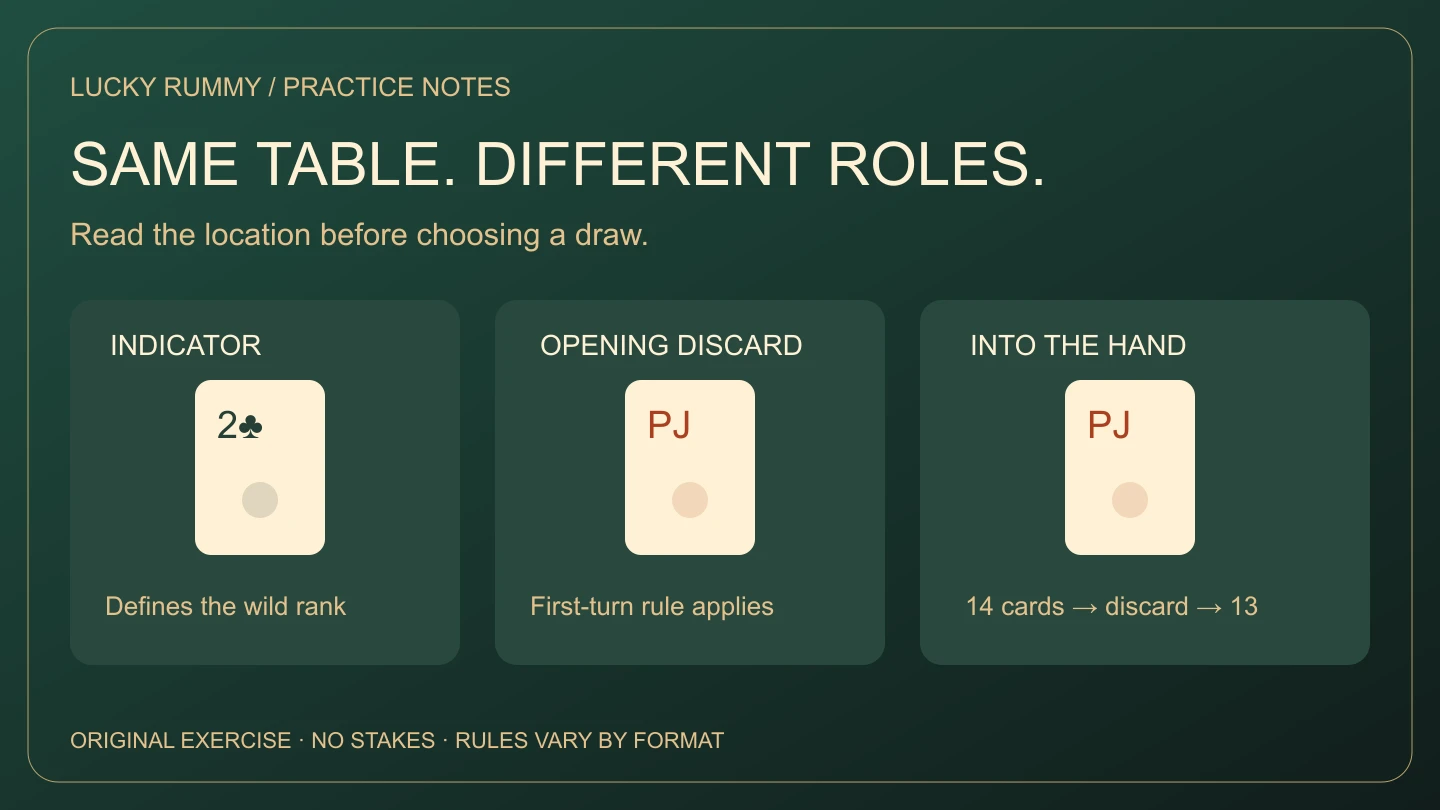
A face-up joker can mean two different things at a Rummy table. It may be the indicator that defines the wild rank, or it may be the card on top of the discard pile. Before deciding whether you can take it, identify its location and the rule governing that location.
This no-stakes exercise follows the opening-discard procedure described in Pagat’s traditional Indian Rummy rules. That description allows the first player to take a joker that starts the discard pile. It does not establish every platform’s joker-pickup rule or confirm Lucky Rummy’s current controls.
Label two separate face-up areas
Put 2♣ in an area labelled indicator. Put a printed joker, PJ, in a different area labelled opening discard. Twos and printed jokers are wild under this exercise’s chosen convention. The indicator stays outside the hand and is not an extra draw option.
Say the distinction aloud: “2♣ tells me which rank is wild; PJ is the top discard offered for this first turn.” Both cards are visible, but visibility alone does not make a card available. Our practice-table setup guide explains how to keep the card areas separate.
Work through the first turn with thirteen cards
Give the learner 4♥ 5♥ 6♥ | 8♣ 9♣ | Q♣ Q♦ Q♠ | 3♦ 4♦ 5♦ 6♦ | K♠. Count 3 + 2 + 3 + 4 + 1 = 13. The hearts and diamonds are natural sequences, the queens form a three-suit set, and the two clubs need another card.
Using the selected opening rule, take PJ from the discard area into the hand. There are now fourteen physical cards. Place PJ after 9♣ and write its role as 10♣. Discard K♠, leaving 4♥ 5♥ 6♥ | 8♣ 9♣ PJ | Q♣ Q♦ Q♠ | 3♦ 4♦ 5♦ 6♦.
The remaining count is 3 + 3 + 3 + 4 = 13. The club group is an impure sequence; the hearts and diamonds remain pure. Every card belongs to one group. This arrangement satisfies the stated grouping conditions, subject to the chosen format’s declaration procedure.
Audit where each visible card ended up
After the move, 2♣ is still the indicator. PJ is in the hand. K♠ is the new top discard. If your worksheet instead shows PJ both in the hand and on the discard pile, you have copied a card rather than moved it.
Under the selected draw-and-discard rule, a card taken from the open pile cannot be returned in the same turn. Here K♠, not PJ, is discarded. Being allowed to pick up the opening joker does not cancel that separate restriction.
Do not extend the opening example to every later turn
Reset the exercise. If someone later discards a joker, the question now concerns a later discard, not the dealer’s opening card. Consult the actual rule for that situation. A rule permitting an opening pickup is not, by itself, proof of unrestricted joker pickups throughout the deal.
If the named rules for your exercise prohibit the opening pickup, the demonstrated move is unavailable; do not take the indicator instead. Choose a permitted action and reassess the resulting cards. A useful card and a legal draw are different checks.
Finish by covering the answer and naming the indicator, the available discard, the drawn card and the outgoing card. Then use the full-hand checklist. The lesson is accurate procedure, not a claim that finding a joker guarantees a result.
Rule reference: Pagat: Indian Rummy, Deal and The play. The separated areas and worked hand are original teaching examples.