
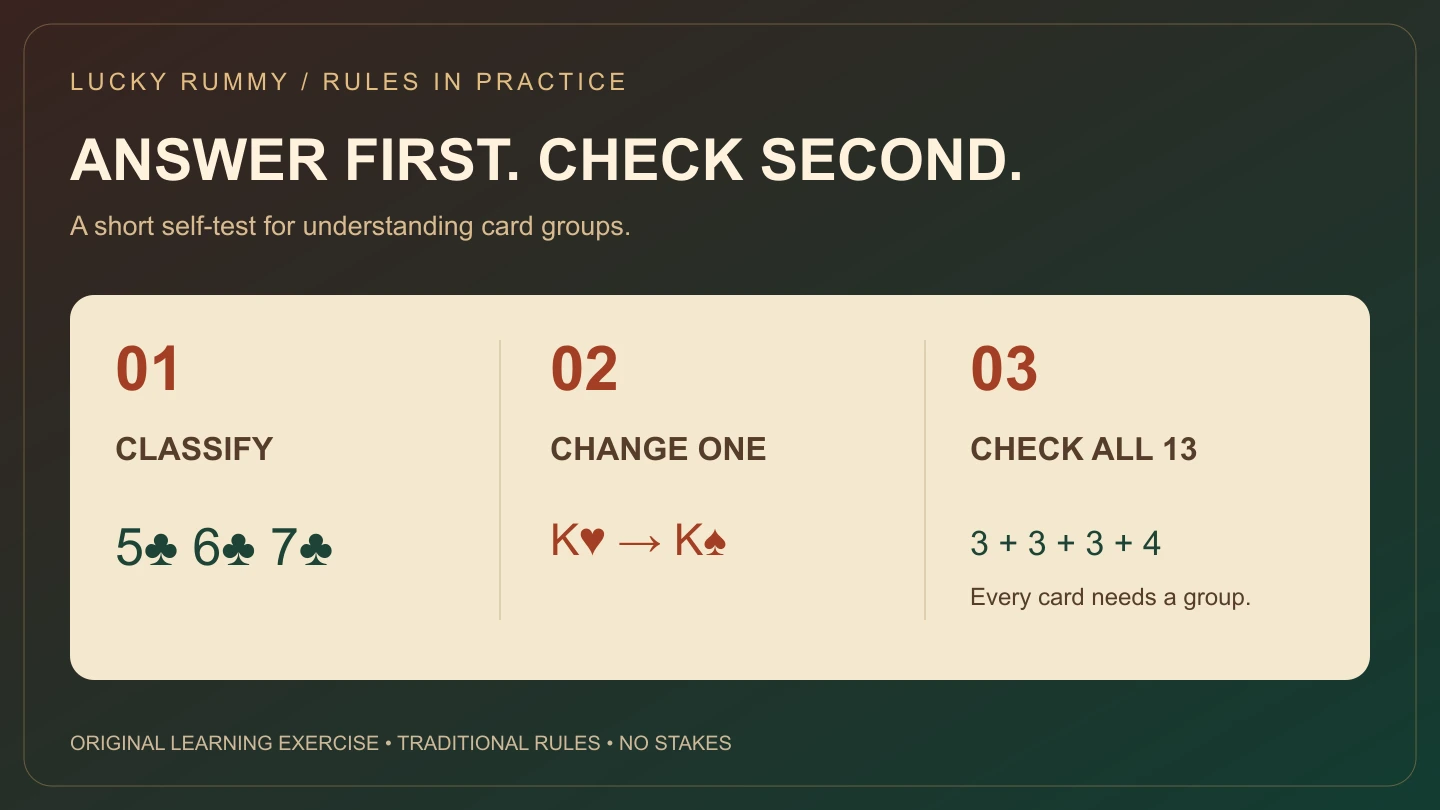
Recognising a familiar diagram is easier than explaining a new hand. A useful practice session asks you to commit to an answer before revealing the explanation. You can do that with a sheet of paper and a small set of cards; no money game or app feature is needed.
This lesson uses ordinary same-suit sequences and different-suit sets, with twos designated wild and no twos in the examples. The goal is to diagnose a specific misunderstanding, not measure your chance of winning. Use the answer sections only after writing your own reasoning.
Round one: explain four fragments
Copy these four fragments onto separate lines: 5♣ 6♣ 7♣; 9♣ 9♦ 9♥; J♠ Q♠ K♥; and 8♦ 8♦ 8♠. The fourth uses two physical copies of 8♦. Do not silently change one diamond to another suit.
For each line, write a classification and one reason. Use “natural sequence”, “set” or “neither under the stated rule”. Avoid answers such as “looks good”. Cover the next paragraph until all four explanations are on paper.
Answer: the first is a natural sequence because rank order and suit both match. The second is a set because the rank matches and the suits differ. The third fails the suit condition; the heart king cannot finish the spade run. The fourth repeats a suit, so it is not an ordinary set, and repeated eights are not a sequence. No special identical-card exception is enabled here.
Round two: predict the effect of one change
Replace only K♥ with K♠ in the third fragment. Before moving the card, write what will change and what will stay the same. The answer is a natural J♠ Q♠ K♠ sequence. The card count and king’s rank stay fixed; its suit changes.
Now reset the fourth fragment and replace one 8♦ with 8♥. It becomes 8♦ 8♥ 8♠, a different-suit set. Record that correction separately. These are teaching substitutions between snapshots, not legal draw instructions for a live turn.
Round three: transfer the test to thirteen cards
Without consulting the earlier answers, check 5♣ 6♣ 7♣ | J♠ Q♠ K♠ | 9♣ 9♦ 9♥ | 3♥ 4♥ 5♥ 6♥. Write the number of physical cards and identify every group before deciding whether the hand satisfies the grouping requirement.
Answer: 3 + 3 + 3 + 4 = 13. There are three natural sequences and one set, with no shared card. Thus the stated combination requirements are satisfied. This is a grouping test, not an instruction to declare outside your turn. Now replace 6♥ with 6♦. The last section has three consecutive hearts plus a loose diamond; twelve grouped cards do not account for all thirteen.
Keep an error note that tells you what to practise
Mark a wrong answer as a suit error, rank-order error, repeated-copy error or whole-hand coverage error. Rewrite the exact reason, then try a fresh example later without the solution visible. Do not convert a small practice score into a prediction about competition or earnings.
The sequence guide explains the definitions, while the beginner guide puts groups into the turn procedure. Stop the short session once you can explain the error, rather than repeatedly rereading an answer you already recognise.
Rule reference: Pagat: Indian Rummy, Runs and sets. All test fragments, replacements and the self-check routine are original.