
An ordinary indicator has a rank: if it is a seven, the rule can designate sevens as wild. A printed joker has no ordinary rank. When that card is turned up as the indicator, the familiar shortcut “use the matching rank” no longer answers the question.
Pagat documents more than one convention for this situation. The comparison below is an offline teaching exercise, not a claim about Lucky Rummy’s current settings. Read the specific table’s instructions before deciding what an ace can represent.
Write down which convention applies
Under the main two-deck procedure described by Pagat, turning up a printed joker leaves the other printed joker available as the wild card. A separately described variation treats aces as jokers when a printed joker is turned up. These are alternatives; do not combine them into an invented rule.
For this exercise, call the first convention A and the ace-wild variation B. Put the printed indicator outside the hand. Do not take it into your thirteen cards just because it is visible. The examples contain no playable printed joker, which keeps the comparison focused on the ace.
Test one fragment before testing the whole hand
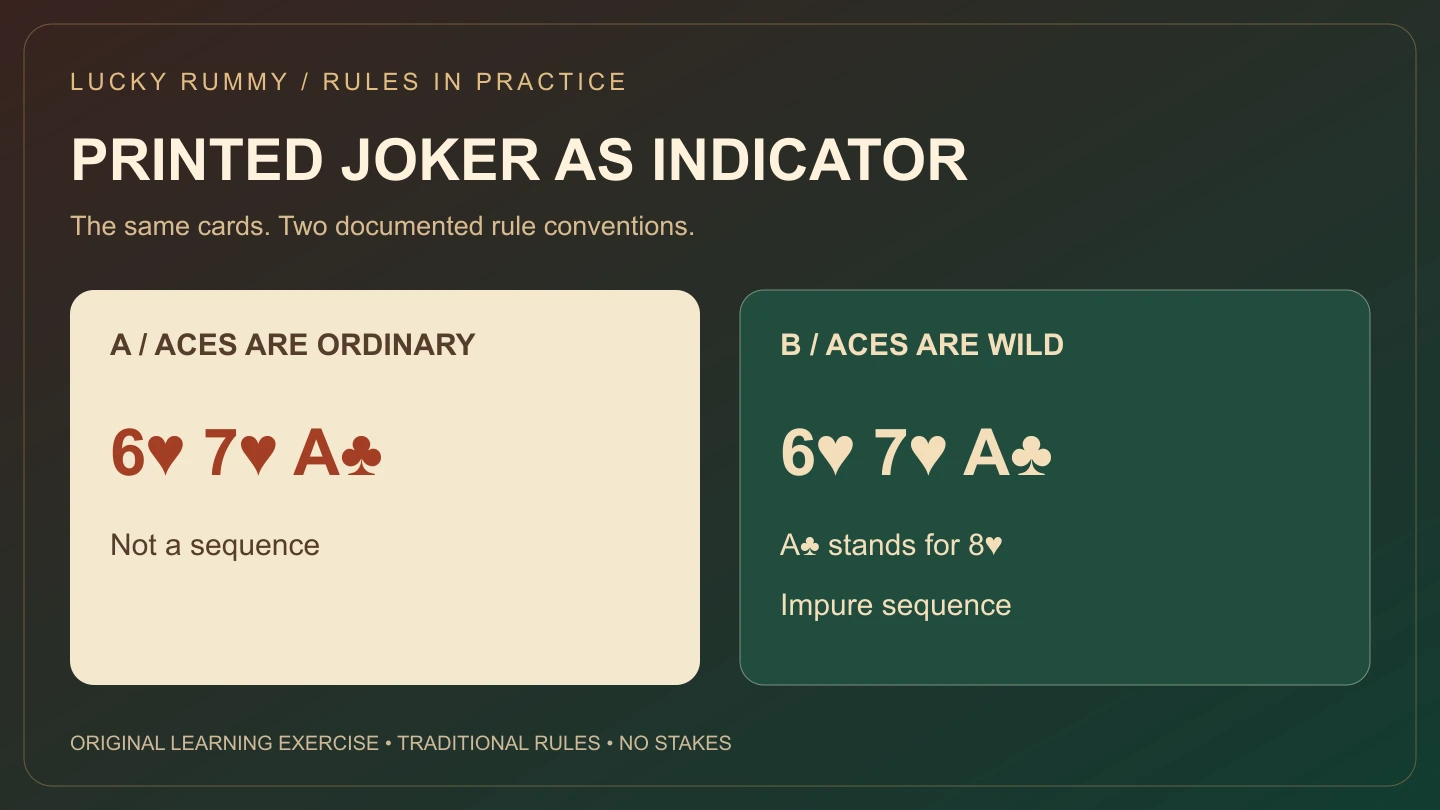
Lay out 6♥ 7♥ A♣. Under A, the club ace is an ordinary ace. It does not supply the missing heart and the fragment is not a sequence. Under B, the ace can stand for 8♥, so the fragment is an impure sequence. It still cannot serve as a pure sequence because a substitution was used.
Write “A♣ represents 8♥” on a worksheet for B. Naming the represented card makes the proposed group checkable. Merely writing “joker used” hides whether the rank and suit actually complete the run.
Use the same thirteen cards in both cases
Now arrange 3♠ 4♠ 5♠ 6♠ | 6♥ 7♥ A♣ | 9♣ 9♦ 9♥ | Q♣ Q♦ Q♥. Count 4 + 3 + 3 + 3 = 13. The spades form a natural sequence, and the nines and queens form different-suit sets.
Under B, the substituted heart sequence supplies the second sequence, so all thirteen cards have valid, non-overlapping groups under the stated requirements. Under A, that heart fragment remains incomplete. The other ten cards do not repair it: there is no second natural sequence available in this inventory.
This is a comparison of two rule sheets, not permission to change rules during a deal. Keep the cards fixed and change only the written assumption. It demonstrates why a screenshot of the hand alone may be insufficient evidence of validity.
Check the rule without guessing a score
Before the practice session, record the indicator identity, whether aces become wild, and where the indicator is kept. If the rules are silent, mark the example unresolved. Do not infer an extra reward, multiplier or app feature from the indicator.
Continue with the rules overview and the pure-sequence explanation. The transferable habit is to write the wild-card assumption before checking a proposed grouping.
Reference: Pagat: Indian Rummy, Deal and Variations. The paired hand and worksheet exercise are original.