
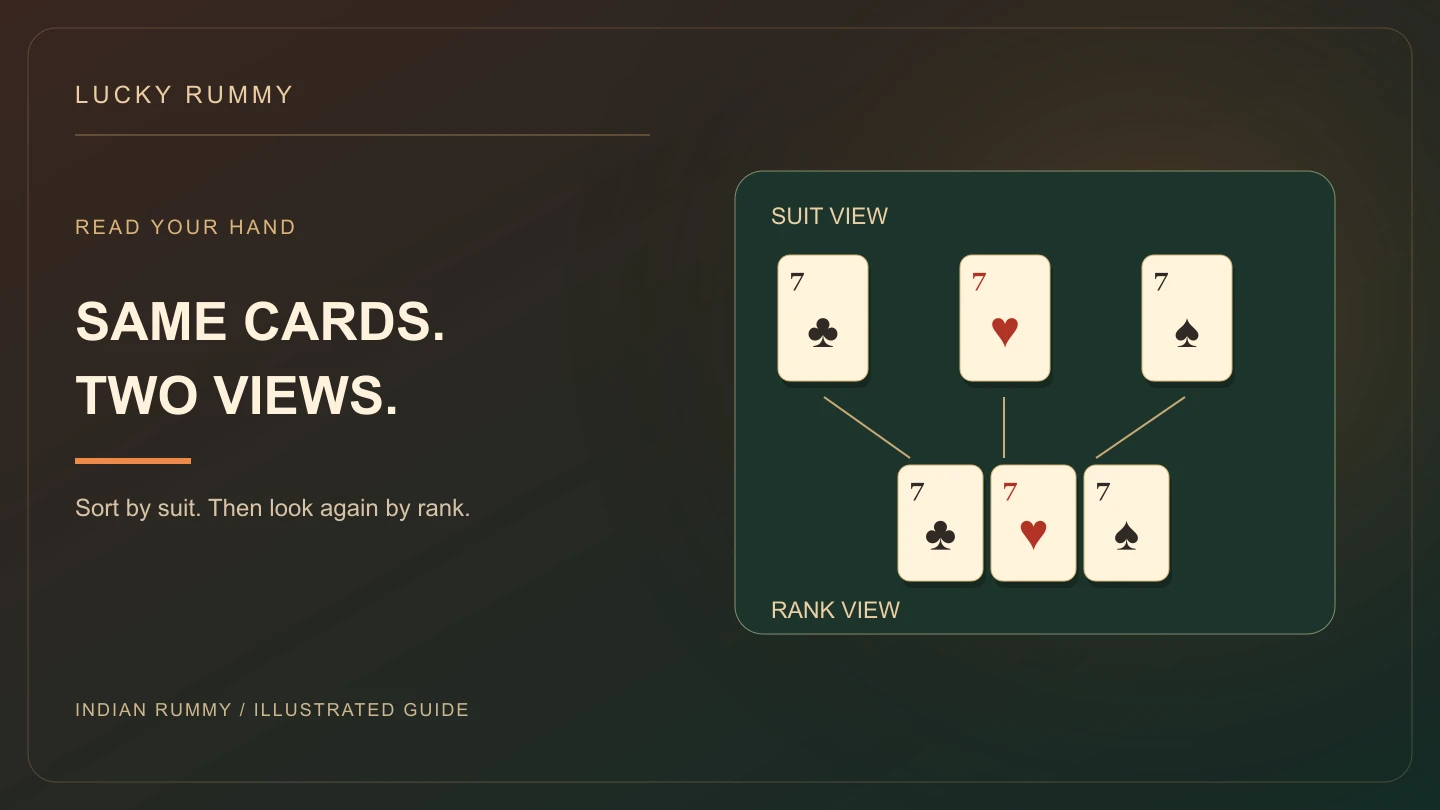
Thirteen shuffled cards can hide a pattern that becomes obvious after rearrangement. Sorting is a way of looking, not a move that changes your cards. A useful practice routine is to inspect the same hand twice: once by suit, then by rank. Write down what each view reveals before deciding what to keep.
This exercise uses ordinary natural cards, with no printed joker and no wild rank assigned. It teaches visual organisation rather than a guaranteed best discard. Apply the actual joker and grouping rules of your chosen game separately.
Start from one fixed inventory
Lay out this deliberately mixed thirteen-card hand: 8♥, 4♣, K♦, 7♠, 6♥, 5♣, 2♦, 7♥, Q♦, 4♠, 6♣, J♦, 7♣. Count it before moving anything. Take a photo or write the list so every later arrangement can be checked against the original.
Give yourself two minutes for the drill, not as a game deadline but as a repeatable practice interval. Keep a separate note for observations. Do not label any card “useless” during this first count: that conclusion would arrive before the search.
Pass one: collect suits and read consecutive ranks
Arrange clubs as 4♣ 5♣ 6♣ 7♣, hearts as 6♥ 7♥ 8♥, diamonds as 2♦ J♦ Q♦ K♦, and spades as 4♠ 7♠. These four rows still contain thirteen cards. They are sorting rows, not a claim that each row is one legal group.
Notice the gap in the diamond row: 2♦ does not join J♦–Q♦–K♦. A row can contain a complete run and a disconnected card. Likewise, the spade row is only a pair of same-suit cards separated in rank. A neat layout should help you see these gaps, not conceal them.
Record the consecutive stretches you can actually point to. If sequence terminology is new, read the rules introduction. For this drill, describing the cards precisely matters more than giving the whole hand a flattering label.
Pass two: collect equal ranks
Rearrange the same inventory by rank. You will find 4♣ 4♠, and 7♣ 7♥ 7♠, among the other cards. The second cluster offers a three-suit set under the ordinary convention; the first is only a two-card cluster. Writing “pair” beside the fours prevents a visual match from being mistaken for a completed group.
The rank view reveals something the suit view made less prominent. But it does not give you extra cards. In particular, 7♥ is now being considered for the sevens cluster after appearing in the heart run. You must choose one physical placement when evaluating a final arrangement.
Compare two layouts instead of combining their advantages
In layout A, keep 4♣ 5♣ 6♣ 7♣ | 6♥ 7♥ 8♥ | J♦ Q♦ K♦. These stretches use ten cards; the loose cards are 2♦, 4♠ and 7♠. This is an observation, not a valid declaration with the loose cards ignored.
In layout B, allocate 7♣ 7♥ 7♠ to the set. The club run can remain 4♣–5♣–6♣, but the heart row becomes 6♥–8♥ with its middle card removed. The diamond run remains intact. Now nine cards are in the three complete groups, and 6♥, 8♥, 2♦ and 4♠ are outside them.
For this particular snapshot, A retains more already-grouped cards. That is not a universal strategy rule, nor does it prove a best future draw. The useful result is discovering the tradeoff before committing. Use the declaration checklist for ending a hand, and the discard guide for the separate decision of what to release.
Repeat with one changed card
Replace 7♠ with 9♥ and repeat both passes from scratch. The heart stretch can now extend through 9♥, while the three-suit sevens set is no longer present. Check that there are still thirteen cards. This small change tests whether you are reading today’s inventory or merely reproducing yesterday’s arrangement.
Rule reference: Pagat’s Runs and Sets section supplies the grouping convention and non-overlap rule. The inventory, two-pass drill and comparison above are original teaching examples.