
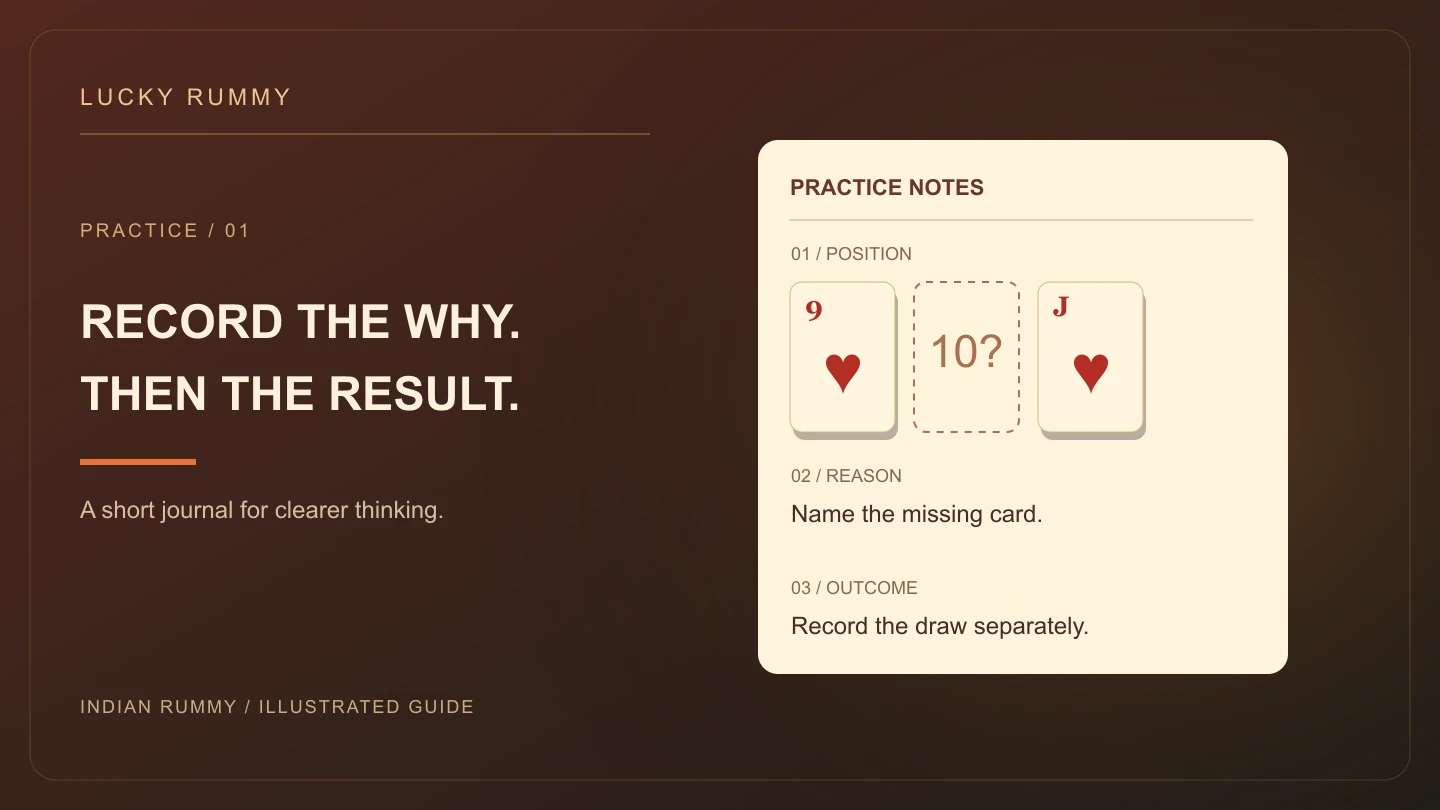
A lucky draw can hide a weak decision, while an unhelpful draw can make a reasonable choice look foolish. A practice journal separates the decision from what happened afterwards. You only need one recorded position and a few honest sentences, not a history of every card you have ever played.
Use this method in offline, no-stakes practice. Do not use note-taking software or outside assistance during a live game where the rules prohibit it. This is a study routine, not a Lucky Rummy product feature, a prediction system or a promise of better financial results.
Capture the position before revealing the next card
Write the cards in your hand, which cards are designated wild, and the precise question you want to study. Record only information actually available at that moment. Keep the next draw face down while doing this. If you fill in your reasoning after seeing it, the answer may quietly borrow knowledge you did not have.
A useful prompt is: “Which incomplete group am I trying to improve, and which card would do that?” Avoid vague entries such as “I needed good cards.” A concrete question can be tested; a vague wish cannot.
Worked entry: keep the observation separate from the plan
For this partial-hand drill, lay out 4♣ 5♣ 6♣ | 9♥ J♥ | K♦. None is wild. This is a six-card fragment for study, not a full hand or a declaration. The club run is complete, the heart pair has a gap, and the king has no partner within this fragment.
Your observation line could read: “The heart pair is missing 10♥ for a three-card natural run.” Your plan line might say: “I will check whether a draw improves that pair before rearranging the completed clubs.” These lines say different things: one describes the cards, the other describes a procedure.
Now reveal Q♠ as the practice draw. It does not fill the heart gap. That outcome does not make the observation wrong. Equally, revealing 10♥ would not prove that every choice you made earlier was good. Assess the statement against the original cards, then record the draw on a separate line.
Compare one alternative you could really have considered
Return Q♠ to the exercise deck and reconstruct the same starting position. Ask whether you overlooked another arrangement using the cards you actually held. Do not add a missing joker or silently turn J♥ into 10♥ to make the alternative work. Keep the exercise narrow; the rest of a full hand could change a real-game decision.
If there is no useful alternative in the fragment, record that limitation. “Insufficient information to choose a full-hand discard” is a stronger review than inventing certainty. Our discard guide gives a complete-hand example for a separate session.
Use a five-line entry
Position: list the exact cards and relevant rules. Question: state one decision. Reason: describe the evidence available then. Outcome: record the later draw without rewriting the reason. Next drill: choose one thing to test again. Keep observations and guesses clearly labelled.
For the example above, the next drill could be to replace J♥ with 10♥ before starting. The heart pair is now 9♥–10♥ rather than 9♥–J♥. Write the natural cards that could complete a three-card run in each version. Explaining that contrast tests recognition more directly than writing “I should be luckier”.
Review patterns, not a single score
After three short sessions, look for repeated reasoning errors: did you misread a suit, forget a wild rank, or treat an unfinished pair as complete? Pick only one recurring error for the next exercise. There is no need to attach a win-rate percentage to three practice positions; the sample is too small and the positions may not even be comparable.
Keep the record private and minimal. Card symbols and your own learning notes are enough; passwords, payment details and other players’ identities are irrelevant. Set a short study limit and stop when tired. If you are still learning the turn structure, begin with the beginner guide; for natural runs, use the pure sequence examples.
Rule reference: the sequence definition in Pagat’s Indian Rummy rules. The journal format and review exercises are original editorial suggestions, not a tested performance claim. Cover: an original practice worksheet illustration, not an app screenshot.